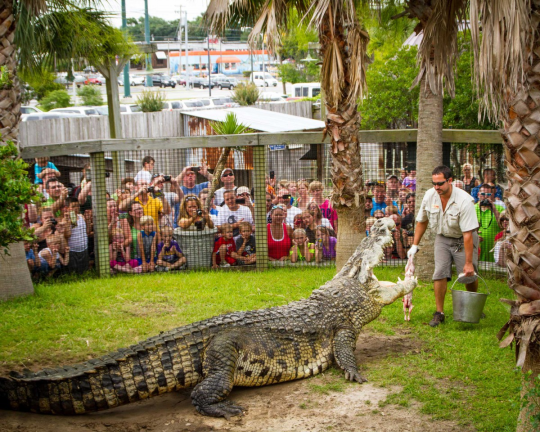
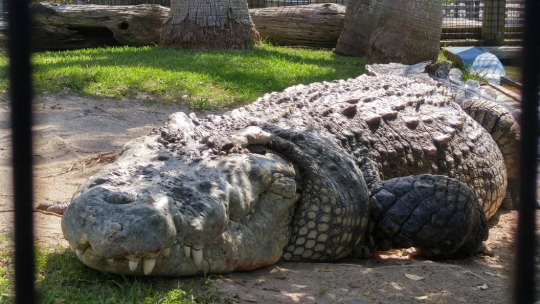
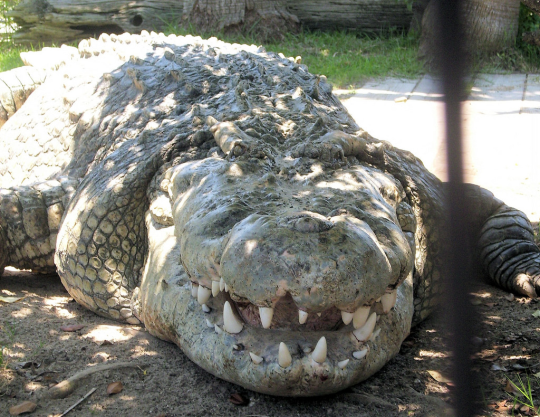
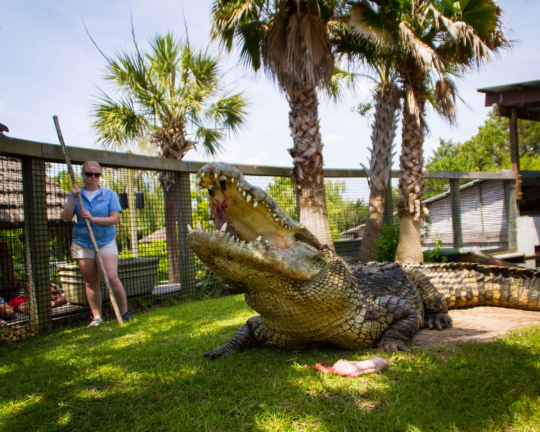
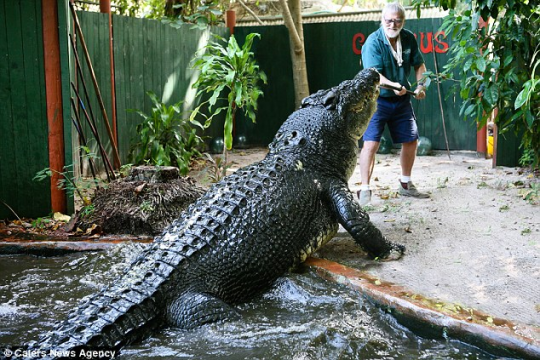
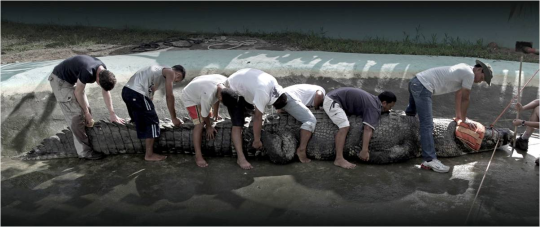
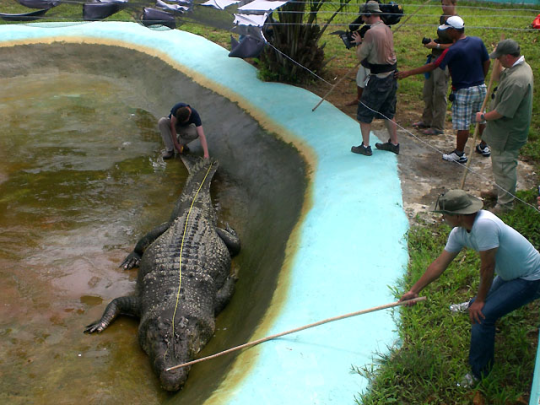
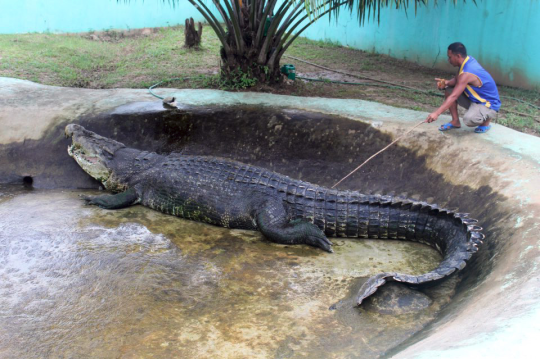
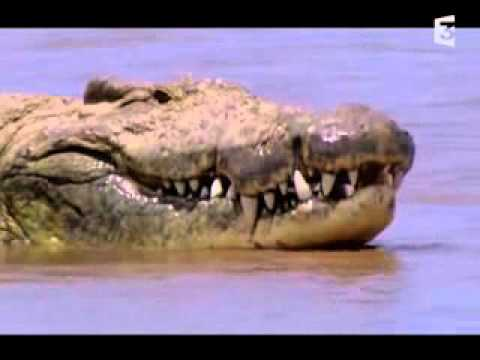
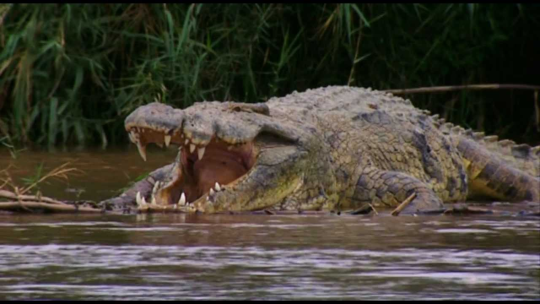
I can’t stop thinking about crocodiles for some reason so here’s some cool pictures I found of probably the second largest one in captivity, his name is Utan:
isn’t he beautiful
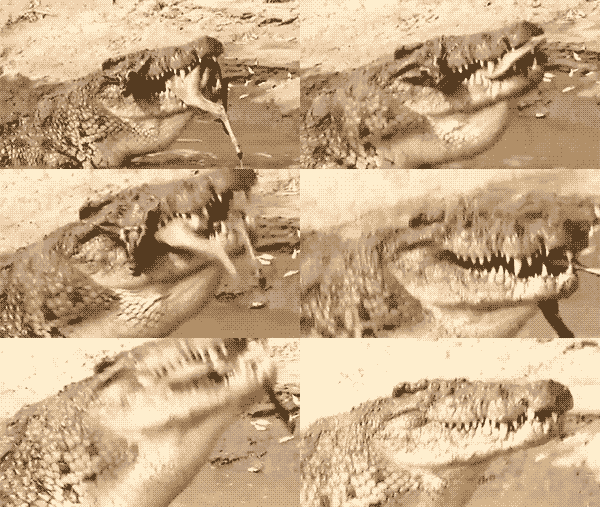
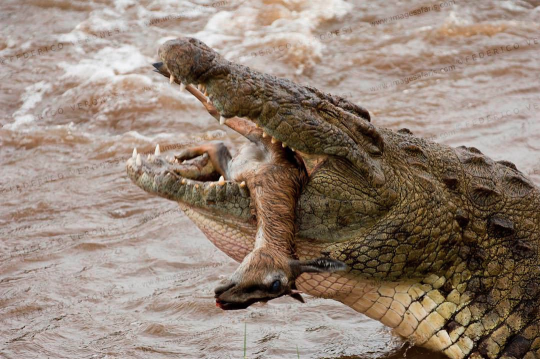
listen to the SOUND when he bites
and that’s not even a real power bite, that’s mostly just heavy bone falling on heavy bone from his jaws and the air rushing out from between them
2000 pounds of Good Boy
you get me
I honestly expected like 5 notes, what HAPPENED here
More tags on this ridiculous post:
Wait, thats the 2nd biggest crocodile? Then what does the biggest one look like?
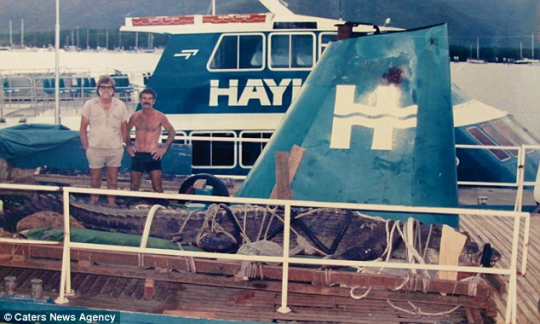
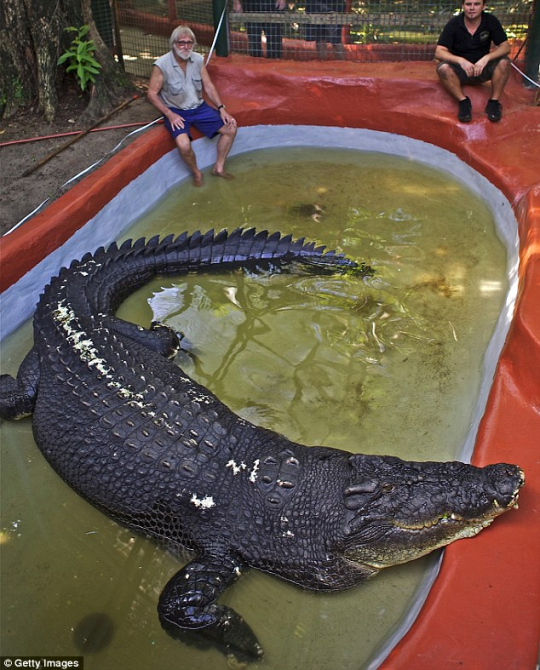
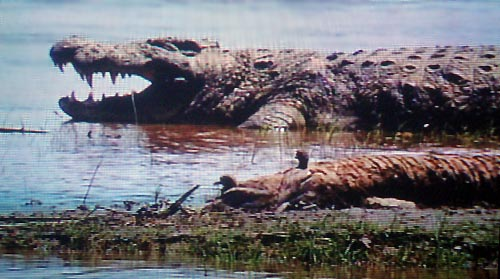
That would be Cassius, a very old Saltwater crocodile who is estimated to be around 114 years old and lives at Marineland Melanesia in Green Island, Australia. His official measurement is 5.48 meters, which makes him the largest in captivity currently. Because Utan is only slightly smaller and much younger, (only in his 50s), he will likely break Cassius’ record eventually. But for now, Cassius holds the title:
He is NOT, however, either the largest crocodile ever captured in Australia OR the largest ever in captivity.
A slightly larger crocodile has been reported (though not yet comfirmed) to have been captured at 5.58 meters.
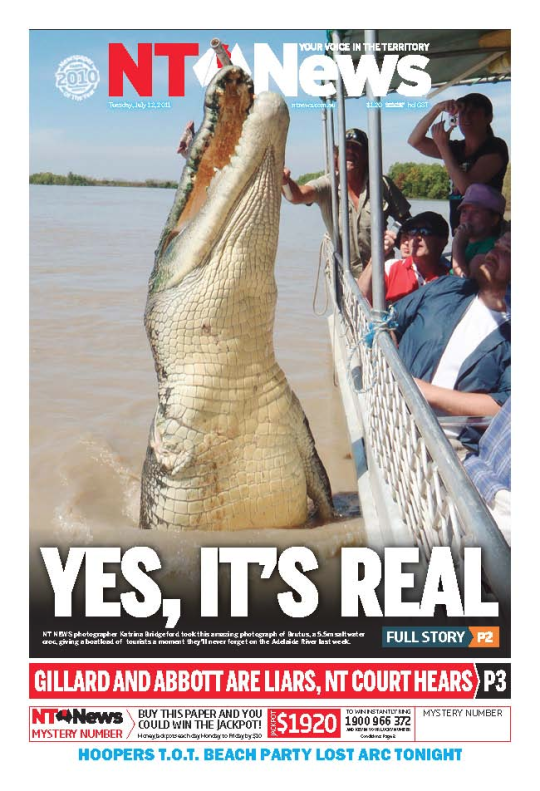
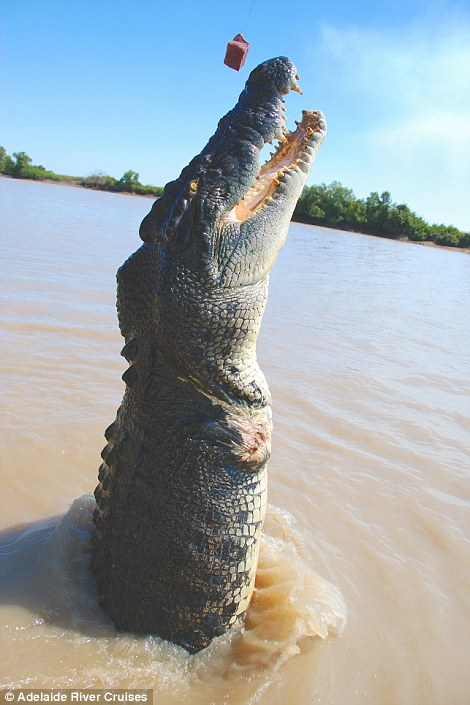
And while the famous Brutus of the Adelaide River was estimated to be just slightly larger than Cassius at 5.5m, he was driven out of his territory by a younger and even larger crocodile, who as a result has been given the name, The Dominator. He is estimated to be just over 6m.
This is Brutus, with an appropriate caption:
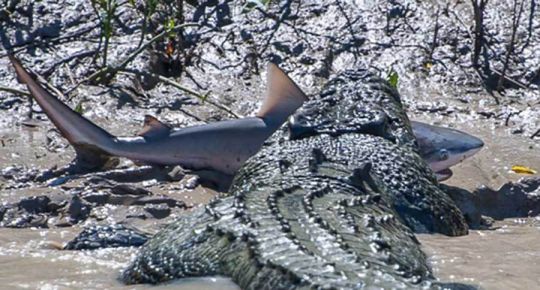
It is believed that he lost that arm in a fight with a Bull Shark.
The Bull Shark lost.
THIS is the crocodile who kicked him out. The Dominator:
And that’s STILL not the biggest.
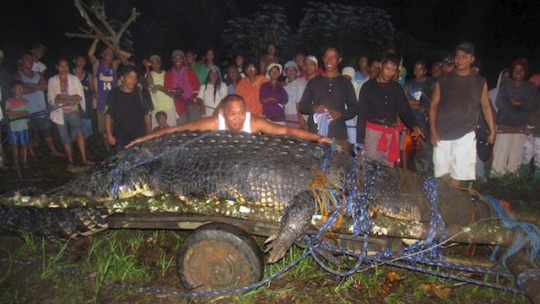
The largest living crocodile ever reliably measured was Lolong, who for the 1.5 years between his capture and his death was the largest crocodile ever held in captivity, at a whopping 6.17 meters (20 feet 3 inches) and 1075 kg (2,370 lbs). He had been feeding on both humans and very large livestock in the Bunawan creek in Agusan del Sur in the Philippines. It took 100 people all night to drag him to shore during his capture.
And here’s why:
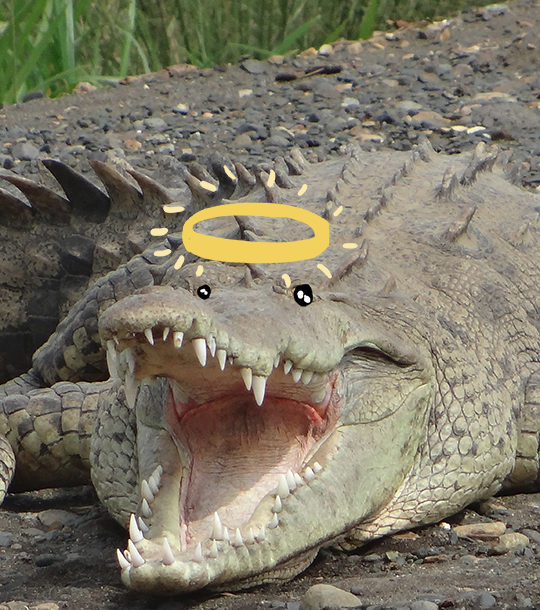
Also, to prevent credit from getting buried on a separate reblog, I have been informed that the above image of the crocodile with the cartoon eyes and halo was made by @rashkah! (And it is wonderful and I would like to thank him for its existence, because it perfectly captures my feelings about terrifying giant primordial reptiles.)
As far as Brutus is concerned I was led to believe that he lost that arm when relatively young.
Since then Brutus developed a habit of hunting and eating Bull Sharks.
Here’s him with a prey.
And if you thought that you’ll be safe if you just stay out of Australia then think again!
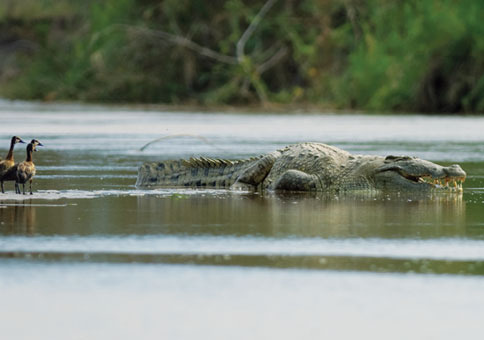
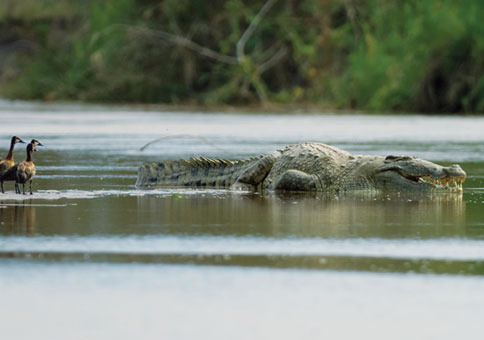
Meet Gustave the Nile Croc.
This crocodile became almost legendary for both it’s size and the habit of hunting both livestock AND humans.
So how big is Gustave?
No one is sure. Since he was NEVER captured.
His estimated size is of at least 5,5m but some give him over 6m.
The terrifying parts are:
1) He is still growing having only about 60 years.
2) Adult crocodiles often perform a gesture of submission to him – something usually done by young crocodiles toward adults – Gustave is just THAT BIG.
3) His sheer size makes it difficult for him to catch agile prey Nile crocs tend to feed on – hence why he developed a habit of hunting either larger prey like Hippopotamus or creatures which are not good at spotting danger in the first place like livestock and humans.
And this is NOT ALL.
Gustave actually has a noticeable scars on his body – he was shot at east 3 times and stabbed with a spear or something similar at one occasion.
He lived to tell the tale – my question is:
What happened to that one dude who attacked Gustave with a spear?
*Crocodile Dundee voice* Mate, that’s not Gustave:
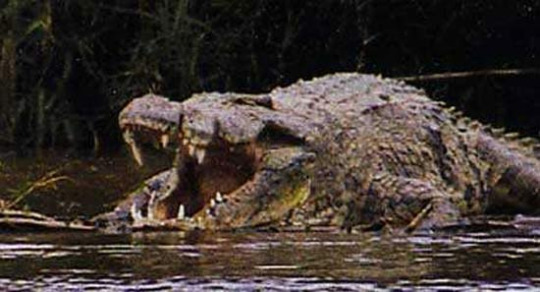
THIS is Gustave:
And he is the PERFECT CROCODILE. He is the perfect example of what I mean when I talk about (as I do) how the morphology of extremely large crocodiles adapts to the changing physics of their bite.
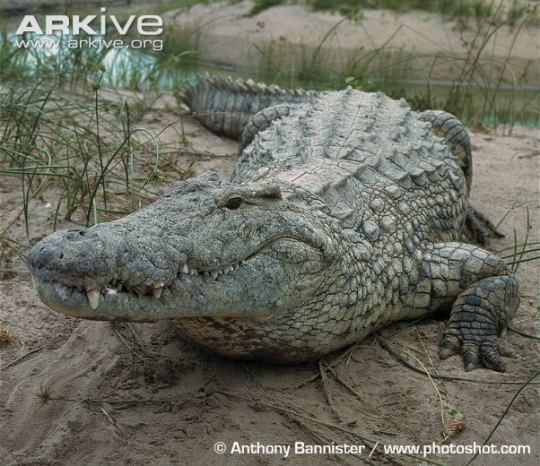
This is a typical adult Nile Crocodile:
And THIS is a god among his kind:
This is it, folks. The Final Form. THIS is what peak performance looks like.
Crocodiles and physics have an interesting relationship. Crocodiles have, by a CONSIDERABLE MARGIN, the strongest bite of any animal on Earth. EVER. Scaled up estimates (based on Nile and Saltwater crocodiles) give the extinct Deinosuchus an estimated bite force MORE THAN DOUBLE the recently updated Tyrannosaurus bite estimates. Living crocodiles have bite forces measured in the range of 5000 pounds per square inch, for an individual around 15-16 feet. It is estimated that modern crocodiles in the range of 18-20 feet would have bit forces around 7-8000 psi or more.
That’s a problem.
Because a crocodile’s skull is only designed to handle so much pressure. Go beyond that limit and the force of impact when those jaws snap shut could literally shatter their own skulls.
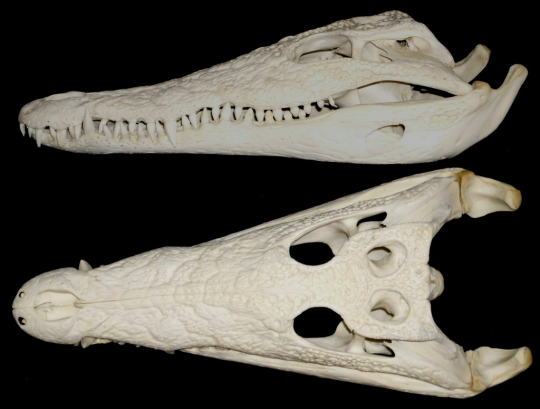
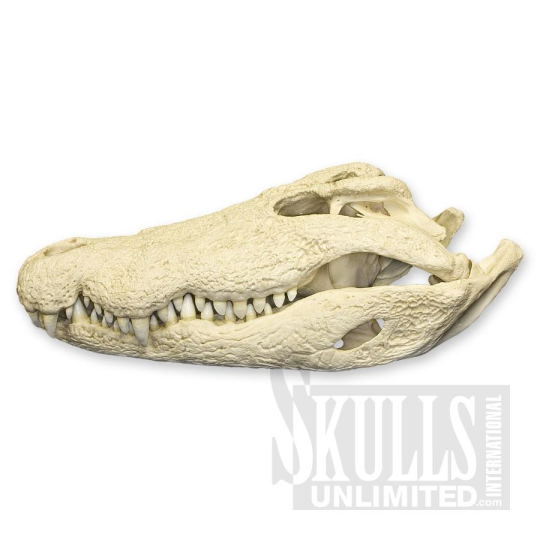
But evolution has spent hundreds of millions of years perfecting crocodiles, so PHYSICS ISN’T GOING TO STOP THEM. What ends up happening in the skulls of these extremely large crocodiles is they will increase dramatically in mass to compensate for the increased forces. A crocodile’s skull is almost exclusively solid bone, with only minimal space for nasal passages, a surprisingly advanced brain, and some slightly porous looking framework that helps the bone distribute the force over a larger area. The effect is by far the most pronounced in Nile crocodiles, which most regularly feed on larger prey and need to make use of all that power.
Compare, 26 inch skull:
vs 29 inch skull:
Both of those are Nile crocodile skulls (or rather, replicas thereof).
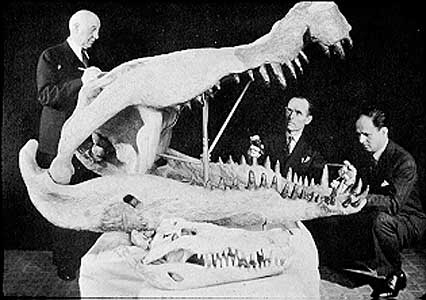
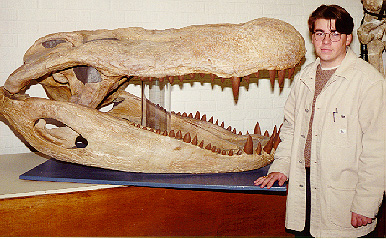
And just for fun, here are the skulls of completely different (and very extinct species), Deinosuchus:
and Purussaurus:
The bigger the crocodile (within a given species), the more massive the skull needs to be to compensate for that UNBELIEVABLE bit pressure. This is one way to see from a distance whether you are looking at a normal sized crocodile:
and a truly extraordinary individual:
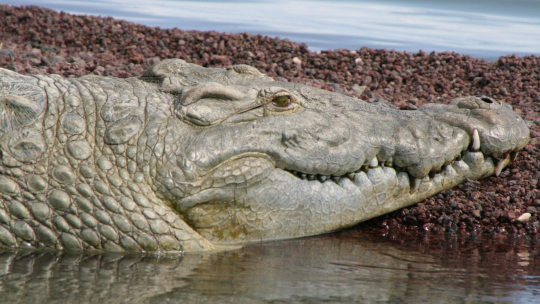
One of the things about Gustave that’s so impressive is how healthy his teeth look. A lot of large crocodiles, in their old age, have very worn down and often missing teeth. They do replace them many times over a lifetime, but when they get very old this slows down. Gustave, at least in every picture taken of him, had teeth that were in very good condition.
Even crocodiles much smaller than Gustave’s reported size (probably similar in size to Dominator or Lolong) tend to have smaller or more worn teeth:
than the pinnacle of his kind:
Lolong! It means Gramps or Grandpa, because he’s a relic of an ancient world where crocs more massive than he was walked the earth. His body is on display somewhere right now though I forgot where.
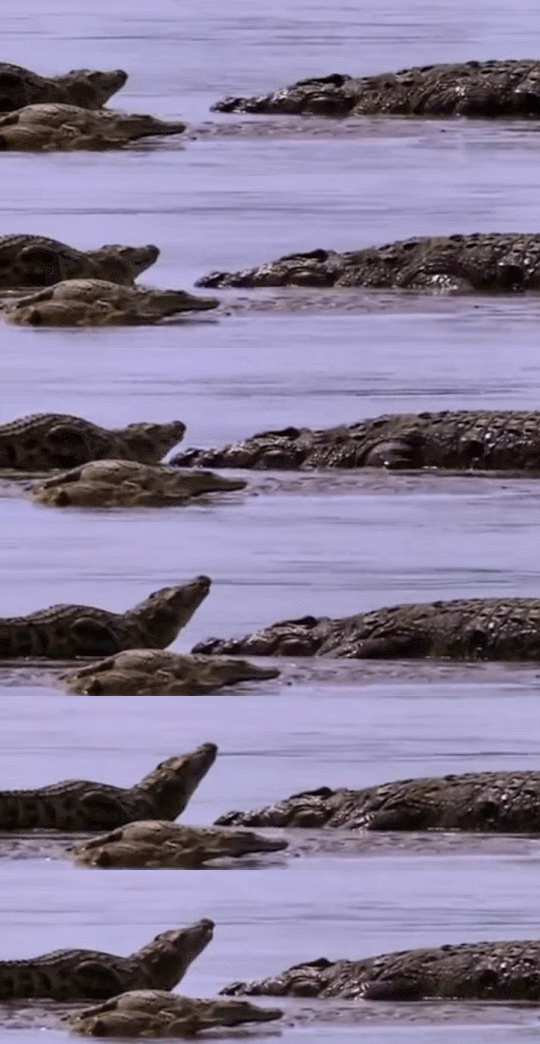
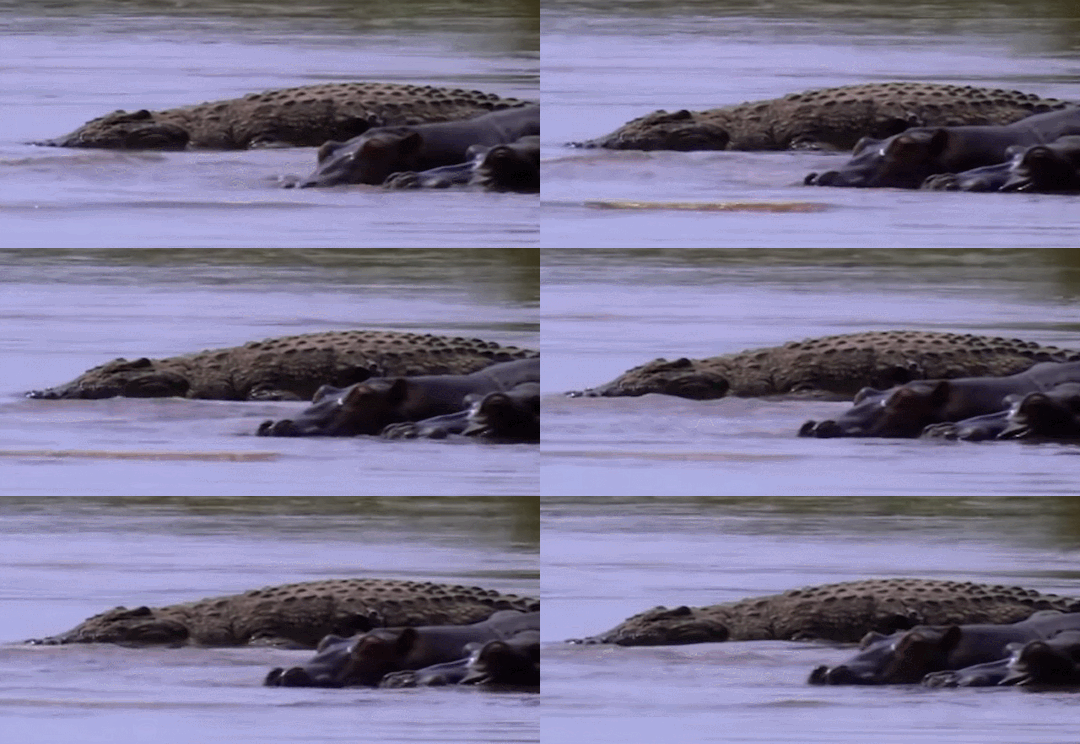
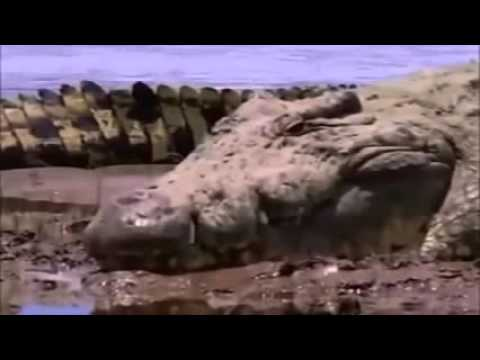
Every time I see this post there’s more crocodiles. It’s the gift that keeps on giving.
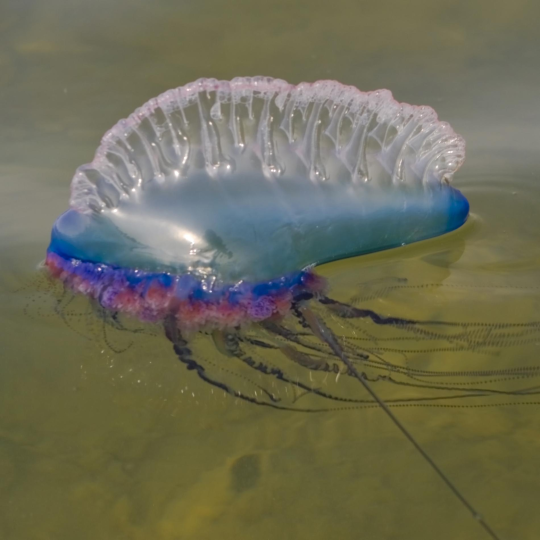
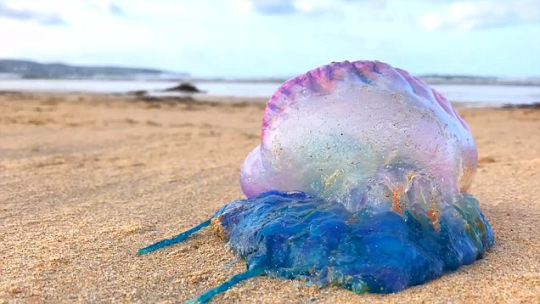
guess what, it’s time for another episode of Weird Biology! today we’re going to learn about a creature that looks like a stained-glass window, but stalks the oceans with toxic might powered only by the wind like a sailing ship of old.
that’s right, it’s the devil’s own shopping bag-
the name is almost longer than the animal.
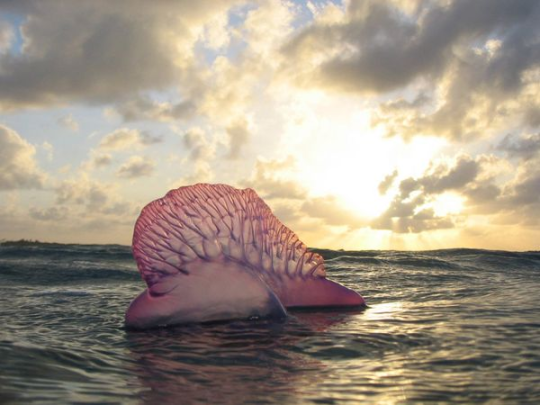
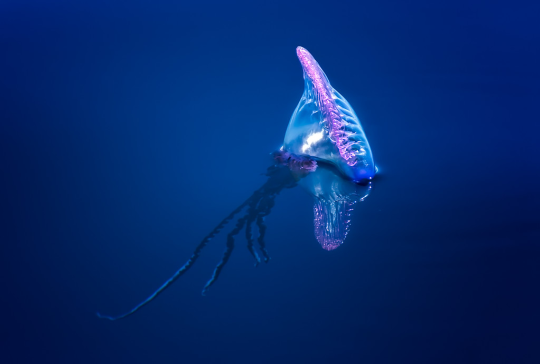
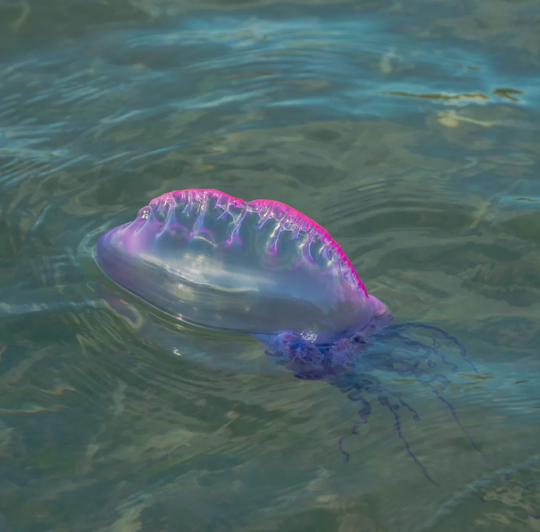
The Portuguese Man o’ War is a floating jellyfish relative called a Hydrozoan. it was named after the 18th century sailing ship, apparently by a blind person. “oh, it looks like a sailing ship under full sail” no it doesn’t, shut up. it looks like a rogue walmart shopping bag that blew into the Atlantic and makes a living by strangling innocent sea turtles.
but like the aforementioned plastic bag, the Man o’ War uses its lovely blue-purple air sac to catch the breeze. it wanders in groups through the warm waters of the Atlantic, driven along by the wind and tides. kind of poetic, really.
as long as you don’t look underwater, anyway.
I’m about to ruin it for everybody, hang on.
like so many other things in life, it’s not what you see on the surface that’s important but what is underneath that counts.
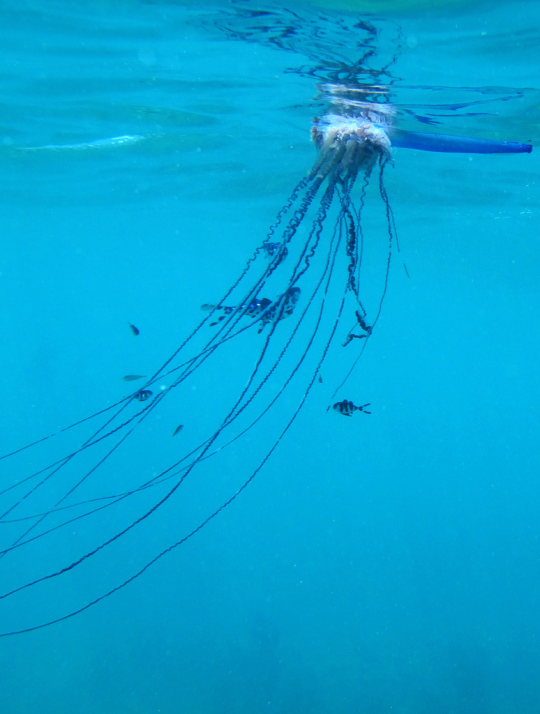
in this case, what’s underneath is up to 165 feet of venomous tentacles. it’s like that thing they say about icebergs, where you only see the top 10% and the rest is an invisible ship-killing nightmare? it’s exactly like that.
except with poison tentacles.
the Man o’ War is basically a biological fishing trawler, trailing these stupidly long tentacles like a fine mesh net through the water. and when an innocent fish who probably has a family at home comes into contact with this “net”, specialized cells called Nematocysts are triggered to fire tiny poison harpoons into the victim, causing instant death or paralysis.
the tentacle then reels itself upward into the body of the Man o’ War like a fishing line, dragging its helpless victim upward to be digested.
so, uh, actually not like a fishing trawler then, not like a fishing trawler at all.
unless the fishing trawler was designed by Junji Ito.
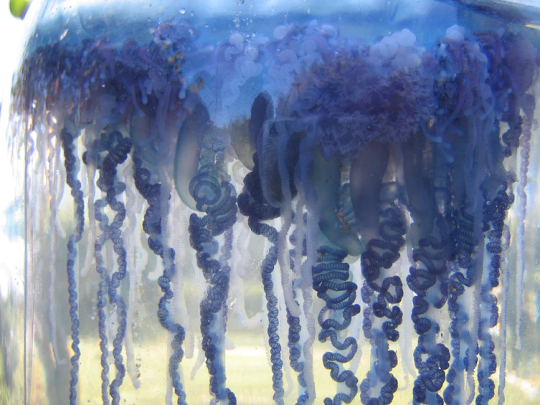
though the Man o’ War may look like a jellyfish, it’s definitely not. in fact, it’s not even a single animal! it’s actually four separate organisms jammed into a venomous trenchcoat like three best friends trying to sneak into an R rated movie.
“how the fuck even”, I hear you say. and that’s a valid question! it’s not everyday that we discover that what we thought was a single animal is actually four smaller animals living communally to form a larger, more dangerous animal. it would be like discovering that opossums are actually comprised of 17 rats each.
no word on if they do a silly dance and tap their fingers together to fuse or what though.
in the Man o’ War’s case, these four individual kinds of “polyps” that comprise the complete final form are the air sac polyp (gets the gang around), the digestive polyp (converts murdered fish into energy for the whole gang), the reproductive polyp (makes small clones of each individual gang member), and the tentacle polyp (murders things indiscriminately for the sheer joy of it).
that’s right, the tentacles are a separate animal! you might be wondering if they sometimes come loose, wander off, and just sting people/animals randomly when they drift into populated areas. what a silly question!
yeah, happens all the time.
SHIT.
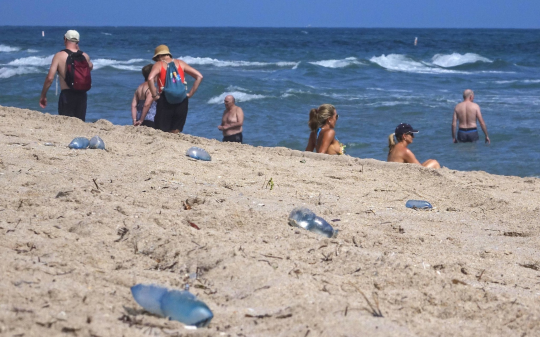
while rarely fatal, Man o’ Wars stings can seriously injure humans. this is a big problem in areas where Man o’ Wars are common, because storms and predators can knock the tentacles right the fuck off. the tentacles drift away, only to wash ashore and sting a hapless beachgoer weeks later. that’s right, rogue tentacles can still sting for days or weeks after separation! even if the Man ‘o War is beached! isn’t that neat! fuck!
the discovery of a beached Man o’ War usually closes the entire fucking beach, for this reason. would YOU want to go fuck around in the sand if it might be full of over a hundred feet of poison spaghetti too fine to notice with the naked eye?
if the answer is yes, I have great news about a bridge I’d like to sell you.
if all this information upset you, I’d like to offer my deepest condolences. but buckle up for one last upsetting fact, and here it is: Man o’ War are spreading.
usually restricted to warm waters, climate change has driven the Man o’ War as far north as Great Britain. that’s awful awful awful news for any country that touches the Atlantic ocean, which is lots of them.
luckily, we have dependable allies in this fight: sea turtles and the Mola Mola! (which I’ve written about before) unfortunately just about all we can do at this point is to cheer these awesome devil-balloon-munchers on from the safety of shore, while trying to invent a Man o’ War-proof barrier net.
for now, watch out for anything that looks like a floating plastic bag.
and for god’s sake, watch where you step.
–
thanks for reading! you can find the rest of the Weird Biology series here.
if you enjoy my work, maybe buy me a coffee or check out my Patreon to see extra content and support Weird Biology.
–
IMAGE SOURCES
img1- National Geographic img2- The Garden of Eadon img3- Sean Nash img4- Enrico Villa img5- livescience.com img6-
diply.com
img7- Daily Mail img8- Sun Sentinel
wow, the replies to this post really took off! I had no idea so many of you had been personally victimized by this creature.
A friendly fox in Pripyat, Chernobyl exclusion zone
*happy cheerful music as fox plays in deserted nuclear radiation land*
This is the aesthetic
Fun facts about the Chernobyl Exclusion Zone:
1) Most of it is pretty safe, even for long periods of time. In fact about 200 native people still live there, but no new settlement is allowed, so that number has declined from about 1200 after the zone was created in 1986.
2)The zone has become an unintentional animal reserve. Its ~1000 square miles of uninhabited forest. Poaching happens, but not to the degree one might expect due to the fear of radiation. Also as a consequence there are lots of human friendly animals like this fox. Most of the humans they do see are tourists that regularly feed them.
3) Its one big science experiment on post human occupation, environmental contamination, and radioactive degradation. Weve actually learned a hell of a lot about what would happen to a city after everyone leaves and how nature takes back over thanks to the city of Pripyat. And how the environment adapts to sudden changes and evolves. A fungus was desvovered in and around the Chernobyl Disaster Site that creates chemical energy out gamma radiation emitted from the melted down core. Something biologists had only theorized as even possible a few years ago, and heres this fungus feeding on it. Its crazy man!
^^ i was literally thinking about if nature and wild life had taken back over the area




 rip tumblr