larouau12:

copperbadge:

metagorgon:

gasmaskaesthetic:

This is a blog about a zucchini grown on the International Space Station in 2012, written from the perspective of the zucchini. Enjoy.

https://blogs.nasa.gov/letters/2012/04/03/post_1333471169633/

My roots are not hermetically sealed in this bag, they have access to gas exchange with the cabin air.  My roots are thus exposed in this transparent bag, naked to the universe.  Embarrassed, it took me a few days to get over the idea that anyone can see my roots without any dirt covering them.

My gardener fusses with my leaves.  I am not sure if I like that.  I now have four and I do not quite understand why he behaves this way.  He sticks his nose up against them.  Does he take me for some sort of a handkerchief?  Apparently he takes pleasure in my earthy green smell.  There is nothing like the smell of living green in this forest of engineered machinery.  I see the resultant smile.  Maybe this is one of my roles as a crewmember on this expedition.

I have a call sign.  I guess a call sign is a fighter pilot thing and was surprised that I could earn such a title.  At first someone suggested “Four-Leaf”.  I was a bit embarrassed when I heard this since I still only sport four leaves and feel a bit sensitive to this fact.  My gardener intervened and said that would not do.  He gave me my call sign – “Rose”.

My gardener made special arrangements for a two way video conference with a special Earth-flower.  When all the arrangements had been made, he took me from my window and placed me center stage in front of the video camera.  She was a very attractive flower all neatly dressed.  He said to her, “I can not offer you much; I can only give you a space zucchini.”  The image of my orange blossom was beamed across the void between spacecraft and Earth.  Her heart melted.  I felt as much a rose as any rose could ever be.

Behind this zucchini is a deeply frustrated romance novelist. 

This beautiful poetry

wheezis:

sourdoughnibblers:

itsfullofstars:

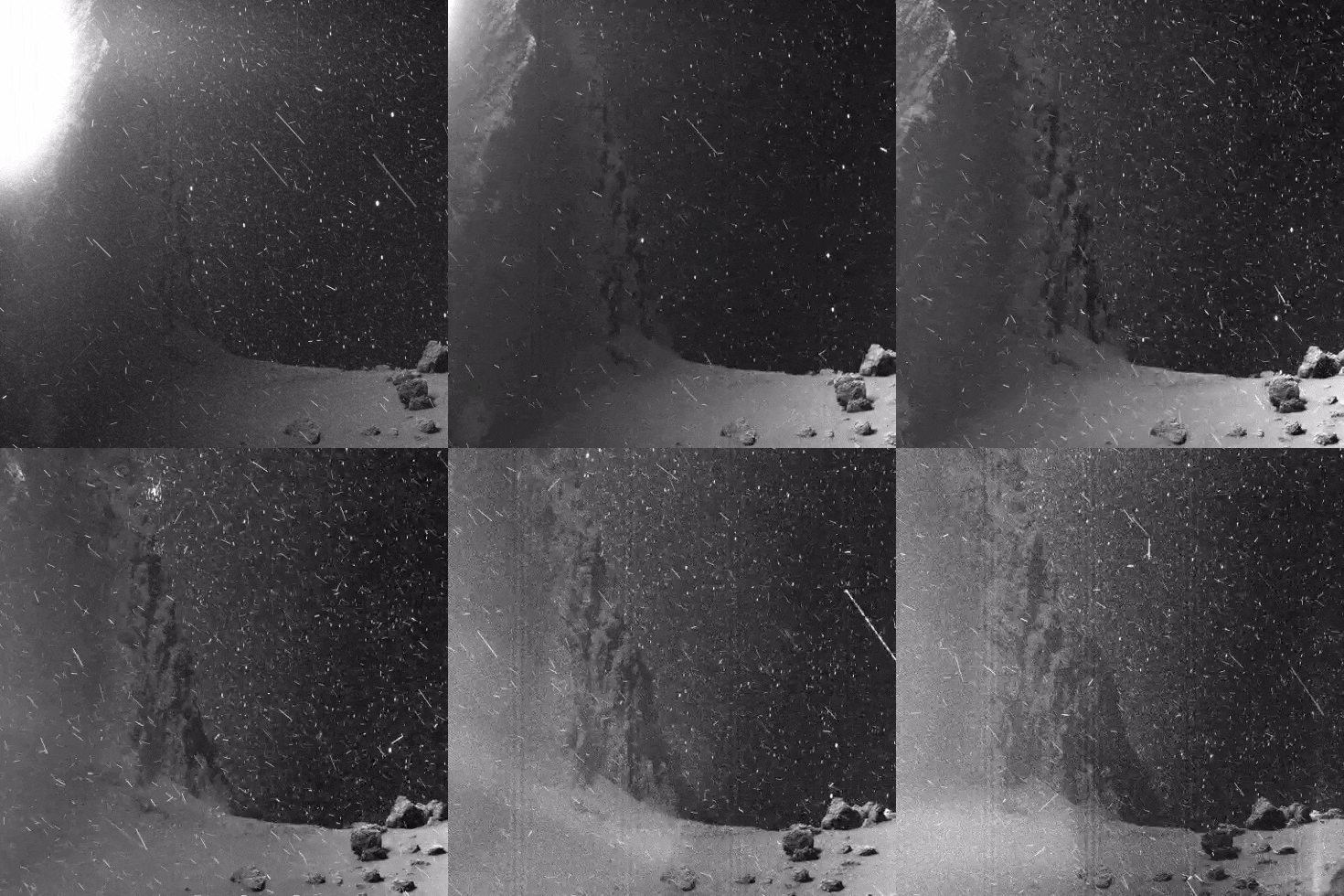
VIDEO FROM THE SURFACE OF A COMET

This is truly incredible.

Details:

Remember Rosetta? That comet-chasing European Space Agency (ESA) probe that deployed (and accidentally bounced) its lander Philae on the surface of Comet 67P? This GIF is made up of images Rosetta beamed back to Earth, which have been freely available online for a while. But it took Twitter user landru79 processing and assembling them into this short, looped clip to reveal the drama they contained.

while the stuff in the foreground is dust/ice on the surface of the comet itself, the background is actually stars. i saw a stabilized video where you can really make it out, and it blew my mind.

here’s the stabilized clip, if anyone’s interested

supernova2395:

madmints:

kasaron:

edwardspoonhands:

hoiplatapolloi:

gifsboom:

Perfect magnets

Fun story: One of the first things I was taught as an astronomy student is that, if you want to be a dick to someone giving a presentation, ask them “and how do the magnetic fields play into this?” and they will invariably say “fuck you I don’t know” because no one understands magnetic fields they are black magic.

Originally posted by fencehopping

Magnets are pure bullshit.

Pure utter bullshit. Electromagnetic forces somehow outstrip gravitic forces in strength by an obscene factor, for no reason I can comprehend and it bothers me.

I love magnets

One, that gif showing the Curie temperature is really cool. 

Two, you don’t understand, magnetic fields are the bane of my existance and I have a masters dissertation about them. I studied how magnetic fields develop in low mass stars and every single meeting with my supervisor ended in some conversation about how stupid magnetism is.

“Oh yeah and this is effected by the magnetic field strength…”

“But why?”

“God knows, I don’t have a clue.”

Was literally said to me by a professor who has spent 20 years of his life looking at magnetism in stars.

ALSO:

“Don’t ask why, we don’t know. Maybe magnetism? Who knows anything about magnetism.” – My Stellar Physics professor when asked about certain processes in stellar formation, something he has been studying for 10 years.

Like we know so little about that it’s actually funny.

Chirping is welcome in birds but not in fusion devices

spaceexp:

Plainsboro NJ (SPX) Mar 20, 2018

Birds do it and so do doughnut-shaped fusion facilities called “tokamaks.” But tokamak chirping – a rapidly changing frequency wave that can be far above what the human ear can detect – is hardly welcome to researchers who seek to bring the fusion that powers the sun and stars to Earth. Such chirping signals a loss of heat that can slow fusion reactions, a loss that has long puzzled scientists.
Full article

astronomyblog:

Saturn’s atmosphere exhibits a banded pattern similar to Jupiter’s, but Saturn’s bands are much fainter and are much wider near the equator. The nomenclature used to describe these bands is the same as on Jupiter. Saturn’s finer cloud patterns were not observed until the flybys of the Voyager spacecraft during the 1980s. Since then, Earth-based telescopy has improved to the point where regular observations can be made. The composition of the clouds varies with depth and increasing pressure.

The winds on Saturn are the second fastest among the Solar System’s planets, after Neptune’s. Voyager data indicate peak easterly winds of 500 m/s (1,800 km/h).

Thermography has shown that Saturn’s south pole has a warm polar vortex, the only known example of such a phenomenon in the Solar System. Whereas temperatures on Saturn are normally −185 °C, temperatures on the vortex often reach as high as −122 °C, suspected to be the warmest spot on Saturn.

Credit: NASA/JPL-Caltech/Space Science Institute and Kevin M. Gill

Hey! I remember a while back (and multiple times since) you mentioned considering astronomy! I know you’re doing theatre (best of luck! You seem very passionate about it and I hope it continues to give you that passion), but what would you say is your favorite part of astronomy? NGL I like exoplanets and astrobiology. Thanks!

omg you’ve been paying attention to all that?? first of all thank you!!!! (and for the luck wishing!!!)

ooh that’s a toughie. there’s a lot to love, and if i could say everything i would, but i have to go with exoplanets as well, but also into more of the astrophysics with like gravitational waves and black holes!!! also magnetism but magnetism is fucking nuts and impossible to understand

thank you so much for this question!!!!

astronomyblog:

Saturn’s atmosphere exhibits a banded pattern similar to Jupiter’s, but Saturn’s bands are much fainter and are much wider near the equator. The nomenclature used to describe these bands is the same as on Jupiter. Saturn’s finer cloud patterns were not observed until the flybys of the Voyager spacecraft during the 1980s. Since then, Earth-based telescopy has improved to the point where regular observations can be made. The composition of the clouds varies with depth and increasing pressure.

The winds on Saturn are the second fastest among the Solar System’s planets, after Neptune’s. Voyager data indicate peak easterly winds of 500 m/s (1,800 km/h).

Thermography has shown that Saturn’s south pole has a warm polar vortex, the only known example of such a phenomenon in the Solar System. Whereas temperatures on Saturn are normally −185 °C, temperatures on the vortex often reach as high as −122 °C, suspected to be the warmest spot on Saturn.

Credit: NASA/JPL-Caltech/Space Science Institute and Kevin M. Gill