Look again at that dot. That’s here. That’s home. That’s us. On it everyone you love, everyone you know, everyone you ever heard of, every human being who ever was, lived out their lives. The aggregate of our joy and suffering, thousands of confident religions, ideologies, and economic doctrines, every hunter and forager, every hero and coward, every creator and destroyer of civilization, every king and peasant, every young couple in love, every mother and father, hopeful child, inventor and explorer, every teacher of morals, every corrupt politician, every “superstar,” every “supreme leader,” every saint and sinner in the history of our species lived there–on a mote of dust suspended in a sunbeam.
The Earth is a very small stage in a vast cosmic arena. Think of the rivers of blood spilled by all those generals and emperors so that, in glory and triumph, they could become the momentary masters of a fraction of a dot. Think of the endless cruelties visited by the inhabitants of one corner of this pixel on the scarcely distinguishable inhabitants of some other corner, how frequent their misunderstandings, how eager they are to kill one another, how fervent their hatreds.
Our posturings, our imagined self-importance, the delusion that we have some privileged position in the Universe, are challenged by this point of pale light. Our planet is a lonely speck in the great enveloping cosmic dark. In our obscurity, in all this vastness, there is no hint that help will come from elsewhere to save us from ourselves.
The Earth is the only world known so far to harbor life. There is nowhere else, at least in the near future, to which our species could migrate. Visit, yes. Settle, not yet. Like it or not, for the moment the Earth is where we make our stand.
It has been said that astronomy is a humbling and character-building experience. There is perhaps no better demonstration of the folly of human conceits than this distant image of our tiny world. To me, it underscores our responsibility to deal more kindly with one another, and to preserve and cherish the pale blue dot, the only home we’ve ever known.
sometimes i laugh b/c like. when we first started exploring astronomy, we used our own solar system as a reference, b/c well. it was the closest thing we could study, right? it only makes sense.
only it turns out that the more we study the universe we find that things that are incredibly common in other solar stystems–like binary/trinary star systems, super-earths, hot jupiters, etc, are completely absent from our system
so like. the more we learn about the universe, the more we realize that it’s not just the earth that’s out of the norm, it’s our entire solar system that’s weird compared to the rest of the known universe
From Washington, D.C., the rings would only fill a portion of the sky, but appear striking nonetheless. Here, we see them at sunrise.
From Guatemala, only 14 degrees above the equator, the rings would begin to stretch across the horizon. Their reflected light would make the moon much brighter.
From Earth’s equator, Saturn’s rings would be viewed edge-on, appearing as a thin, bright line bisecting the sky.
At the March and September equinoxes, the Sun would be positioned directly over the rings, casting a dramatic shadow at the equator.
At midnight at the Tropic of Capricorn, which sits at 23 degrees south latitude, the Earth casts a shadow over the middle of the rings, while the outer portions remain lit.
A 3D mapping model of a chunk of the universe – 380,000 laser-etched dots in a glass sphere each represent a galaxy, and the diameter is 800 million lightyears.(Source)
We out here creating a lil mini universes and shit
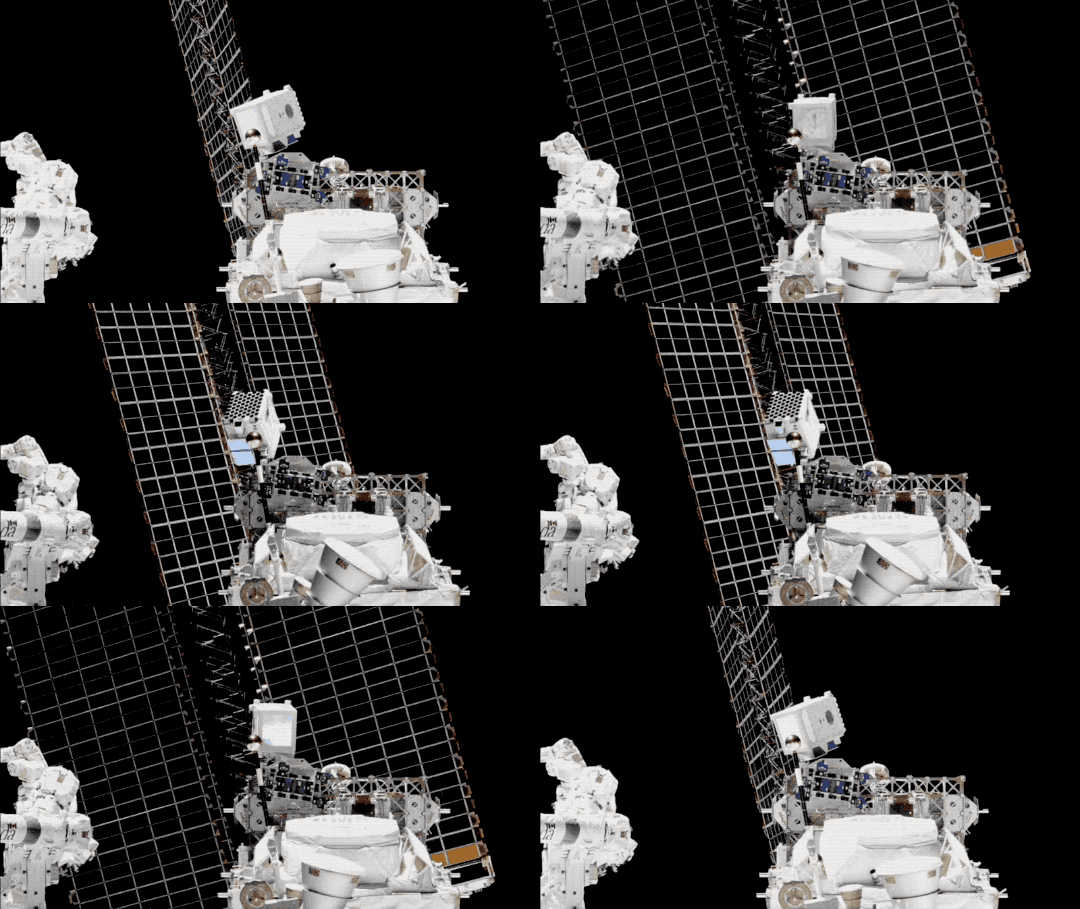
We’re going to talk about some of the amazing new things NICER is showing us about black holes. But first, let’s talk about black holes — how do they work, and where do they come from? There are two important types of black holes we’ll talk about here: stellar and supermassive. Stellar mass black holes are three to dozens of times as massive as our Sun while supermassive black holes can be billions of times as massive!
Stellar black holes begin with a bang — literally! They are one of the possible objects left over after a large star dies in a supernova explosion. Scientists think there are as many as a billion stellar mass black holes in our Milky Way galaxy alone!
Supermassive black holes have remained rather mysterious in comparison. Data suggest that supermassive black holes could be created when multiple black holes merge and make a bigger one. Or that these black holes formed during the early stages of galaxy formation, born when massive clouds of gas collapsed billions of years ago. There is very strong evidence that a supermassive black hole lies at the center of all large galaxies, as in our Milky Way.
Imagine an object 10 times more massive than the Sun squeezed into a sphere approximately the diameter of New York City — or cramming a billion trillion people into a car! These two examples give a sense of how incredibly compact and dense black holes can be.
Because so much stuff is squished into such a relatively small volume, a black hole’s gravity is strong enough that nothing — not even light — can escape from it. But if light can’t escape a dark fate when it encounters a black hole, how can we “see” black holes?
Scientists can’t observe black holes directly, because light can’t escape to bring us information about what’s going on inside them. Instead, they detect the presence of black holes indirectly — by looking for their effects on the cosmic objects around them. We see stars orbiting somethingmassive but invisible to our telescopes, or even disappearing entirely!
When a star approaches a black hole’s event horizon — the point of no return — it’s torn apart. A technical term for this is “spaghettification” — we’re not kidding! Cosmic objects that go through the process of spaghettification become vertically stretched and horizontally compressed into thin, long shapes like noodles.
Scientists can also look for accretion disks when searching for black holes. These disks are relatively flat sheets of gas and dust that surround a cosmic object such as a star or black hole. The material in the disk swirls around and around, until it falls into the black hole. And because of the friction created by the constant movement, the material becomes super hot and emits light, including X-rays.
At last — light! Different wavelengths of light coming from accretion disks are something we can see with our instruments. This reveals important information about black holes, even though we can’t see them directly.
So what has NICER helped us learn about black holes? One of the objects this instrument has studied during its time aboard the International Space Station is the ever-so-forgettably-named black hole GRS 1915+105, which lies nearly 36,000 light-years — or 200 million billion miles — away, in the direction of the constellation Aquila.
Scientists have found disk winds — fast streams of gas created by heat or pressure — near this black hole. Disk winds are pretty peculiar, and we still have a lot of questions about them. Where do they come from? And do they change the shape of the accretion disk?
It’s been difficult to answer these questions, but NICER is more sensitive than previous missions designed to return similar science data. Plus NICER often looks at GRS 1915+105 so it can see changes over time.
NICER’s observations of GRS 1915+105 have provided astronomers a prime example of disk wind patterns, allowing scientists to construct models that can help us better understand how accretion disks and their outflows around black holes work.
NICER has also collected data on a stellar mass black hole with another long name — MAXI J1535-571 (we can call it J1535 for short) — adding to information provided by NuSTAR, Chandra, and MAXI. Even though these are all X-ray detectors, their observations tell us something slightly different about J1535, complementing each other’s data!
This rapidly spinning black hole is part of a binary system, slurping material off its partner, a star. A thin halo of hot gas above the disk illuminates the accretion disk and causes it to glow in X-ray light, which reveals still more information about the shape, temperature, and even the chemical content of the disk. And it turns out that J1535’s disk may be warped!
Image courtesy of NRAO/AUI and Artist: John Kagaya (Hoshi No Techou)
This isn’t the first time we have seen evidence for a warped disk, but J1535’s disk can help us learn more about stellar black holes in binary systems, such as how they feed off their companions and how the accretion disks around black holes are structured.
NICER primarily studies neutron stars — it’s in the name! These are lighter-weight relatives of black holes that can be formed when stars explode. But NICER is also changing what we know about many types of X-ray sources. Thanks to NICER’s efforts, we are one step closer to a complete picture of black holes. And hey, that’s pretty nice!
Make sure to follow us on Tumblr for your regular dose of space: http://nasa.tumblr.com.
Remember Rosetta? That comet-chasing European Space Agency (ESA) probe that deployed (and accidentally bounced) its lander Philae on the surface of Comet 67P? This GIF is made up of images Rosetta beamed back to Earth, which have been freely available online for a while. But it took Twitter user landru79 processing and assembling them into this short, looped clip to reveal the drama they contained.
while the stuff in the foreground is dust/ice on the surface of the comet itself, the background is actually stars. i saw a stabilized video where you can really make it out, and it blew my mind.
CERN – European Organization for Nuclear Research logo.
31 Aug 2018
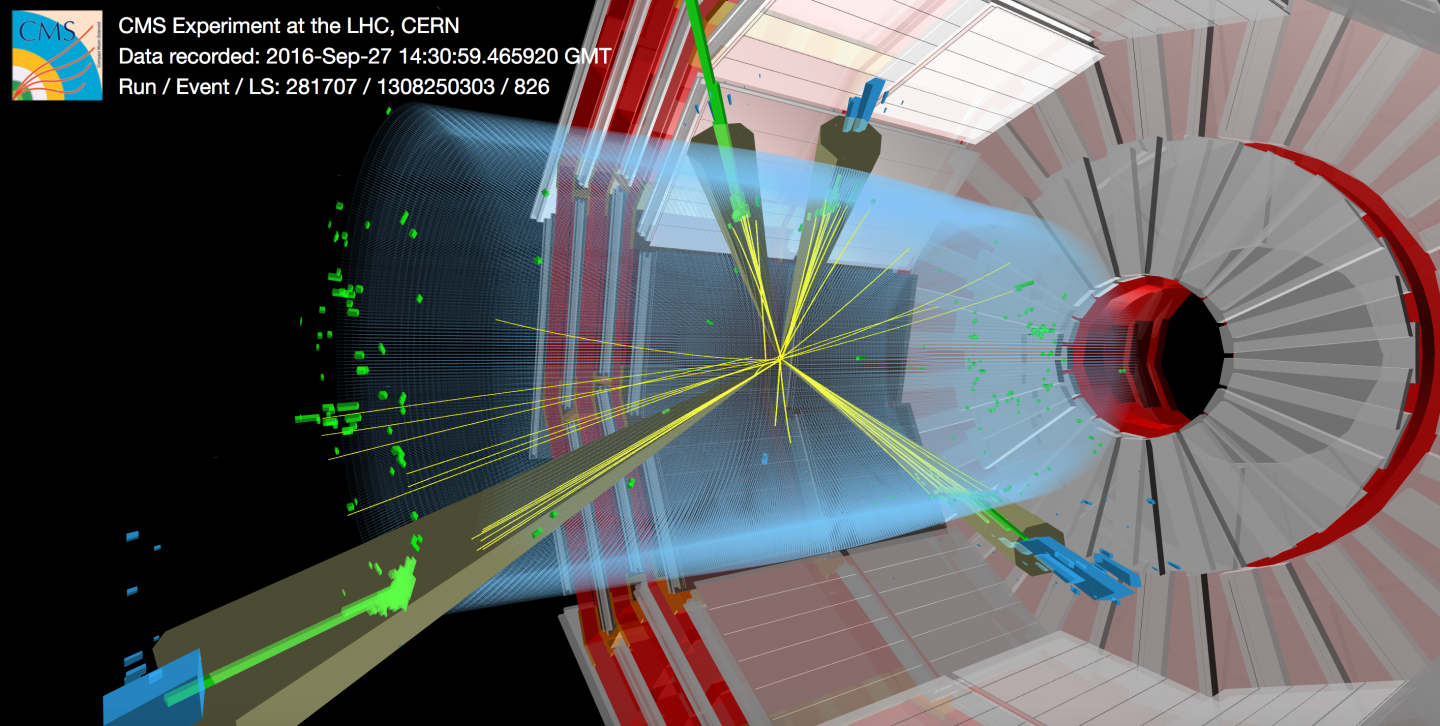
A proton–proton collision event with two emerging-jet candidates. (Image: CMS/CERN)
Quarks are the smallest particles that we know of. In fact, according to the Standard Model of particle physics, which describes all known particles and their interactions, quarks should be infinitely small. If that’s not mind-boggling enough, enter dark quarks – hypothetical particles that have been proposed to explain dark matter, an invisible form of matter that fills the universe and holds the Milky Way and other galaxies together.
In a recent study, the CMS collaboration describes how it has sifted through data from the Large Hadron Collider (LHC) to try and spot dark quarks. Although the search came up empty-handed, it allowed the team to inch closer to the parent particles from which dark quarks may originate.
One compelling theory extends the Standard Model to explain why the observed mass densities of normal matter and dark matter are similar. It does so by invoking the existence of dark quarks that interact with ordinary quarks via a mediator particle. If such mediator particles were produced in pairs in a proton–proton collision, each mediator particle of the pair would transform into a normal quark and a dark quark, both of which would produce a spray, or “jet”, of particles called hadrons, composed of quarks or dark quarks. In total, there would be two jets of regular hadrons originating from the collision point, and two “emerging” jets that would emerge a distance away from the collision point because dark hadrons would take some time to decay into visible particles.
In their study, the CMS researchers looked through data from proton–proton collisions collected at the LHC at an energy of 13 TeV to search for instances, or “events”, in which such mediator particles and associated emerging jets might occur. They used two distinguishing features to identify emerging jets and pick them out from a background of events that are expected to mimic their traits.
Large Hadron Collider (LHC). Animation Credit: CERN
The team found no strong evidence for the existence of such emerging jets, but the data allowed them to exclude masses for the hypothetical mediator particle of 400–1250 GeV for dark pions that travel for lengths between 5 and 225 mm before they decay. The results are the first from a dedicated search for such mediator particles and jets.
Note:
CERN, the European Organization for Nuclear Research, is one of the world’s largest and most respected centres for scientific research. Its business is fundamental physics, finding out what the Universe is made of and how it works. At CERN, the world’s largest and most complex scientific instruments are used to study the basic constituents of matter — the fundamental particles. By studying what happens when these particles collide, physicists learn about the laws of Nature.
The instruments used at CERN are particle accelerators and detectors. Accelerators boost beams of particles to high energies before they are made to collide with each other or with stationary targets. Detectors observe and record the results of these collisions.
Founded in 1954, the CERN Laboratory sits astride the Franco–Swiss border near Geneva. It was one of Europe’s first joint ventures and now has 22 Member States.





 rip tumblr