oh damn. you’re 100% right, i didn’t know that. i’ll try to be more critical of memes like the one i reblogged from now on. would it be better to delete the post, or should i just leave it be/find a post that explains the faults in the meme and reblog that too?
This is the scene where M’Baku calls out Shuri during the challenge. I love that everyone surrounding her snaps to action, but please check out Shuri’s body-language here.
Look at her face.
She is looking M’Baku dead in the eye. Her stance is open and relaxed. She’s not the least bit intimidated.
Also notice that Shuri’s mom and most of the Dora aren’t pointing those vibranium spears at M’Baku.
They are effectively holding Shuri back.
….Just something to think about.
M’Baku: have been overseen by a CHILD who SCOFFS at TRADITION
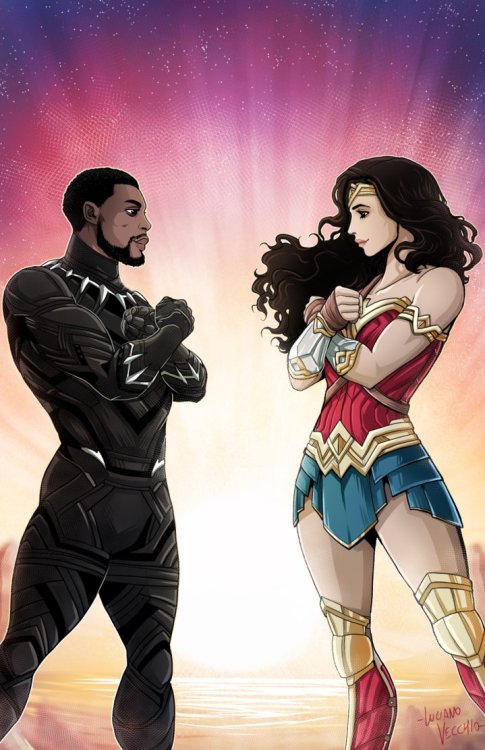
Wonder Woman greeting T’Challa with the Wakanda Forever salute, but forgetting what happens when she clashes her gauntlets like that
Accidentally blowing him through three walls, a car, and M’Baku
He is, of course, completely fine, but that was certainly not the greeting he expected from the suddenly VERY apologetic Princess
Bonus: T’Challa runs back to Diana and does the salute again, channeling the power from the improved kinetic absorption and redistribution on his suit, and launches Diana straight into the sky. They laugh about it later.
This is the wholesome content I signed up for
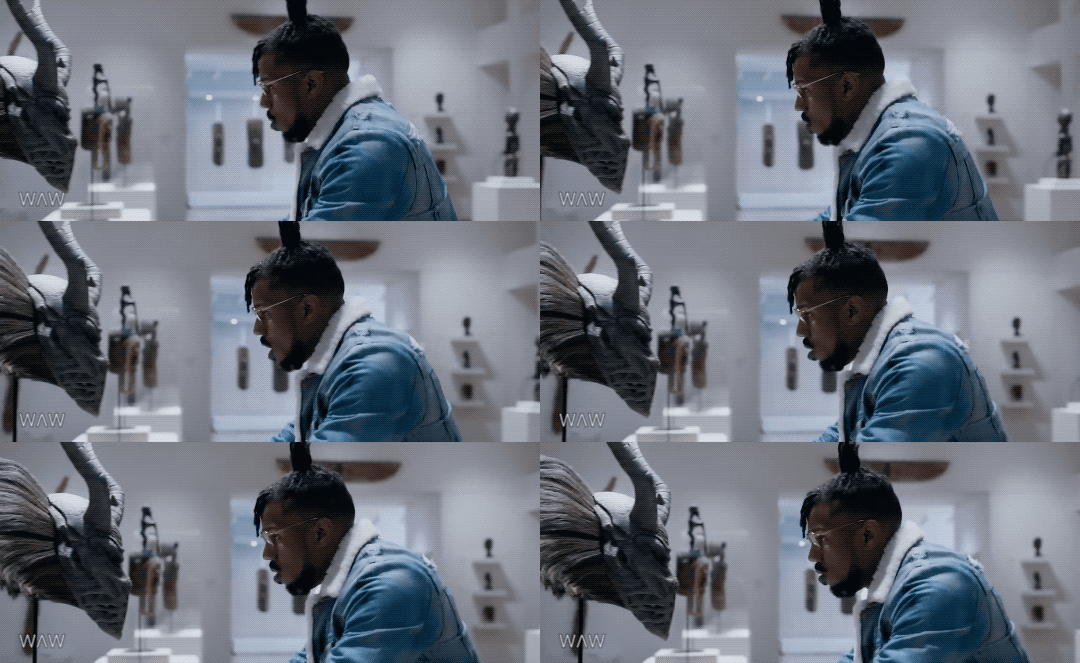
Further bonus: during a later team-up, the villain has T’Challa by the throat and is threatening to snap his neck if Diana comes any closer. She hesitates, at which point the villain laughs and asks if T’Challa has any last words. Of course he does:
Killmonger: How do you think your ancestors got these? You think they paid a full price for it? Or did they take them like they took everything else?
I work in a museum- an old one- and during this scene I was nudging my brother the whole time. I clapped a little at that line. Museums need to rethink the way we curate things. If we aren’t elevating the heritage of those objects’ creators, if we aren’t telling their story, if we aren’t making those narratives accessible to the descendants and letting them lead, then what is even the point? Decolonize collections. Practice co-curation. Hire scholars of color, and make the collections accessible to visiting scholars. Involve the descendant community and elevate their voices, not the white colonial narrative.
And for goodness’ sakes, don’t run your museum like a jewellery shop. Have context. Honor the objects for their beauty, but remember that no object is as important as the people who created it.
Ummmm,, and like straight up, give things back? Indigenous communities in North America have campaigned for decades to have body parts, ceremonial items and sacred parts of our history returned to their communities.
Ofcourse, Hurd scholars of colour and think critically about your role. But like sometimes, you just have to give things back.
That’s repatriation (what I meant by “decolonize collections”) and it’s actually been federal law in America for almost thirty years. It’s been happening and will continue to happen, but it’s a LOT more complicated than just “give the stuff back.” Obviously you’re totally right- giving the stuff back is absolutely necessary.
But at the same time, giving ALL the old stuff back to Native groups doesn’t really work, either- for us OR for them. What happens to the stuff when it goes back? Do the modern Alaskan Athabascans really want the 1000+ baskets the museum I work at holds? (No, they don’t. We asked them. They definitely do not want those baskets back.) What about Native groups who don’t want remains back- the Navajo, for instance, believe that the remains of the dead are taboo objects, unclean and best left buried. And there are some Native groups who actually WANT their objects in museums. Not every object has a ritual context- sometimes a pot is just a pot. Even some ritual objects aren’t as spiritually important, and we’ve actually had people from different tribes come in and help rewrite language surrounding an object, or give instructions as to how it should be stored. Some groups really want us to display their cultural artifacts, because it reminds people that Native American cultures are alive and real.
One thing that works really well in a lot of cases is co-curation, which is when we commission and work with Native artists, leaders, and scholars to reframe the way we display objects. Like, recently, we asked Chris Pappan, who’s a Kanza artist, to come in and draw on the displays from the ‘30s. The juxtaposition of his art with the colonialist view of Native Americans has had a huge impact in visitor impressions- people go to that gallery now to learn and see what’s ACTUALLY happening today with Native Americans. This I think is how these institutions can use their power for good- elevating creator voices and letting them present their own past and own history. The Field does that a lot- we’ve had exhibitions from Rhonda Holy Bear, Bunky Echo-Hawk, and are continuing to work with Native Americans from many tribes to redesign and reframe the objects on display. We’re not doing this for social justice points- we’re doing this because the Field Museum gets something like 1.5+million visitors a year, and we owe it to the Native tribes we stole from to a.) tell their story b.) how they want it.
If you take all evidence of Native Americans out of the big natural history museums, you’re taking away representation- and education- and a lot of tribes actually don’t want that. What many groups want is the old colonial narratives to go away and be replaced with their own messaging and history. Native Americans are mythologized and what we did to them is sanitized in the US education system. I know that the person who responded is in Canada- and from what I hear, they’re even worse about destroying Native history and sanitizing what the colonists did (and continue to do) to them and their cultures. And this is where I think museums can actually HELP. People only care about things they’re familiar with. If the only image you have of a Native American is a racist football mascot, you’re not going to care about them as a culture- you’re not even going to see them as people. There’s a lot of white people who don’t believe in Native Americans. Like, they legit don’t think that there’s ANY Native groups left, and I know this because I’ve talked to these people at work. It’s baffling, how little Americans know about their own country’s behavior. And it’s totally a global problem- I could go on for days about what the British Museum Needs To Do With Those Fucking Marbles, Give Them Back You Cowards, You Have Enough Money To Ensure Their Care In Greece You’re Just Being Assholes- but I wanted to respond with a Native American context because of the person I’m replying to AND because… well, most Americans don’t know this, and they need to, because knowing about repatriation and why we do it is important.
Repatriation is so very vital, but it’s even more vital to listen to the Native American groups and ask them what they want to happen- as well as treat each tribe individually. We don’t hold onto Tlingit remains because the Navajo don’t want their remains back. Treating all tribes as identical is wrong- not as wrong as withholding their precious cultural traditions, relics, and remains- but if we’re even going to (as a museum industry) attempt to apologize for the atrocities we’ve sanctioned, the first thing we gotta do is ask people what they want.
And the next thing we gotta do is listen.
I’m starting to work in a Museum, and though my museum is about Natural Science something stuck le about all of this. The museum does not only exhibit but also safekeeps collections and in the introductory course we were given three keys to the basis of a museum: preservating, researching and exhibiting.
And one is worthless without the other. Our collections are meaningless if they aren’t available for investigation. It’s totally encouraged for scientists to come and use our collections. Granted, our collection mostly consists of dead animals, plants and fossils. And part of my own museum’s goal is orientated to reclaiming by mostly having our own collections as otherwise some of our best fossils are exhibited in museums in USA.
In our museum, all a scientists has to do is basically send an email to access the collection.
So what strikes me is that you point that one of the things to get better is “make the collections available to visiting scholars”. Is that not the case? Or is it specifically not available to scholars of color?
It REALLY varies from museum to museum! Some museums it’s really easy to get in- but others, it’s SO. MUCH. RED. TAPE. I had mine in mind when I was writing that, because collections access takes absolutely forever.
Anytime something is so precious that a culture wants it back but the museum wants it too, i bet you anything some artist would love the commission to duplicate it.
And sometimes that works out amazing.
The Field used to have this totem pole. There are many such poles in the museum, and others in museums around the world- but not all poles have the same significance- it depends on context. This pole, in particular, was a 26 foot tall pole that had been stolen from an “abandoned” Tlingit village- of course, the village wasn’t abandoned, and the people who lived there never consented to giving up their totem poles, and they rather wanted them back.
Anyways, the Field had one that was taken from the Cape Fox Tlingit back in 1899, and in 2001, we sent it home.
In 2002, the Cape Fox Tlingit gave the museum a log. A big one, a huge cedar log. They didn’t need to, but they did, and what the museum did with it was this:
A father-son team of Tlingit artisans- Nathan and Steven Jackson- were commissioned to design and create a new totem pole for the museum. They worked with the museum to create a totem pole that celebrated Tlingit traditions and the modern Tlingit people- a totem pole that combined ancient designs with modern ideas. It’s a gorgeous piece with an incredibly pertinent meaning- according to the Jacksons, the hybrid design illustrates the “refraction” or bending of traditional Tlingit culture that occurred during a turbulent history of cultural loss and recovery.
Which do you think tells you more about what it means to be Tlingit today?
*Walks into museum*
“Hey I’m a Spanish Catholic I expect all 17 billion dollars worth of treasure currently on display in your exhibit. It did come from the wreck of the San José, so by keeping it here you are robbing me of my national and cultural heritage. It’s okay though, you can just get an artist to make reproductions of it all.”
Ugh, I told myself I was done responding to this post, but lord help me, I’m back on other peoples’ bullshit. That’s entirely different and you know it, you’re just being obtuse on purpose.
The Latin in your sidebar translates to (I think, it’s been a while since I took Latin) “Blessed are those who walk the law,” so let’s go over the legal context, because when you actually look into how “a shipwreck from a major military power in international waters” is different from “a (one) totem pole that was taken from people with living descendants (like, great-grandkids),” this little hypothetical holds about as strongly as the Spanish Armada after Queen Elizabeth the First was done with ‘em.
1. The treasure from the wreck of the San José is a modern find, not something that was taken… and also, it’s a shipwreck. While the treasure itself dates back to the colonial period, because it’s a shipwreck, it falls under international maritime law.
2. According to the UN convention on maritime law, countries control twelve nautical miles out from their coastlines- and anything outside of that is international waters. Decent enough summary here: http://www.cbc.ca/news/world/who-keeps-bounty-found-at-sea-1.839631 Warships, however, are considered property of the home state, again per the UN (specifically UNESCO)’s convention on sovereign immunity.
This is important for a couple of reasons. First, Spain is a member of the UN. Unlike Native Americans in the US and any laws regarding the collection fo their material culture and remains, Spain ratified the United Nations Convention on the Law of the Sea. (Also unlike the Native American nations in the US, Spain’s sovereignty isn’t in question, nor is Spain’s history or right to exist. Are other sovereign nations attempting to sanitize their past actions against the Spanish people and are using or have used museums in the past as an attempt to cover up what they did? I’ve never once had a museum guest tell me that Spanish people didn’t exist.) So according to a maritime law convention that Spain willingly entered into, a convention that wasn’t coerced, and a convention that’s benefited Spain, Spain has (at least) partial legal rights to the wreck…
So, if that treasure ever gets brought up, what’s most likely based on just sheer practicality of maritime archaeology is that the stuff that’s too fragile to travel- bits of the hull, things that need on-site saltwater conservation, etc.- will stay in Columbia and the Spanish will get a bunch of their stuff back. After all, that’s happened before. That’s literally what Spain has done before- somebody’s found their wreck, it gets salvaged, Spain goes “we’d like those coins back,” legal battles happen… and then Spain gets their coins back. That’s a thing that happens. This thing that you’re describing as a potentially bad hypothetical that you don’t like? This thing happens! Spain gets to keep its gold when it gets dredged up if it wants it!
4. Spain doesn’t go into museums and ask for its stuff from shipwrecks back because it doesn’t need to. Thanks to years of court precedents and UN/UNESCO conventions, Spain’s got the process of “hey, you have our stuff, give it back” down.
“When a ship has been discovered, the country where the ship was registered can point to something called sovereign immunity (in addition to claims of ownership). This refers to a specific category of ships that are immune from legal proceedings by another state. Warships and other government ships operated for non-commercial purposes enjoy sovereign immunity… Under the sovereign immunity principle in 2009, a judge in the US ruled the court lacked jurisdiction over a case involving a treasure hunting company called Odyssey Marine Exploration and the wreck of the Spanish ship the Nuestra Senora de las Mercedes.The US company found 17 tonnes of coins off the coast of Gibraltar and transported them to the US. But the company was ordered to give back the haul – an estimated half a million coins and other artefacts – to the government of Spain. Odyssey said they found the wreck in international waters and claimed salvage rights. Spain said it had never relinquished ownership of the ship’s cargo and the coins were part of the country’s national heritage.“
Also, 5, and frankly the only reason I responded to this:
Comparing a Spanish treasure galleon to Native American items of spiritual significance is horrendously disrespectful and blatantly disregards the history surrounding Spanish and Catholic imperialism. Do you really think that to the Catholic church, gold coins and precious jewels have the same spiritual value as human remains, totem poles, and other objects of religious significance?
Don’t answer that, I’ve been to the Vatican.
Oh, and the replicas? The museum commissioned that. The Tlingit didn’t say “oh, you can just make a replica.” It was part of an effort to build connections and community and an accurate depiction of a living culture- something that’s infinitely more valuable to a good educational institute than a carved log.
Tl;dr? The San José stuff isn’t in a museum because it’s underwater. If it ever gets brought up, it’ll very likely go back to Spain due to international precedent and Spanish-Columbian diplomacy. Your argument is weaker than the Hapsburg bloodline and the situation isn’t even remotely comparable to actual repatriation attempts. What would be comparable is if the Peruvian and Argentinian government petitioned for the San José material because it was minted with the blood of their miners- but I’m not sure you’re quite on the academic footing to deal with that brutal history, considering you can’t even come up with a decent example of a potential counterargument.
T’challa, a weary sibling, testing new gear: is this a prank
Shuri, ignoring the 42 hidden 360° cameras, 26 hidden audio recorders, her YouTube livestream, her Instagram livestream, the camera she hid in his shirt for a first person pov, Peter Parker on the ceiling, the camera in her hair, Nakia behind the door, and all the Dora Milaje staring through the window: no


 rip tumblr