I think people really underestimate how fucking evil a large chunk of American Christianity is, when they try to say to antichoicers “well if you’re against abortion, at least you should support things like WIC and SNAP, so that women facing an unplanned pregnancy can still feed their future kid”
I’ll be blunt, to American Christians like this, “but single mothers and their kids will starve!” is the entire fucking point. Being ostracized by your family and community and left for you and your bastard child to starve alone in abject misery and deprivation is what they believe the Godly punishment should be for being “unchaste,” and that things like food benefits and contraception are destroying moral society because they let women have unapproved sex without being as controlled by the fear of being cast out to starve with an unwanted kid (this also heavily ties into misogynist racism against woc, especially black women, who are accused of being “welfare queens,” draining good, properly chaste white Christians with kids born from their supposedly mindlessly lustful and irresponsible behavior, that can only be kept in check with threats of starvation or violence).
“Women (especially woc) cannot overcome their base urges and live virtuous lives without being heavily trained and coerced by threats of deprivation, isolation, and violence” is one of the most important unspoken ground rules of reactionary movements, both religious and secular
Evangelicals have no long-standing theological problem with abortion. My parents have been married for longer than evangelicals have been against abortion. Evangelicals in the 1970s didn’t care about abortion. Being against abortion was a Catholic thing. Evangelicals thought abortion is unfortunate, but not evil.
What changed?
Bob Jones v. US (1983).
Bob Jones University, an evangelical school, had a segregationist dating policy. It means what you think it does – they wouldn’t allow white students to date black students. They also wouldn’t admit black students who supported interracial marriage. This was in the mid-70s. Loving v Virginia was nearly a decade in the rearview mirror. The government threatened to revoke their tax-exempt status as a university unless this Jim Crow shit stopped. The school sued, and this eventually went to the Supreme Court. The Court, unsurprisingly, agreed with the government.
What was clear to evangelical leaders, then, in 1983, was that out-and-out racism was no longer going to be tolerated. What could they focus on that would have the same effect? What could rally the base without openly espousing racist views?
Reagan, with his “welfare queens” dog-whistle politicking gave them a like-minded politician glad of their support. And Surgeon General C. Everett Koop was only to happy to tell people what he thought of abortion.
So here we are, thirty-five years later, with every evangelical doing their damnedest to pretend that evangelicals have always been against abortion. They’ve lied themselves into believing it, and now they claim they’re against birth control too. That’s even more spurious – If they actually thought life begins at conception, then birth control would be a necessity, because fertilized eggs being rejected is the norm. Most of what they want to call human life never even gets implanted in the womb, or lasts very long if it does. And if they cared about life, welfare programs ought to be the most important, to ensure everyone has a good standard of living worthy of human beings.
But they don’t care about those things, so the only conclusion is that they are not pro-life. They just don’t want to see family planning and health care go to women, people of color, LGBTQ folks, etc.
It was never about being pro-life.
(and incidentally – Bob Jones v US was an 8-1 decision. Who was the dissenting voice? None other than William Rehnquist. Who was elevated to Chief Justice by Reagan when Warren Burger retired a few years later. None of what has happened has happened by accident)
And it’s worth noting that Bob Jones University defended their policy exclusively on religious freedom grounds, but Rehnquist’s dissent was based entirely on procedural grounds. Even the one justice who was “on their side” didn’t buy their argument and had to justify it on other grounds. It’s been a long road from BJU v. US to the Hobby Lobby case.
An Exotic Dancer Demonstrates That Her Underwear Was Too Large To Have Exposed Herself, After Undercover Police Officers Arrested Her In Florida
Dorothy Counts – The First Black Girl To Attend An All-White School In The United States – Being Teased And Taunted By Her White Male Peers At Charlotte’s Harry Harding High School, 1957
Austrian Boy Receives New Shoes During WWII
Jewish Prisoners After Being Liberated From A Death Train, 1945
The Graves Of A Catholic Woman And Her Protestant Husband, Holland, 1888
A Lone Man Refusing To Do The Nazi Salute, 1936
Job Hunting In 1930’s
German Soldiers React To Footage Of Concentration Camps, 1945
Residents Of West Berlin Show Children To Their Grandparents Who Reside On The Eastern Side, 1961
Acrobats Balance On Top Of The Empire State Building, 1934
Mafia Boss Joe Masseria Lays Dead On A Brooklyn Restaurant Floor Holding The Ace Of Spades, 1931
Lesbian Couple At Le Monocle, Paris, 1932
The Most Beautiful Suicide – Evelyn Mchale Leapt To Her Death From The Empire State Building, 1947
The Remains Of The Astronaut Vladimir Komarov, A Man Who Fell From Space, 1967
Race Organizers Attempt To Stop Kathrine Switzer From Competing In The Boston Marathon. She Became The First Woman To Finish The Race, 1967
Harold Whittles Hearing Sound For The First Time, 1974
Nikola Tesla Sitting In His Laboratory With His “Magnifying Transmitter”
the historical relationship between race / white supremacy and capitalism, & the attendant relationship between race and class, are multifaceted and complex. anyone who tries to tell you that these relationships are settled and simple, that either race or class has absolute primacy over the other, that white supremacy and capitalism aren’t in many ways dependent upon & respondent to each other in how they were formed and in how they continue to shape the world in which we all live, is oversimplifying a question that’s been at the core of a lot of anti-capitalist, anti-racist, & anti-colonialist thought for decades at least. the issue should not be one of conflict–asking “which of these systems overrides or matters more than the other”–but one of synthesis–working to understand how these systems function with and in relation to each other, albeit sometimes in troubled or complicated ways. to have any hope of inquiring into these issues we cannot be afraid of complexity.
the makings of race & the makings of modern capitalism are historically inextricable from each other. if race as we know it today (and specifically the categories of white, Black, & Indigenous american) can be understood as having arisen from european colonialist expansion and the attending enslavement & genocide (/ “removal”) of Indigenous populations, and, slightly later, the more systematic enslavement of and trade in African people–things that, in the late 1600s, began to demand a post hoc explanation as to why some people were subject to enslavement and not others–then, equally, that very imperialist expansion that gave rise to race can be understood as a driving force in the birth of modern capitalism (see especially Fields). and european imperialism and colonialism elsewhere in the world, along with, most recently, neoliberalism, have continued to develop and reinforce the relationship between white supremacy and capitalism (see especially Harris). historical evidence suggests that racism and racial ideology had to be invented and then, in many contexts, had to be taught–and taught diligently–to European peasants, especially indentured servants, in order to suppress their tendency to organise against their masters alongside African slaves (see Federici, 106-107). it took another couple hundred years even after all of this for race to be considered in quite the manner it’s considered in today–as a matter of “biology,” rather than of climate or environment (see especially Harvey). “race” is a set of fictions subject to constant shifting and re-negotiation, & seeing its construction and foundations will require recourse to capital (among other things) at every level.
to claim that race is trans-historical, or that it predates and supercedes capitalism, is to remove race from the circumstances that led to its creation, and therefore to naturalise & to essentialise it. but there is nothing natural or naturally arising about racial ideology or racism.
to claim that racism is an ingrained sense of hatred for non-”white” people that exists in “white” people for reasons entirely unrelated to the material realities of enslavement and colonialist and imperialist expansion, and to the “transition” from feudalism to capitalism as it occurred in Europe and elsewhere, is to claim both that there is some sort of biological or metaphysical truth to the (often troubled) category of “white,” and that there is somehow something naturally detestable about the people who fall outside of that category. on both counts this viewpoint does white supremacy’s work for it. it is also, in its essentials, the accepted liberal view of race, no matter what language you dress it up in.
certainly europeans prior to their colonisation of the americas had cultural and aesthetic ideas and ideals that, viewed through the distorting lens of hindsight, seem to be referencing race, and they’re commonly brought up as early examples of racism & anti-Blackness. indeed, europeans recalled and repurposed these ideas & aesthetics concurrently with the invention of race, subsuming them into the developing system & discourse of white supremacy (and also things like anti-Blackness and colourism). but it’s ahistorical and disingenuous to call this “race” in the context of a conversation in which the term is being used to denote a more specific set of historically contingent (since ~ the very late 1600s) and biologised (since no sooner than the 1850s) ideas & categories.
to claim that race supercedes capitalism, or that struggle against white supremacy is in any way divorcable from, or is even counter to, struggle against capitalism, is also to erase or otherwise misrepresent the legacy of countless racialised peoples & colonial subjects who understood & understand their struggles against these two systems to be inextricably linked. anti-colonial & anti-racist organising have been socialist for decades and it’s downright silly to pretend otherwise. acting like communist or socialist activism & organisation is somehow inherently a white thing is to deny agency & complexity to the many Black revolutionaries, peoples in the Global South, & other nonwhite people and people of colour whose resistance to white supremacy and capitalism provide frameworks for communist organising to this day. socialism is not “white” and never has been (see especially “Who is Oakland”).
of course the other, equally misguided, side of all of this is the tack taken by a lot of white leftists who ignore the roles of imperialism & colonialism in the formation of modern capitalism, ignore the roles that race & colonialism play in creating superexploited subjects in the periphery of empire whose labour can be extorted for the benefit of the ruling class, and ignore the ways in which white supremacy works as an institutional barrier to accumulating wealth for Black people and other people of colour in the West. to claim that capitalism is material while race is merely social, that the relationship between capitalism and race is one of base vs. superstructure (yes, I have really had this argument), or to claim that there is any way to dismantle capitalism without confronting white supremacy, is equally to disregard and disrespect the work & lived experiences of racialised & colonised socialists and revolutionaries.
to disregard any attempt to account for the material realities of race as mere “identity politics” that subvert nonwhite people’s loyalties away from “purer” class struggle–implied or stated to be the only legitimate arena for resistance of any kind–is to ignore how race materially (including, yes, economically) impacts the lives of racialised people. it is also to ignore the role that race has played in subverting the loyalties of white wage labourers against people of colour by giving them small concessions (slightly better jobs & working conditions, plus the mere psychological satisfaction that hey, at least they were white) as incentives against organising alongside working class people of colour. this racial divide between members of the working class needs to be addressed–not merely swept under the rug as an example of white workers working against their own self-interest (as if–while, yes, still worse off than they would be if capitalism were not in place–they did not materially benefit at the expense of other workers). white supremacy and racism need to be confronted in any struggle against capitalism. ignoring all of this is flagrantly to disregard things that Black revolutionaries in the U.S. have known, again, for decades, as well as to express a profound lack of care for nonwhite peoples across the board. and that’s why white leftists get on my damn nerves, lmao.
“There’s certainly a raw and visceral shock to seeing swastikas displayed in American streets,” Hart tells TIME. “But this is a topic I’d been working on for quite a while at that point, and while it wasn’t something I expected, it was a trend I’d been observing. I wasn’t terribly shocked but there’s still a visceral reaction when you see that kind of symbolism displayed in the 21st century.”
Hart, who came to the topic via research on the eugenics movement and the history of Nazi sympathy in Britain, says he realized early on that there was a lot more to the American side of that story than most textbooks acknowledged. Some of the big names might get mentioned briefly — the radio priest Father Charles Coughlin, or the highly public German American Bund organization — but in general, he says, the American narrative of the years leading up to World War II has elided the role of those who supported the wrong side. And yet, American exchange students went to Germany and returned with glowing reviews, while none other than Charles Lindbergh denounced Jewish people for pushing the U.S. toward unnecessary war. In its various expressions, the pro-Nazi stance during those years was mostly focused not on creating an active military alliance with Germany or bringing the U.S. under Nazi control (something Hitler himself thought wouldn’t be possible) but rather on keeping the U.S. out of war in Europe.
So why was that past overlooked for so long?
In part, Hart theorizes, it’s because the American story of World War II is such a powerful national narrative. The United States, that narrative says, helped save the world. Rocked by Pearl Harbor, Americans stepped up to turn the tide for the Allies and thus solidified their nation’s place as a global superpower. That narrative doesn’t have much room for the relatively small, but significant, number of Americans who were rooting for the other side.
“It’s always been uncomfortable in this country to talk about isolationism, though the ideas are still out there,” he says, “It’s part of the American mythology. We want to remember ourselves as always having been on the right side in this war.”
It was also possible for those who had participated in Nazi-sympathetic groups to later cloak their beliefs in the Cold War’s anti-communist push — a dynamic that had in fact driven some of them to fascism in the first place, as it seemed “tougher on communism than democracy is,” as Hart puts it. (One survey he cites found that in 1938, more Americans thought that communism was worse than fascism than vice versa.) Such people could truthfully insist that they’d always been anti-communist without revealing that they’d been fascists, and their fellow Americans were still so worried about communism that they might not press the matter.
you wanna see some badass shit from the early 20th century?? The Lumière brothers created the first full color photograph… in fucking 1903! So these dudes dyed potatoes (in red, blue, and green), mashed them down into just pure fuckin’ starch, and used these dyed potato starches as filters to block out/let in certain wavelengths of light. They coated one side of a glass plate with the starches and sensitized the other side with a mixture of gelatin and light sensitive materials (silver nitrate) and loaded these plates in their cameras.. This is a really simple explanation of the process and I may have missed some things
We think history is so far removed from us, but sometimes I’m reminded how very close we are to each other on the timeline.
My paternal grandfather was born in 1906 (I have older parents). He and my grandmother came through Ellis Island.
My vocal coach’s grandparents survived the 1906 San Fransisco earthquake and fire.
My great-grandfather lived to the age of 106. He often spoke of how strongly he remembered his nursemaid’s taffeta skirts rustling as she walked when he was a child. He was born in the 1870s. My grandmother recorded him on video in the 1980s talking about those Victorian bustle skirts he grew up with.
On my mother’s side, we tracked down a marriage record for her 17th-century English ancestors, their signatures still crystal-clear and confident on the yellowed parchment. The church where they were married still stands in London.
Samuel J. Seymour was born in 1860 and at age five, he witnessed the assassination of Abraham Lincoln. Almost 100 years later, at age 96, he went on live television and recounted his firsthand account of the death of the president. You can watch the interview here.
The last survivor of the sinking of the Titanic, Millvina Dean, died in 2009.
The oldest person ever, Jeanne Calment, lived to age 122. She died in 1997 after recording a pop album, the same year The Spice Girls were topping the charts; but she remembered that as a child, Vincent Van Gogh once visited her father’s paint shop.
It’s easy to think of history as abstract, black and white, theoretical. But do some digging–you’ll probably find that it’s within arm’s reach.
Dude i got through all these but that last one fuck me up
a lot of people i’ve interacted with still think the whole chiquita death squads thing was only a rumor so I wanted to point out that they owned up to it and got fined.
so a corporation literally funded right wing terrorists to kill innocent people and only got fined. $25 million. chiquita has annual revenues of $3 billion. that should really have been a wake up call to anyone thinking corporations are treated unfairly, but it wasn’t. this is capitalism.
Pepsi is also directly responsible for the coup of Allende. Allende was actually supposed to win the 1963 election, but was unable to bc corporations like Pepsi poured millions into his opponent’s campaign. In return, his opponent promised to protect their investments. In 1970, when Allende finally won, the CEO of PepsiCo explicitly demanded President Nixon stage a coup against Allende bc as a socialist, he would threaten Pepsi’s and other foreign investments. Pressured by these corporations, Nixon eventually took action https://www.theguardian.com/business/1998/nov/08/observerbusiness.theobserver
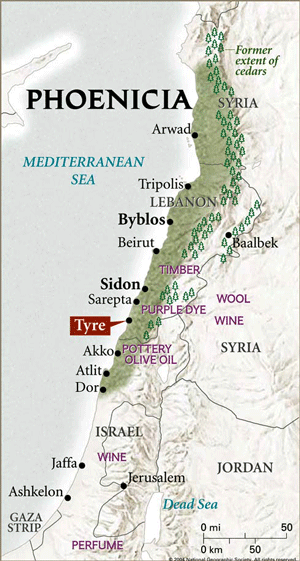
Although the Phoenicians were among the most influential people in the Mediterranean in the first millennium BCE, very little is understood about them. For instance, there was never a kingdom called “Phoenicia.”
Rather, there were a bunch of cities, sharing a strip of land on the coast of modern-day Lebanon, Syria, and northern Israel. These cities were never united. Each was fiercely independent, though they shared a language, an alphabet, and several cultural characteristics.
Many of these cities survive today. For instance, Berot became modern Beirut, and Sidon became modern Saida.


 rip tumblr