“Imagine if people had been going ‘don’t fight hate with hate’ back when Hitler was around.”
Fam…let me tell you bout Poland.
Let me tell you about how the entire rest of Europe sat ack and watched the invasion of Poland because they thought it would be “improper” to send military aid. How they were unwilling to enforce the treaties that Germany was breaking, because that would make them “just as bad.” They sat back and wrote strongly worded letters while fascists grew in power because they didn’t want to dirty their hands. They thought reasonable discussion and politics would be enough to stop a fascist dictator from rising to power.
Spoiler alert: it wasn’t enough.
like yes, people literally did try that argument then too.
Everywhere there’s fascists there are fascist apologists hiding under the guise of pacifism, ready to enable their shit and demonize resistance.
You ever read some shit so evil it kinda pumps the brakes on the rest of your day?
Are you fucking ready for this knowledge? To my exasperated followers, give me a break, I haven’t given a good historical rant about her in a few months. Also who the hell uses the word ‘vegetable’ anymore? Yeah, I’m taking over this post. Here we go:
Rosemary Kennedy was JFK’s sister. Joseph Kennedy manipulated his children for years, always wanting them to be the picturesque family to help gain political traction. “Oh, they’re so pretty, oh, they’re so well-behaved, oh, they’re the definition of family ideals” that stuff.
For the most part, the rest of the Kennedy children obliged.
Rosemary?
Rosemary left her boarding school to go on dates.
…Yeah. Yeah, that was it. Rosemary left the boarding school and went on dates. That was her “rebellious nature”. She was a tad bit clumsy, she might have actually had borderline Asperger’s due to her inability to pick up on social cues, and she left her boarding school to go on dates with boys. That last one pissed off Joseph so that, by the time Rosemary was twenty-three (the above cruce post makes it seem like she was a teenager but no, she was twenty-three, I’m not saying this to diminish anything, I’m saying that she was a fully-grown adult and still under her father’s manipulations), he took her to Walter Jackson Freeman without consulting his wife. If you haven’t been privy to any of my rants, Walter Jackson Freeman was a man who used icepicks and knives to cut into people’s heads, chopping off pieces of their brain, a process known as the frontal lobotomy. Icepicks. The things you used to chip ice. Icepicks. Although I’m pretty sure he used a kitchen knife on Rosemary because, you know, that’s so much better. Anywho, not only was she forced into the operation, not only was she forced to sing God Bless America, but she was forced to say The Lord’s Prayer. The. Lord’s. Prayer. Until. She. Couldn’t. Because. They. Paralyzed. Her.
Joseph was so disgusted by her new state (you know, because she was paralyzed) that he sent her to a far-off asylum where she remained for decades. When JFK ran for his presidency and was asked about the whereabouts of his sister, he said that she was away, teaching and/or studying.
Nobody visited Rosemary for decades.
Nobody visited Rosemary for decades.
When her mother finally visited, Rosemary lunged at her in anger and had to be sedated. Her mother’s response? You ready for this? I mean, seriously, are you ready? Like I know what you’re thinking: “Mate, you just went into a rant by memory (yeah, I’m typing this all by memory) about a woman whose brain was hacked up using a butter knife so that she wouldn’t embarrass her family during their political campaign, only for that woman to become paralyzed and institutionalized without visitors for decades, what the fuck can be worse than that?” Seriously though, brace yourselves.
When Rose Kennedy saw her daughter for the first time in decades (after Rosemary was institutionalized as a result of Joseph’s severe medical abuse), when Rose saw her…her first concern…was that she was fat.
Like I said, I wrote this all from memory, but have a bundle of sources confirming everything:
Lobotomies to “correct” misbehaving children weren’t isolated to this family. This was considered a parent’s right. This family isn’t specially cursed, this was fucking “normal” at one point.
Even now, there’s disabled kids who have to fight their parents about invasive and detrimental surgeries and “medical treatments” like this.
It’s part the abuse culture that surrounds parenting – that parents can do what they want to their kids and nobody can tell them otherwise – and part more standard bigotry. The lines between sexism, racism, and ableism tend to blur when it comes to parental abuse culture.
And shit like this is happening in everyday homes,
“In the spring of 1940, when the Nazis overran France from the north, much of its Jewish population tried to escape the country towards the south. In order to cross the border, they needed visas to Spain and Portugal, and together with a flood of other refugees, tens of thousands of Jews besieged the Portuguese consulate in Bordeaux in a desperate attempt to get that life-saving piece of paper. The Portuguese government forbade its consuls in France to issue visas without prior approval from the Foreign Ministry, but the consul in Bordeaux, Aristides de Sousa Mendes, decided to disregard the order, throwing to the wind a thirty-year diplomatic career. As Nazi tanks were closing in on Bordeaux, Sousa Mendes and his team worked around the clock for ten days and nights, barely stopping to sleep, just issuing visas and stamping pieces of paper. Sousa Mendes issued thousands of visas before collapsing from exhaustion.
The Portuguese government—which had little desire to accept any of these refugees—sent agents to escort the disobedient consul back home, and fired him from the foreign office. Yet officials who cared little for the plight of human beings nevertheless had a deep reverence for documents, and the visas Sousa Mendes issued against orders were respected by French, Spanish and Portuguese bureaucrats alike, spiriting up to 30,000 people out of the Nazi death trap. Sousa Mendes, armed with little more than a rubber stamp, was responsible for the largest rescue operation by a single individual during the Holocaust.”
—Homo Deus: A Brief History of Tomorrow by Yuval Noah Harari
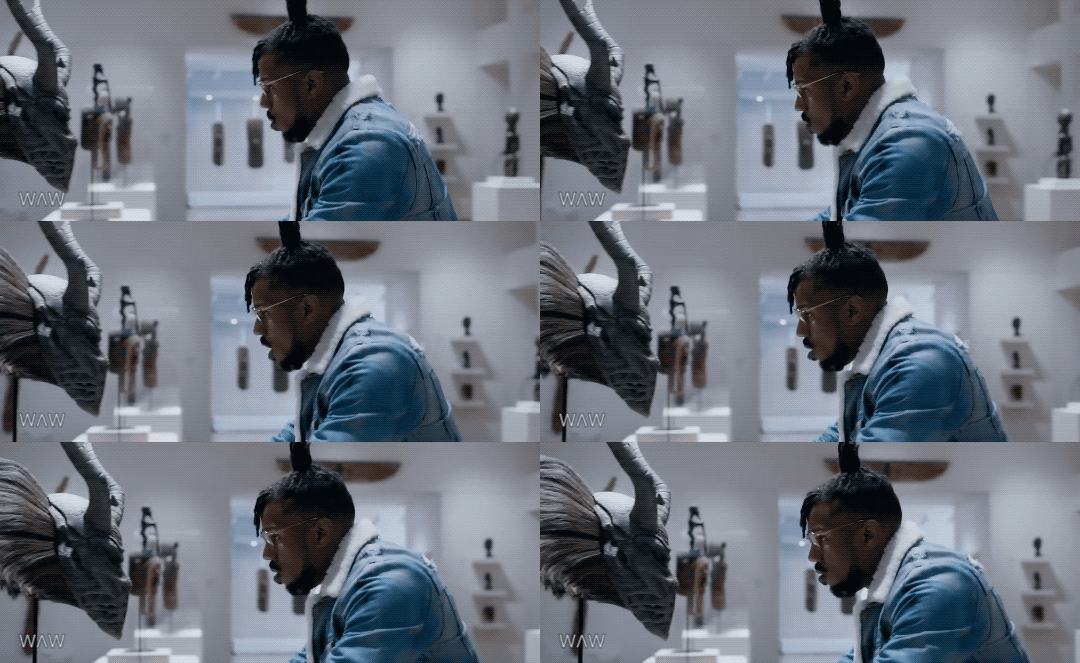
Killmonger: How do you think your ancestors got these? You think they paid a full price for it? Or did they take them like they took everything else?
I work in a museum- an old one- and during this scene I was nudging my brother the whole time. I clapped a little at that line. Museums need to rethink the way we curate things. If we aren’t elevating the heritage of those objects’ creators, if we aren’t telling their story, if we aren’t making those narratives accessible to the descendants and letting them lead, then what is even the point? Decolonize collections. Practice co-curation. Hire scholars of color, and make the collections accessible to visiting scholars. Involve the descendant community and elevate their voices, not the white colonial narrative.
And for goodness’ sakes, don’t run your museum like a jewellery shop. Have context. Honor the objects for their beauty, but remember that no object is as important as the people who created it.
Ummmm,, and like straight up, give things back? Indigenous communities in North America have campaigned for decades to have body parts, ceremonial items and sacred parts of our history returned to their communities.
Ofcourse, Hurd scholars of colour and think critically about your role. But like sometimes, you just have to give things back.
That’s repatriation (what I meant by “decolonize collections”) and it’s actually been federal law in America for almost thirty years. It’s been happening and will continue to happen, but it’s a LOT more complicated than just “give the stuff back.” Obviously you’re totally right- giving the stuff back is absolutely necessary.
But at the same time, giving ALL the old stuff back to Native groups doesn’t really work, either- for us OR for them. What happens to the stuff when it goes back? Do the modern Alaskan Athabascans really want the 1000+ baskets the museum I work at holds? (No, they don’t. We asked them. They definitely do not want those baskets back.) What about Native groups who don’t want remains back- the Navajo, for instance, believe that the remains of the dead are taboo objects, unclean and best left buried. And there are some Native groups who actually WANT their objects in museums. Not every object has a ritual context- sometimes a pot is just a pot. Even some ritual objects aren’t as spiritually important, and we’ve actually had people from different tribes come in and help rewrite language surrounding an object, or give instructions as to how it should be stored. Some groups really want us to display their cultural artifacts, because it reminds people that Native American cultures are alive and real.
One thing that works really well in a lot of cases is co-curation, which is when we commission and work with Native artists, leaders, and scholars to reframe the way we display objects. Like, recently, we asked Chris Pappan, who’s a Kanza artist, to come in and draw on the displays from the ‘30s. The juxtaposition of his art with the colonialist view of Native Americans has had a huge impact in visitor impressions- people go to that gallery now to learn and see what’s ACTUALLY happening today with Native Americans. This I think is how these institutions can use their power for good- elevating creator voices and letting them present their own past and own history. The Field does that a lot- we’ve had exhibitions from Rhonda Holy Bear, Bunky Echo-Hawk, and are continuing to work with Native Americans from many tribes to redesign and reframe the objects on display. We’re not doing this for social justice points- we’re doing this because the Field Museum gets something like 1.5+million visitors a year, and we owe it to the Native tribes we stole from to a.) tell their story b.) how they want it.
If you take all evidence of Native Americans out of the big natural history museums, you’re taking away representation- and education- and a lot of tribes actually don’t want that. What many groups want is the old colonial narratives to go away and be replaced with their own messaging and history. Native Americans are mythologized and what we did to them is sanitized in the US education system. I know that the person who responded is in Canada- and from what I hear, they’re even worse about destroying Native history and sanitizing what the colonists did (and continue to do) to them and their cultures. And this is where I think museums can actually HELP. People only care about things they’re familiar with. If the only image you have of a Native American is a racist football mascot, you’re not going to care about them as a culture- you’re not even going to see them as people. There’s a lot of white people who don’t believe in Native Americans. Like, they legit don’t think that there’s ANY Native groups left, and I know this because I’ve talked to these people at work. It’s baffling, how little Americans know about their own country’s behavior. And it’s totally a global problem- I could go on for days about what the British Museum Needs To Do With Those Fucking Marbles, Give Them Back You Cowards, You Have Enough Money To Ensure Their Care In Greece You’re Just Being Assholes- but I wanted to respond with a Native American context because of the person I’m replying to AND because… well, most Americans don’t know this, and they need to, because knowing about repatriation and why we do it is important.
Repatriation is so very vital, but it’s even more vital to listen to the Native American groups and ask them what they want to happen- as well as treat each tribe individually. We don’t hold onto Tlingit remains because the Navajo don’t want their remains back. Treating all tribes as identical is wrong- not as wrong as withholding their precious cultural traditions, relics, and remains- but if we’re even going to (as a museum industry) attempt to apologize for the atrocities we’ve sanctioned, the first thing we gotta do is ask people what they want.
And the next thing we gotta do is listen.
I’m starting to work in a Museum, and though my museum is about Natural Science something stuck le about all of this. The museum does not only exhibit but also safekeeps collections and in the introductory course we were given three keys to the basis of a museum: preservating, researching and exhibiting.
And one is worthless without the other. Our collections are meaningless if they aren’t available for investigation. It’s totally encouraged for scientists to come and use our collections. Granted, our collection mostly consists of dead animals, plants and fossils. And part of my own museum’s goal is orientated to reclaiming by mostly having our own collections as otherwise some of our best fossils are exhibited in museums in USA.
In our museum, all a scientists has to do is basically send an email to access the collection.
So what strikes me is that you point that one of the things to get better is “make the collections available to visiting scholars”. Is that not the case? Or is it specifically not available to scholars of color?
It REALLY varies from museum to museum! Some museums it’s really easy to get in- but others, it’s SO. MUCH. RED. TAPE. I had mine in mind when I was writing that, because collections access takes absolutely forever.
Anytime something is so precious that a culture wants it back but the museum wants it too, i bet you anything some artist would love the commission to duplicate it.
And sometimes that works out amazing.
The Field used to have this totem pole. There are many such poles in the museum, and others in museums around the world- but not all poles have the same significance- it depends on context. This pole, in particular, was a 26 foot tall pole that had been stolen from an “abandoned” Tlingit village- of course, the village wasn’t abandoned, and the people who lived there never consented to giving up their totem poles, and they rather wanted them back.
Anyways, the Field had one that was taken from the Cape Fox Tlingit back in 1899, and in 2001, we sent it home.
In 2002, the Cape Fox Tlingit gave the museum a log. A big one, a huge cedar log. They didn’t need to, but they did, and what the museum did with it was this:
A father-son team of Tlingit artisans- Nathan and Steven Jackson- were commissioned to design and create a new totem pole for the museum. They worked with the museum to create a totem pole that celebrated Tlingit traditions and the modern Tlingit people- a totem pole that combined ancient designs with modern ideas. It’s a gorgeous piece with an incredibly pertinent meaning- according to the Jacksons, the hybrid design illustrates the “refraction” or bending of traditional Tlingit culture that occurred during a turbulent history of cultural loss and recovery.
Which do you think tells you more about what it means to be Tlingit today?
*Walks into museum*
“Hey I’m a Spanish Catholic I expect all 17 billion dollars worth of treasure currently on display in your exhibit. It did come from the wreck of the San José, so by keeping it here you are robbing me of my national and cultural heritage. It’s okay though, you can just get an artist to make reproductions of it all.”
Ugh, I told myself I was done responding to this post, but lord help me, I’m back on other peoples’ bullshit. That’s entirely different and you know it, you’re just being obtuse on purpose.
The Latin in your sidebar translates to (I think, it’s been a while since I took Latin) “Blessed are those who walk the law,” so let’s go over the legal context, because when you actually look into how “a shipwreck from a major military power in international waters” is different from “a (one) totem pole that was taken from people with living descendants (like, great-grandkids),” this little hypothetical holds about as strongly as the Spanish Armada after Queen Elizabeth the First was done with ‘em.
1. The treasure from the wreck of the San José is a modern find, not something that was taken… and also, it’s a shipwreck. While the treasure itself dates back to the colonial period, because it’s a shipwreck, it falls under international maritime law.
2. According to the UN convention on maritime law, countries control twelve nautical miles out from their coastlines- and anything outside of that is international waters. Decent enough summary here: http://www.cbc.ca/news/world/who-keeps-bounty-found-at-sea-1.839631 Warships, however, are considered property of the home state, again per the UN (specifically UNESCO)’s convention on sovereign immunity.
This is important for a couple of reasons. First, Spain is a member of the UN. Unlike Native Americans in the US and any laws regarding the collection fo their material culture and remains, Spain ratified the United Nations Convention on the Law of the Sea. (Also unlike the Native American nations in the US, Spain’s sovereignty isn’t in question, nor is Spain’s history or right to exist. Are other sovereign nations attempting to sanitize their past actions against the Spanish people and are using or have used museums in the past as an attempt to cover up what they did? I’ve never once had a museum guest tell me that Spanish people didn’t exist.) So according to a maritime law convention that Spain willingly entered into, a convention that wasn’t coerced, and a convention that’s benefited Spain, Spain has (at least) partial legal rights to the wreck…
So, if that treasure ever gets brought up, what’s most likely based on just sheer practicality of maritime archaeology is that the stuff that’s too fragile to travel- bits of the hull, things that need on-site saltwater conservation, etc.- will stay in Columbia and the Spanish will get a bunch of their stuff back. After all, that’s happened before. That’s literally what Spain has done before- somebody’s found their wreck, it gets salvaged, Spain goes “we’d like those coins back,” legal battles happen… and then Spain gets their coins back. That’s a thing that happens. This thing that you’re describing as a potentially bad hypothetical that you don’t like? This thing happens! Spain gets to keep its gold when it gets dredged up if it wants it!
4. Spain doesn’t go into museums and ask for its stuff from shipwrecks back because it doesn’t need to. Thanks to years of court precedents and UN/UNESCO conventions, Spain’s got the process of “hey, you have our stuff, give it back” down.
“When a ship has been discovered, the country where the ship was registered can point to something called sovereign immunity (in addition to claims of ownership). This refers to a specific category of ships that are immune from legal proceedings by another state. Warships and other government ships operated for non-commercial purposes enjoy sovereign immunity… Under the sovereign immunity principle in 2009, a judge in the US ruled the court lacked jurisdiction over a case involving a treasure hunting company called Odyssey Marine Exploration and the wreck of the Spanish ship the Nuestra Senora de las Mercedes.The US company found 17 tonnes of coins off the coast of Gibraltar and transported them to the US. But the company was ordered to give back the haul – an estimated half a million coins and other artefacts – to the government of Spain. Odyssey said they found the wreck in international waters and claimed salvage rights. Spain said it had never relinquished ownership of the ship’s cargo and the coins were part of the country’s national heritage.“
Also, 5, and frankly the only reason I responded to this:
Comparing a Spanish treasure galleon to Native American items of spiritual significance is horrendously disrespectful and blatantly disregards the history surrounding Spanish and Catholic imperialism. Do you really think that to the Catholic church, gold coins and precious jewels have the same spiritual value as human remains, totem poles, and other objects of religious significance?
Don’t answer that, I’ve been to the Vatican.
Oh, and the replicas? The museum commissioned that. The Tlingit didn’t say “oh, you can just make a replica.” It was part of an effort to build connections and community and an accurate depiction of a living culture- something that’s infinitely more valuable to a good educational institute than a carved log.
Tl;dr? The San José stuff isn’t in a museum because it’s underwater. If it ever gets brought up, it’ll very likely go back to Spain due to international precedent and Spanish-Columbian diplomacy. Your argument is weaker than the Hapsburg bloodline and the situation isn’t even remotely comparable to actual repatriation attempts. What would be comparable is if the Peruvian and Argentinian government petitioned for the San José material because it was minted with the blood of their miners- but I’m not sure you’re quite on the academic footing to deal with that brutal history, considering you can’t even come up with a decent example of a potential counterargument.
I learned in a Latin Studies class (with a chill white dude professor) that when the Europeans first saw Aztec cities they were stunned by the grid. The Aztecs had city planning and that there was no rational lay out to European cities at the time. No organization.
When the Spanish first arrived in Tenochtitlan (now downtown mexico city) they thought they were dreaming. They had arrived from incredibly unsanitary medieval Europe to a city five times the size of that century’s london with a working sewage system, artificial “floating gardens” (chinampas), a grid system, and aqueducts providing fresh water. Which wasn’t even for drinking! Water from the aqueducts was used for washing and bathing- they preferred using nearby mountain springs for drinking. Hygiene was a huge part if their culture, most people bathed twice a day while the king bathed at least four times a day.
Located on an island in the middle of a lake, they used advanced causeways to allow access to the mainland that could be cut off to let canoes through or to defend the city. The Spanish saw their buildings and towers and thought they were rising out of the water. The city was one of the most advanced societies at the time.
Anyone who thinks that Native Americans were the savages instead of the filthy, disease ridden colonizers who appeared on their land is a damn fool.
jews try and explain how intergenerational trauma works and functions in our families + communities and white gentiles r still like “so you get intergenerational trauma when anything bad has previously happened to any group of people like you??”
like i don’t know how to get y’all to stop wrapping your head around how these kinds of numbers affect a marginalized group:
a third of all Jews on the FACE OF THE EARTH died within a few years
like there’s just such a comprehensive failure to understand or empathize with what exactly that means. how many communities were destroyed, how many families were destroyed, how our languages were destroyed because most of the speakers were murdered, how many children grew up in the wake of this trauma, what it’s like to try and parent in the aftermath of a genocide that kills a third of your people (two thirds of all european Jews!), what it’s like to have the spectre of this hung over your head every single day from childhood
There’s this complete disconnect that a lot of non-Jewish gadje have about exactly what the Samudaripen (Holocaust) DID to our two populations. Like, there are entire subgroups that just don’t exist anymore… Seeing these numbers makes my heart hurt.
As an atheist, it‘s very interesting to see how theists still believe in (and worship) their god, after such horrible things happen to them and their community. I thought their god would protect them…?
Okay, first of all, the Holocaust was a racially based genocide. Hitler and the Third Reich weren’t killing Jews because of theological issues. He believed that Jews (along with the Romani people) as a race were inferior and impure. Racial purity was also why other groups of victims were targeting.
Second of all, and more importantly, you are a horrible and disgusting human being. You should be ashamed of yourself.
Years before he was elected president,
Teddy Roosevelt defeated a bully in a
bar fight. As soon as he walked in, a
stranger began cursing at him, called
him ‘four eyes’, and insisted that he buy
everyone drinks. Deceptively looking
past him, Teddy stood and said, “Well,
if I’ve got to, I’ve got to,” then knocked
the guy out with 3 consecutive punches
and took his guns away. The crowd
cheered, put the bully out in the shed,
and he had fled town by morning. SourceSource 2
marvel is disney’s forever cash cow! it appeals to children, teens, and sweaty adults! it’s all quite loud and colorful, with the same safe formula every time, but with different directors and tweaks to make it whatever the fuck memorable each time. plus the reliance on violence to push the plot will give them those dank US military checks until explosions go extinct. truly we live in horrific times but i don’t really care
thank u all for letting me know the military quit cutting checks for the MCU after Avengers because they got offended bc the fictional magic men are an alternative to the american military. i’m sorry i was misinformed but more importantly that’s really, really, really, really, really fucking funny
Really (about military)?😕 I am not even surprise because Captain America The Winter Soldier is lowkey critic of it.
They actually namedrop Operation Paperclip in Winter Soldier, which shocked me when I watched it the first time— when Zola talks about how the Nazi-analogue group Hydra survived in plain sight, with direct approval from the US government on top of its infiltration into the government itself.
Operation Paperclip irl was a (now declassified) government ratline program where the US selected notable Nazi scientists, engineers, etc., to sponsor for American immigration with new identities to protect & hide their old identities, sparing them from punishment for their war crimes so long as they continued their work here on behalf of the American government rather than the Third Reich.
I remember watching the film & going, “Ah, so that’s why there’s fewer government vehicles & military extras than is the standard for scenes of this scale, they gave up the DOD money.”
All of which—
positioning Captain America in direct opposition to a fake government agency infiltrated by fake Nazis & saying that the Nazis corrupted everything so badly that he had to throw the whole agency away…
and then that pissing off real government & military officials, who methinks doth protest too much;
(because those military personnel were/are still touchy over public perception of what the US gov’t. actually did during & after WW2, versus the myth of American heroism pushed by mainstream media & public education in this country; the truth disrupts the status quo, even with make believe Nazis, and thus unacceptable)
and who then decided to take away funds they had previously earmarked for this franchise back when they were happy to use it as positive propaganda/for recruitment & advertisement
—is, in fact, really, really, really, really, really fucking funny.




 rip tumblr