your-frenchblondgirl:

starkravinghazelnuts:

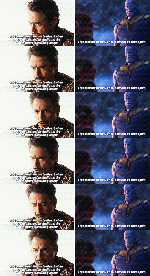
[Tony] has this sort of existential connection to Thanos.” – Joe Russo

“You realize this interesting parallel between Thanos and Tony. They’re both aware of something from an early point and constantly having to deal with being smarter. Thanos is a futurist as much as Tony Stark.” – Christopher Markus

Tony and Thanos appear to be two heads to the same coin. Between them, they share a lot of remarkable similarities. But what separates them is heart. Tony has compassion, while Thanos does not. 

This is emphasized in Avengers: Infinity War. Thanos hurls his adopted daughter, Gamora, off a cliff; while Tony promises his son-figure, Peter, he will catch him when he falls.

image

Tony wants to save the universe by safeguarding as many lives as he can, while Thanos believes saving the

universe

necessitates massive loss of life. They are equal, yet opposite. 

vindicatedtruth:

melrakki:

starkarya:

“We don’t trade lives”Captain Steven Grant Rogers

That’s the thing about him. After Civil War, a lot of people argued that Steve’s actions were selfish because he acted simply out of love for his best friend rather than doing what’s right and honestly now? When someone says something like this I wonder if they know Steven Grant Rogers at all because let me tell you, he would do the same for a complete stranger who was in a tough spot and needed his help. I mean, Vision even fought against him in Civil War, and look at him.

I would actually propose that Steve’s decisions are always based on what he believes is righteven if it means standing up against the very people he loves.

I keep seeing people argue that he’s blindingly selfish when it comes to Bucky; people also seem to conveniently forget that he nearly died fighting against Bucky during Winter Soldier, because even his love for Bucky couldn’t stand in the way of saving millions of lives and keeping HYDRA from taking over the world.

What’s amazing and admirable about Steve is that he somehow manages to balance his beliefs about what is right with his unconditional loyalty to all of his friends. It’s especially apparent in Civil War:

  • He didn’t shy away from sharing or even completely owning up to the blame for what happened in Lagos, refusing to let Wanda carry that burden on herself.
  • After hearing about the UN bombing, his first instinct was to call Natasha to ask if she’s okay, because he didn’t take it against her that she took Tony’s side.  He respected her decision and just wanted to see if she was okay.
  • He took Bucky’s side this time instead of fighting him not because he was his best friendalthough of course that’s part of the considerationbut because Bucky just revealed that there were five more Winter Soldiers just like him, and Steve’s initial understanding of what Zemo meant by toppling an empire was taking control of these Winter Soldiers to take down a country, and that is what he couldn’t allow to happen.  He didn’t even stop to consider what country it was, because his loyalty wasn’t confined to just America; he just knew that he couldn’t let any country fall if he could help it.  
  • He owned up responsibility to what happened to his friends when Secretary Ross incarcerated them, and took the risk of breaking them out, because he could never leave behind his friends, especially not Sam, who had been completely supportive of him despite voicing his own apprehensions; but also Scott, whom he was open to about the risks from the very beginning; Clint, whom he knew had a family to protect; and Wanda.
  • And most of all, he owned up to the blame on the pain he caused Tony, apologised to him while respecting Tony’s anger at himeven giving back his shield when Tony asked him to, despite his shield being such a integral part of who he is, the way Mjolnir was to Thorand willingly gave Tony the space and time away that he needed; but also—and this is the most important part—promising Tony that no matter what happened between them, no matter what will happen between them, no matter what Tony feels towards him, he will always be there for Tony.  He gave Tony that phone because he wanted to give Tony the choice to contact him, wanted to let Tony have that initiative, and he wouldn’t impose himself on Tony if Tony didn’t want him to.  He respected Tony’s choice to cut him off, but—this should be stressed—he made it clear that he wasn’t cutting Tony off from his life.

And on a related matter, it should also be noted that the Steve Rogers of Civil War is also the Steve Rogers who had been betrayed by both SHIELD and HYDRA in Winter Soldier, who found out that the very organization he was working for was in fact using him covertly in their mission to take over the world.  

This is why he said:

  • [The Sokovia Accords] just shifts the blame. [Organizations] are run by people with agendas, and agendas change. If we sign this, we surrender our right to choose. What if this panel sends us somewhere we don’t think we should go? What if there’s somewhere we need to go and they won’t let us?

It’s simply because he doesn’t want any of his friends to be betrayed by the government the way it happened to him; which is exactly what happened by the end of the movie anyway.   The point I’m trying to make is not that he’s rightthe politics here is tricky and there’s no one way to do it rightbut simply that he didn’t make his point out of selfish reasons and he sure as hell didn’t do it just for Bucky; he did it because he wanted to protect his friends from the agendas of organizations who might end up using them like they did to him.  

And most of all, he didn’t want to undermine the safety of anyone or any country just because of the ever-changing politics and agendas of people.

Fast forward to Infinity War, and people are criticizing his choice to save Vision instead of destroying the Mind Stone immediately (and killing Vision in the process).  Barring the fact that I find it highly disturbing that people are even suggesting murdering a friend (yes, I consider Vision as someone with life—but that’s a whole other issue that I’m willing to discuss another time), I also want to point out that Vision can also be considered as Tony’s son, in a much truer way than even Peter Parker.  

Bruce even said it directly: there is so much of himself and Tony in Vision, making them more like familyespecially because there is so much of JARVIS and Ultron in Vision, both of whom are also Tony’s creations. In choosing to protect Vision, Steve in essence did the best he could to protect not only a friend and comrade, not only the person Wanda loves, but also Tony’s son, when Tony couldn’t be there to protect Vision himself, regardless of whether or not Tony has already forgiven Steve.

Steve did his very best to do the right thing for Vision, for Wanda, for Tony, because he unconditionally loves them all, regardless of how they felt about him.

And that moment in the Avengers compound when Steve was watching Wanda’s face crumple when Vision himself was suggesting that he should sacrifice himself, that moment was incredibly poignant too; because seeing the empathy flicker across Steve’s face, he must have been reminded of his own missed chance of a love and life with Peggy, and he didn’t want Wanda to experience thatprecisely because he knew what the heartbreak felt like.

We don’t trade lives,” Steve declared. And to the very best of his ability, he would always, always mean all of them.

andromeda3116:

so i saw some people discussing how loki in ragnarok shouldn’t have been at all phased or subverted by dr. strange – which i agree with, but also, hey, it’s comedic and you can argue that he was taken off-guard, but upon re-watch, something stuck out to me –

there’s this moment when they appear at the bottom of the stairs and thor rolls down the last couple and stands up and he says

we could’ve just walked.

and it made me think of how magic works in terry pratchett’s novels, how (to paraphrase) the hard part wasn’t turning someone into a frog, it was not turning someone into a frog when you knew how easy it was.

like, the whole scene with dr. strange is just. all magic. all pointless magic. unnecessary magic, when, well. they could have just walked.

whereas loki doesn’t really rely on magic overmuch in the movie – he uses it as a tool, when he needs it, but if the job can be done with plain old non-magical trickery or a knife, he just uses those. he resorts to magic when he’s cornered by valkyrie, he uses it when his goals are most directly accomplished by using magic rather than by other means.

whereas dr. strange is using magic all over his scene, just to use it. just because he can. magic was unnecessary for ninety percent of what he did in that scene, the only time he needed magic was to whisk them away to norway. but he teleported all over the place even when he only needed to move a few feet, gave thor an ever-refilling beer that just spilled everywhere, floated around to make a show of how ~magical~ he was, when…

he could have just walked.

i mean, i’m very sure that the filmmakers intended it for comedic effect, but there’s also a layer there of dr. strange being much less comfortable with magic than loki is – loki doesn’t need to bust out the magic at every opportunity, it’s simply a skill, a tool that is completely under his control and at his disposal. whereas dr. strange (at least in his scene in ragnarok) is showing off, which reeks of insecurity.

i guess i’m thinking… if you take the magic away, loki is still a deadly, formidable opponent with many tricks up his sleeve, but dr. strange is just a guy in a cape.

deadcatwithaflamethrower:

widow-tracer:

yol-ande:

feynites:

jasjuliet:

respainey:

jollysunflora:

daxxglax:

asgardreid:

sinbadism:

bogleech:

You know, with all the language throughout Star Wars about “giving in” to the Dark Side, how the Dark Side makes you more powerful, how the Dark Side makes you age strangely and destroys you, it sure doesn’t sound like an “opposite side of the coin” so much as the “deeper end of the pool,” like it’s actually the true form of the force and being a Jedi is about keeping it tamed so it doesn’t eat you the way it actually wants.

the force is entropy

Eldritch Jedi pls

This is one of the reasons i love the second Knights of the Old Republic game, wherein one of the major characters (who defines herself neither as Jedi nor Sith) actually views the Force this way, saying  “I hate the Force. I hate that it seems to have a will, that it would control us to achieve some measure of balance, when countless lives are lost.”

It’s also the game that gave us the two most entropic, eldritch characters in the franchise: Darth Nihilus, whose dark-side-borne ability to feed on the Force and consume life itself has twisted him into a half-living “wound in the Force”, more presence than flesh

and Darth Sion, whose entire body is a ruin, his flesh nothing but ragged scar tissue, every bone and muscle broken and torn, kept animated by will alone as he forces himself, second by agonizing second, to exist

I wish there were more horrifying perspectives on the force like that

#the force is a horrorterror

This is one of the reasons the term “Light Side” never felt right to me, even before it was used in any official media; The Force always struck me more like an ocean than a binary concept: the deeper you go, the darker and more crushing it gets — at a certain point becoming an effectually consistent darkness — and while light filters down and fades for some distance, if there is a truly light “side” it’d be the surface.

Which isn’t to say “the Force is evil unless you flounder about near the top” — just that it’s a natural force, and as such is something you need to respect and be adequately prepared for. (Take electricity, for example: super awesome and pretty dang useful, but OH HOLY SMOKES don’t try and harness it unless you REALLY know what you’re doing!)

In this sense, being tempted by the Dark Side is less a case of “Hey, I wonder what’s on the other side of this coin it looks pretty cool haha oh whoops I’m Space Walter White now,” and more one of “The deeper into this thing you go, the harder you’ll need to fight to resist the ever-increasing pressure, to remain whole, even to just see whatever the heck you’re actually doing.”

(which is why Jedi training is so important: those padawans gotta build themselves a mental Deepsea Challenger!)

THIS META BLESSED ME

Okay but let’s suppose, for a moment, that the Force is actually malevolent.

That would make a lot of sense.

Consider, for a moment, an eldritch parasite. This ancient being feeds off of the life-force of other creatures. Not that unusual, as most living things also consume other living things, to various degrees. But this one is technically somewhat removed from the usual structures of biology. It is a passive and opportunistic predator, for the most part. Whenever a living being that is connected to it – however weakly – dies, it consumes part of its energy, and gets bigger.

As life in the galaxy flourishes, and time passes, this singular entity gets bigger, and bigger, and bigger. Like a catfish; the only limit to its growth is how much it can consume to fuel it. The larger it gets, the more it is able to sink its invisible claws into other living beings, until eventually there is hardly any life out there which hasn’t been ‘infected’ by it, and slated to become its spiritual dinner as soon as its biological form gives out.

And here we actually come to – of all things – the midichlorians. Which, the Jedi use to measure someone’s sensitivity to the Force, which works because midichlorians are the vehicle for the predatory parasite to infest living beings. The immune systems in some people begin to develop a certain degree of resistance to them, which is why some folks have more, and some have less, and this directly correlates to their Force sensitivity. The more midichlorians you have, the worse your immune system is at fending off the parasite.

The Force counters the risk of being bred out of subsequent generations by developing camouflage, and adapting itself into a more seemingly-symbiotic relationship with its prey.

What the Jedi see as the ‘light side’ of the Force, is a reflective layer that this predator has created via its connection to all living things. This network is the honey trap that encourages the beings still strongly connected to it, to spread that connection, because it affords them advantages while they are still alive. But its elements are comprised mostly of echoes and reflections of their fellow prey organisms. Force Ghosts that resemble the departed. Emotions that are transmitted along this layer and between individuals. Small amounts of power that can be siphoned off to impact the environment, and can also spread the Force to whatever living thing it comes into contact with.

This being is huge now, it needs a lot of juice in order to maintain its existence, let along continue to grow. And like most predators it’s willing to expend a certain amount of energy in order to guarantee a bigger pay-off.

The deeper you go into the Force, the more the Force starts exerting its own will through you. And the less you see of the reflected camouflage of it, and the more apparent it becomes that the Force wants large swaths of death to feed it. Which is why Dark Siders often become so preoccupied with things like Death Stars.

But it’s a balancing act. A large population of relatively peaceful Force sensitives, like the Jedi, cost more than they’re worth, because beyond a point they take too much energy from the Force and don’t kill enough people to pay for it. A single individual abusing their powers for self-gain and murdering left and right, though, accomplishes the goal of feeding it. The Force obviously doesn’t want its food supply to die out completely, but this explains the persistent cycles of the Star Wars universe – as a soon as a group of peaceful Force users becomes prominent, they get wiped out by a few Dark Siders who have tread too deeply past the reflective surface of the Force, and become actual vessels for its will.

And then when the Dark Siders have finished killing a whole bunch of people, it’s time for them to go, too, so that they don’t wipe out the entire populace and kill off the Force’s food supply beyond its ability to reasonably recover. The peaceful types then see an upswing, as they are more adept at spreading the Force. So the cycle goes – Jedi spread the Force, Sith kill the Jedi and feed the Force, Jedi kill the Sith and resume spreading the Force. It’s a planting and harvest cycle, and the galaxy is populated with the Force’s living spirit crops. Anakin Skywalker, who was arguably one of the beings most closely connected to the Force, and had an extremely high midichlorian count, basically lived this cycle in its entirety as an individual – he spread the Force as a Jedi, he killed people as a Sith, and then he ended it all in order to preserve his progeny for the next round.

tl;dr – the Force wants to eat your soul. The reason the ‘light side’ types always get so up in their own asses is because what they perceive as the Force is basically their own reflections dangling in front of them like an angler fish’s lure. The reason the ‘dark side’ types get so messed up is because they’re basically the equivalent of those grasshoppers who get infected with a parasite that makes them drown themselves.

This point of view would actually explain both No-Attachment rule and the Order’s cradle-robbing – some more self-aware Jedi saw the Force for what it is and pushed for a rule that potentially would cut births of Force-sensitive kids to a bare minimum. And those who were born Force-sensitive thanks to a quirk of the Force are to be taken from the society in the quickest way possible before they mess up, given tools to keep it at bay, and indoctrinated to never want to dabble in the deeper ends of their ability. It would also explain the whole debacle of Unifying vs Living Force and why Jedi seem to prefer the former – all of the description of the Living Force I came across present it as more ever changing, nearly organic entity and Jedi that use is as more responsive to its nudges, so potentially more inclined to being “corrupted” by it.

@deadcatwithaflamethrower

I love how this doesn’t fit OT canon for Jedi (when George was a more conscientus writer) but it fits PT canon Jedi (when he had already lost his fucking mind) perfectly.

kingjem:

taika destroying mjolnir in the first few scenes of ragnarok was one of the best decisions in the movie simply bc mjolnir measured worthiness and for many people that meant that mjolnir was what made thor special, that if it weren’t for mjolnir hed be a nobody

and i loved that he destroyed it bc it proved that isnt true. thor will always be a hero, with or without mjolnir and even though the hammer proved thor has a heart of gold, he doesn’t need it and is even more powerful without it

icyxmischief:

claracivry:

Not quite whump exactly, possibly more fanon than anything else, but I love all the little scenes in Avengers that imply that Loki’s connection with the Chitauri was not pleasant or friendly, but rather… painful. And all the threats and general mistrust that lead you to think why were they working together in the first place?

It’s…not just an implication, though. 

Okay, I just. I love this photoset, and no disrespect to the OP, but I am getting tired of people outside the Loki fandom behaving as if our belief that Thanos mistreated Loki is “just headcanons.”  There is ample canonical evidence.  Like, you can take Loki or leave him.  No one is excusing his past behavior, and no one is saying he’s a character everyone is gonna love. But let’s just call it like it is: Loki has PTSD from working under Thanos.  

1) Loki worked under Thanos at the same time as Nebula and Gamora.  Like the sisters, he was a fieldmarshal, “child,” and “collectible” of Thanos’s; like all abusers and warlords throughout fiction and actual world history, he uses the psychological tactic of taking the young specimens of a conquered civilization and assimilating them into his own “culture,” in this case an enormous mercenary intergalactic army, for his own purposes, therefore both debasing and demoralizing the enemy.   Nebula and Gamora both suffered “enhancements” to their body chemistry and, in Nebula’s case, to their anatomical structure****  in order to be made better fit to find Infinity Gems.  What was Loki’s role under Thanos? To secure an Infinity Gem.  It is inescapable that Loki was mistreated by Thanos. Why else would he hate him so much for “saving” him and equipping him with power? 

2) Why did Loki work under Thanos, if Thanos mistreated him? Because, as the Other made explicitly clear, to deny Thanos his wits, knowledge, and resources would be to be tortured and killed.  If Loki wanted to ever see life beyond Thanos’s grasp, he had to provide the Tesseract.  Having earth to rule in Odin and Thor’s image was just a consolation prize; Loki’s main goal was to SURVIVE THANOS.  I don’t blame people for not realizing this upon seeing Avengers Assemble; the movie was enjoyable but the writing was often convoluted and unclear, making it seem as if Loki’s only goal was to be a “diva” who “freed people from freedom.”  All of that was a distraction.  

3) How do I know that? Not just because of little morsels of evidence, like Loki showing signs of heat exhaustion and back injury, but for bigger, more incontrovertible reasons:  Loki’s conversation with Thor at Stark Tower, during the Chitauri Invasion, before stabbing him in the side.  A deleted scene shows that the Other CAN HEAR LOKI  and not even necessarily through the Mind Gem in the scepter,  as does a scene in the gifset above, and the Other will take all of Loki’s disobedience directly back to Thanos. Therefore when Thor pleas with Loki to join forces with him, Loki is not at liberty to agree; he has to say “it’s too late” and flee, even though he is brought to tears, lamenting the “sentiment” that he wishes he could acknowledge and indulge, but it would get them both killed. Remember at this point Thor has no idea Thanos even exists, but Loki does.   And Loki knows that there will be unending torture, not just from threats, but from experience, if he fails. 

4) Loki hid on Asgard as Odin.  Does anyone really believe that was just to be lazy, drink wine, and watch plays of himself?  No.  He was hiding from Thanos, particularly with the knowledge that he had sent the Aether, another Infinity Gem, to the Collector, and kept the Tesseract safely stored in Asgard’s Vault.  Hell, I could speculate that he didn’t even know the Infinity Gauntlet was a fake, as Hela revealed, and thought that as long as that was hidden in the Vault, he was safe, but again, this post is not about speculation. But why is Loki so terrified of Thanos that he’d put his entire life on hold and masquerade indefinitely as Odin?  Because Thanos is a monster and mistreated him.  

5) Probably most importantly, Tom Hiddleston discussed the script of Avengers with Joss Whedon and they decided explicitly that Thanos AND the Chitauri physically and psychologically abused Loki.  (I do not have the old 2012 interview link but if anyone reading this does, please send it).  

I have more reasons but honestly? Tl;dr Thanos mistreated Loki.  It’s a fact, like “Loki has black hair.”  As someone who has PTSD and as someone who has training in counseling, I happen to think it informs his behavior for every film installment from Avengers 1 on.  You can reject Loki as a character, but you cannot reject the facts about his backstory. 

****please note that Nebula was disfigured simply in a fit of sadistic pique over how she couldn’t measure up to her sister, and later when the siblings formed a healthier emotional bond, Thanos killed Gamora in front of, and to further spite, Nebula.  And anyone thinks Thanos wouldn’t also have enough spite to do direct harm to Loki? 

****Bear in mind also that the Tesseract/Space Gem, while not controlling a mind overtly, does have negative psychological affects, much like substance abuse.  Thanos used that to hook Loki–much like Loki used it to hook Bartonand Selvig–and provide himself an insurance policy of absolute obedience.  Like, that’s also canon.  Not piddling, not headcanons, not grasping at straws. CANON.