I’ve been asked many times what someone should look for when trying to find a good artist. The best way you can do this is to look at their portfolio, whether it’s in a book at their shop or online. If they don’t have good work in their portfolio, they’re probably not good artists.
The shop may be clean, the people there might be nice, and the design they draw up for you might be exactly what you want, but if your artist doesn’t stand up to the points listed above, then you’re going to get a bad tattoo.
It’s okay to walk into a shop, talk with an artist for a while, and decide you don’t want a tattoo from them. Even if the artist has a bad attitude about it or tries to convince you to just let them do it, remember this is going to be on your body for the rest of your life.
This is fucking fantastic thank you!!
So important. I had an apprentice tattoo me once without any supervision – wound up with a blurry tattoo, and a messed up tendon for a while after 😡
“A concentration camp is built the same way a stadium or hotel is built: with businessmen, estimates, competitive bids, and no doubt a bribe or two”
Cinema without people: Concentration camps in Night and Fog (1956, Alain Resnais, dir.)
I’m concerned with the rise of ultra-nationalistic right wing thinking here in the United States of America, and I donate each month to the Southern Poverty Law Center, which monitors hate and extremist groups. I post these images from Resnais’ powerful film as an exhortation to do what you can to help stamp out white supremacist and ultra-nationalist ideologies before we find ourselves reliving the cultural atrocities of the past.(I’ll be posting more from this film; feel free to filter using the trigger warnings in the tags (tw:genocide; tw:war))
This is worse. Looking at these you can tell they have no significant monetary value. They were confiscated as a fear tactic. Nothing more.
This picture breaks my heart everytime it appears in my dash. It’s a fear tactic, alright but—
The first one in the left corner: It’s a first communion rosary, and it’s not cheap.
The black one in the first line: That’s a widow rosary and it’s old.
The white one in the second line: is a commemoration rosary. It has a miniature picture in the round part. I haven’t seen that since the 70′s.
In the third line, multicolor one: It’s an Anima mundi, I have only seen those in the hands of Rosary ministery’s old ladies. The oldest ones are from the 80′s after Juan Pablo II came to Mexico for the first time. It’s one of the old ones, I know because the crucifixes are different.
The third one on the fourth line: Red and gold. The style is old, the metal is dark, that’s a 50′s rosary, probably a quinceañera one (or it’s maybe older, from the 40′s when the brides carried red roses with their offerings).
The fifth one on the fourth line: It’s a quinceañera rosary with Ignatius’s tear. The style is old and in my part of Mexico is orphan girls who used it. At least it was when I was young.
The third one of the fifth line: the blue one with the anchor. That one I have only seen in Veracruz and it doesn’t look new.
The fifth one on the fifth line: That’s a 90′s wedding rosary. Black and white patterns were popular on that date.
The fourth one on the last line: That’s a first communion rosary from the 30′s. It’s delicate and most probably silver.
The rest wrench my heart too, the humble everyday rosaries with wooden beads and knots. Those are cheap and bear the wear and tear of their user handling. But those I described are much more.
Those are mother’s rosaries.
Those are not just rosaries. Those are mementos, that’s the proof of their families stories. They are taking from them the only portable things they can carry to feel the connection to their families.
It’s not a fear tactic. Call it like by its name.
It’s dehumanization.
I’m having decidedly unChristian thoughts about this entire administration.
thoughts against this entire administration are 100% Christian; what’s unchristian is to watch these greedy monsters destroy lives and look the other way
Reblogging because I feel helpless to do much else right now.
And because these are the pictures that need to be front and center in my conservative parish…I wonder what would happen if I blew one up and slealth stuck it on the bulletin board.
Note I am not courageous by nature. Make me do this. Make me.
Please call attention to this wherever you can. They don’t do this to people they intend to treat fairly or even humanely.
Mugshot of a teenage girl arrested for protesting segregation, Mississippi, 1961.
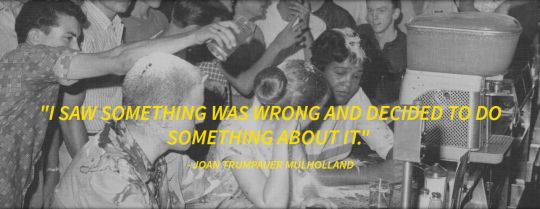
Her name is Joan Trumpauer Mulholland. Her family disowned her for her activism. After her first arrest, she was tested for mental illness, because Virginia law enforcement couldn’t think of any other reason why a white Virginian girl would want to fight for civil rights.
She also created the Joan Trumpauer Mullholland Foundation. Most recently, she was interviewed on Samatha Bee’s Full Frontal on February 15 for their segment on Black History Month.
Don’t reduce civil rights heroes to “teenage girl”.
Her great-grandparents were slave owners in Georgia, and after the United States Civil War, they became sharecroppers. Trumpauer later recalled an occasion that forever changed her perspective, when visiting her family in Georgia during summer. Joan and her childhood friend Mary, dared each other to walk into “n*gger” town, which was located on the other side of the train tracks. Mulholland stated her eyes were opened by the experience: “No one said anything to me, but the way they shrunk back and became invisible, showed me that they believed that they weren’t as good as me. At the age of 10, Joan Trumpauer began to recognize the economic divide between the races. At that moment she vowed to herself that if she could do anything, to help be a part of the Civil Rights Movement and change the world, she would.
In the spring of 1960, Mulholland participated in her first of many sit-ins. Being a white, southern woman, her civil rights activism was not understood. She was branded as mentally ill and was taken in for testing after her first arrest. Out of fear of shakedowns, Mulholland wore a skirt with a deep, ruffled hem where she would hide paper that she had crumpled until it was soft and then folded neatly. With this paper, Mulholland was able to write a diary about her experiences that still exists today. In this diary, she explains what they were given to eat, and how they sang almost all night long. She even mentioned the segregation in the jail cells and stated, “I think all the girls in here are gems but I feel more in common with the Negro girls & wish I was locked in with them instead of these atheist Yankees.
Soon after Mulholland’s release, Charlayne Hunter-Gault and Hamilton E. Holmes became the first African American students to enroll at the University of Georgia. Mulholland thought, “Now if whites were going to riot when black students were going to white schools, what were they going to do if a white student went to a black school?” She then became the first white student to enroll in Tougaloo College in Jackson, where she met Medgar Evers, Dr. Martin Luther King Jr., Reverend Ed King, and Anne Moody.
She received many letters scolding or threatening her while she was attending Tougaloo. Her parents later tried to reconcile with their daughter, and they tried to bribe her with a trip to Europe. She accepted their offer and went with them during summer vacation. Shortly after they returned, however, she went straight back to Tougaloo College.
She ultimately retired after teaching English as a Second Language for 40 years and started the Joan Trumpauer Mulholland Foundation, dedicated to educating the youth about the Civil Rights Movement and how to become activists in their own communities.
I watched a YouTube video once (by a guy who’s name escapes me) about the importance of making sure the stories of white activists are told. His point was that it’s not about lavishing praise on them just because they were white and “woke”, it’s about letting other white allies see that others have come before them who were willing to sacrifice and do the hard work. This way they can see themselves in someone and realize that destroying inequality isn’t a fringe interest or just an “us vs. them” issue. It has to be ALL OF US.
This is the perfect pet for people who want to keep a small container of water with something pretty in it. Even though it’s a plant and not a fish, it’s way cuter than a sad, cramped betta- and less maintenance, too. A marimo is perfect for that pretty aesthetic or your college dorm room. Want a mason jar aquarium? A marimo will be perfectly happy in there. Want a fishbowl with pretty rocks? Get a marimo, or even a few of them! I can’t overstate how wonderful and cute marimo are.
Reblogging this here in case anyone wants to see literally the only pet that can be humanely kept in a mason jar or a fish bowl.
even if the fraud was like 5% it wouldn’t compare to rich people cheating the system by trillions lmao
Also, SNAP “fraud” is like exchanging some of your stamps for cash to buy necessities you can’t buy with stamps, like soap or deodorant or tampons
TBH even if one hundred percent of people on food stamps were committing food stamp fraud I’d still be in favor of keeping the program around
Hey I wanna talk about this.
I work at a drug addiction counseling center. A ton of my clients have, at one time or another, sold their food stamps. This is basically exactly what the GOP is afraid of, right? Drug addicts selling their food stamps.
I have learned, now, to ask them WHY they sold their food stamps. Here is an incomplete list of the answers:
– I need tampons, and you can’t buy them with foodstamps
– See above RE: toilet paper
– I was living in a hotel with no kitchen then. I had to buy pre-prepared food
– The homeless shelter won’t let me keep food in my locker or room, so I have to buy pre-prepared food (Yes, really)
– I had to make rent
– My sister had to make rent
– My son had to make rent
– I needed co-pays to get my medication or I’ll die
– I needed co-pays to get my medication or I’ll loose control of my mental health
But the absolute most common form of food stamp fraud I see? Giving away food stamps to other family members who get no food stamps or insufficient food stamps to feed their families. I see that every month. People glassy eyed and hungry because they gave away their food to their adult kids, their grand kids, cousins, siblings etc.
So, is food stamp fraud rampant? In some places, yes. And I’m not about to chastise people for it.