Saturn’s atmosphere exhibits a banded pattern similar to Jupiter’s, but Saturn’s bands are much fainter and are much wider near the equator. The nomenclature used to describe these bands is the same as on Jupiter. Saturn’s finer cloud patterns were not observed until the flybys of the Voyager spacecraft during the 1980s. Since then, Earth-based telescopy has improved to the point where regular observations can be made. The composition of the clouds varies with depth and increasing pressure.
The winds on Saturn are the second fastest among the Solar System’s planets, after Neptune’s. Voyager data indicate peak easterly winds of 500 m/s (1,800 km/h).
Thermography has shown that Saturn’s south pole has a warm polar vortex, the only known example of such a phenomenon in the Solar System. Whereas temperatures on Saturn are normally −185 °C, temperatures on the vortex often reach as high as −122 °C, suspected to be the warmest spot on Saturn.
Credit: NASA/JPL-Caltech/Space Science Institute and Kevin M. Gill
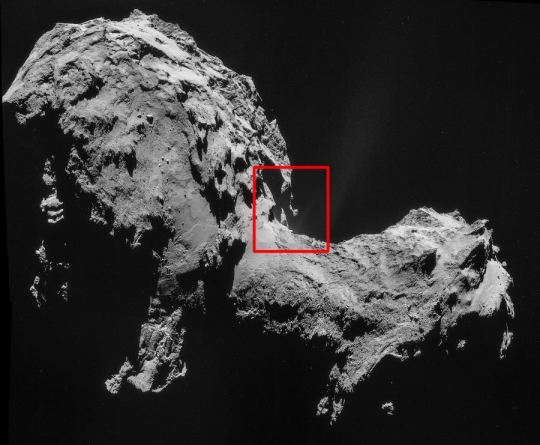
Dust, stars, and cosmic rays swirling around Comet 67P/Churyumov–Gerasimenko, captured by the Rosetta probe. (Source)
*kicks the front door in* DO YOU SEE HOW GODDAMN FUCKING COOL THIS SHIT IS
WE HAVE VIDEO. FROM THE SURFACE OF A COMET. SENT BY A ROBOT.
ROSETTA PROBE YOU’RE AMAZING WE LOVE YOU
That cliff is a kilometer high. is Here’s what you’re actually looking at:
THANK YOU
i was wondering
Not only is this shit cool as hell but you gotta realize how unbelievably remarkable of a task this is and how hard it was to pull off.
Humans managed to send a tiny hunk of metal stuffed with electronics millions and millions and millions of miles away through this hostile, airless envionent to land (without breaking it!) on the equivalent of a dirty snowball shooting though outer space
That’s like shooting a bullet from LA to London and hitting a moving target that’s only one foot across, and having the bullet survive the ordeal unscathed.
Plus! We humans developed a way to videotape and transmit pictures from this snowball in space so we know what it’s like to stand the surface.
The “Death Comet” Will Pass By Earth Just After Halloween
On October 31st, 2015, NASA tracked a strange-looking comet as it made a close flyby of Earth. This asteroid, known as 2015 TB145, was monitored by the multiple observatories and radar installation of the agency’s Deep Space Network. Because of the timing and the skull-like appearance of this asteroid, scientists nicknamed it the “Death Comet”.
Naturally, there was no reason to worry, as the asteroid posed no threat and passed within about 498,900 km (310,000 mi) of Earth. But the timing and the appearance of the comet were nothing if not chilling. And coincidentally enough, the “Death Comet” (aka. “The Great Pumpkin Comet”), will be passing Earth for the second time, this time shortly after Halloween.
“The trajectory of 2015 TB145 is well understood. At the point of closest approach, it will be no closer than about 300,000 miles — 480,000 kilometers or 1.3 lunar distances. Even though that is relatively close by celestial standards, it is expected to be fairly faint, so night-sky Earth observers would need at least a small telescope to view it.” – Paul Chodas, the manager of the Center for Near Earth Object Studies at NASA’s Jet Propulsion Laboratory
Once again, 2015 TB145 will pose no threat to life on Earth. According to the Mother Nature Network, it will make its closest pass to Earth on November 11th, reaching a distance of about 38.6 million km (24 million mi) from the surface. This is roughly one-hundred times the average distance between the Earth and the Moon (384,399 km; 238,855 mi), or a quarter of the distance between the Earth and the Sun (149.6 million km; 93 million mi).
It wrinkles my brain that Jupiter’s moon Europa has oceans that are sixty miles deep, while Earth’s oceans only reach seven miles deep at most. I’m willing to bet good money that there’s life in Europa’s oceans. Like five bucks. You hear me, NASA? I bet you five bucks that there’s life on Europa… Now that there’s money and reputation on the line, I bet they send a mission there real quick.
I have no idea when this was originally posted, but NASA is working on their Europa mission RIGHT NOW to look for alien life! But get this, they theorize that because of the depth, gravity, and composition of the oceans, any organisms that lived there would be waaay bigger than aquatic life on Earth. So far everything’s going well with regards to their Europa mission so they should have a spacecraft on its way to look for giant sea monsters in space in only a few years. (The planned date is in the early 2020s.)
Looks like my negotiations worked. You’re welcome, humanity.
I’ve never been gripped with such cold terror and pure delight in my LIFE
I’m caught between desperately wanting us to find nothing big and expecting kaiju
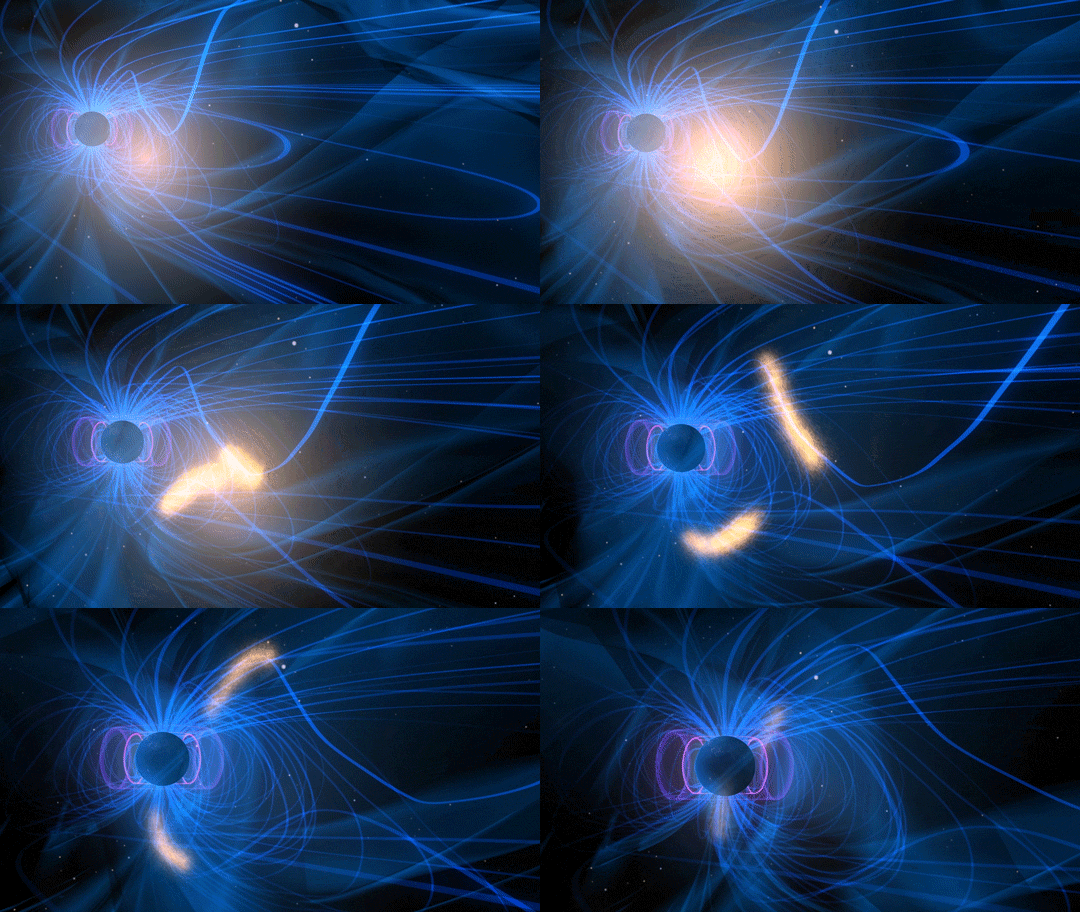
Just as gravity is one key to how things move on Earth, a process called magnetic reconnection is key to how electrically-charged particles speed through space. Now, our Magnetospheric Multiscale mission, or MMS, has discovered magnetic reconnection – a process by which magnetic field lines explosively reconfigure – occurring in a new and surprising way near Earth.
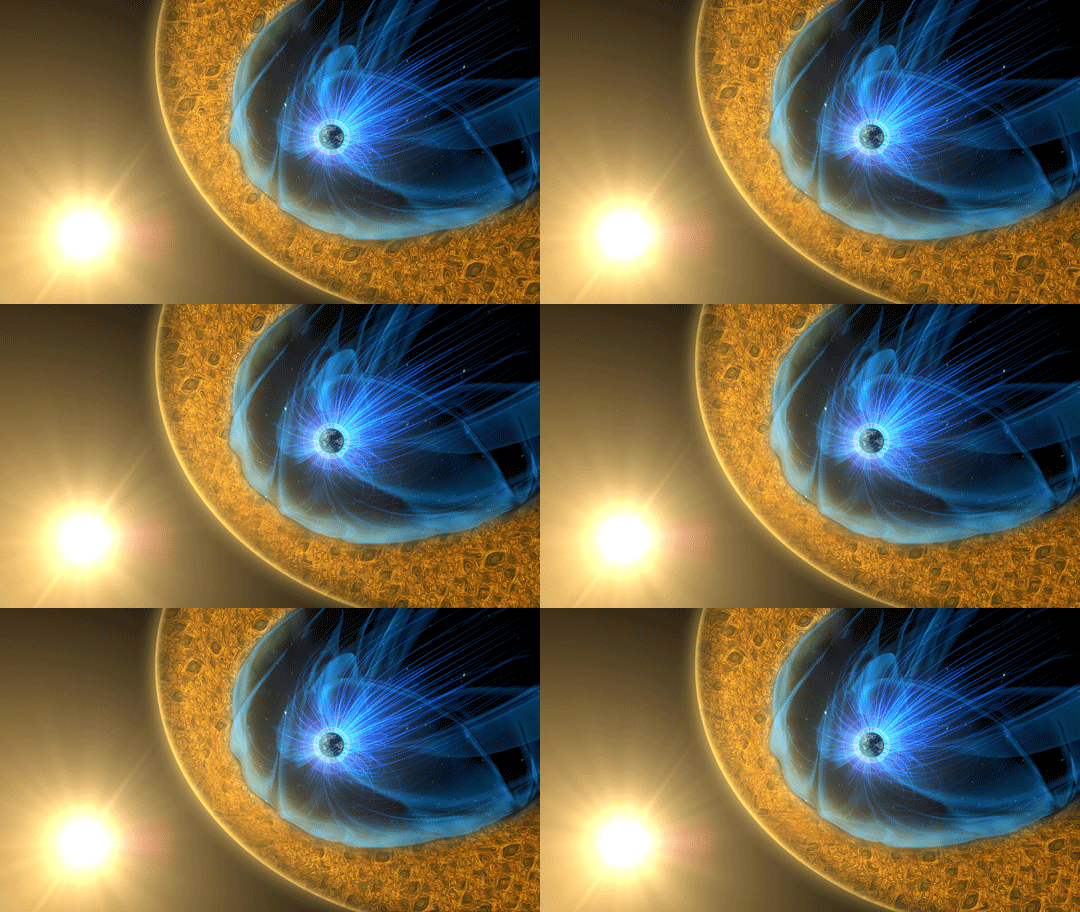
Invisible to the eye, a vast network of magnetic energy and particles surround our planet — a dynamic system that influences our satellites and technology. The more we understand the way those particles move, the more we can protect our spacecraft and astronauts both near Earth and as we explore deeper into the solar system.
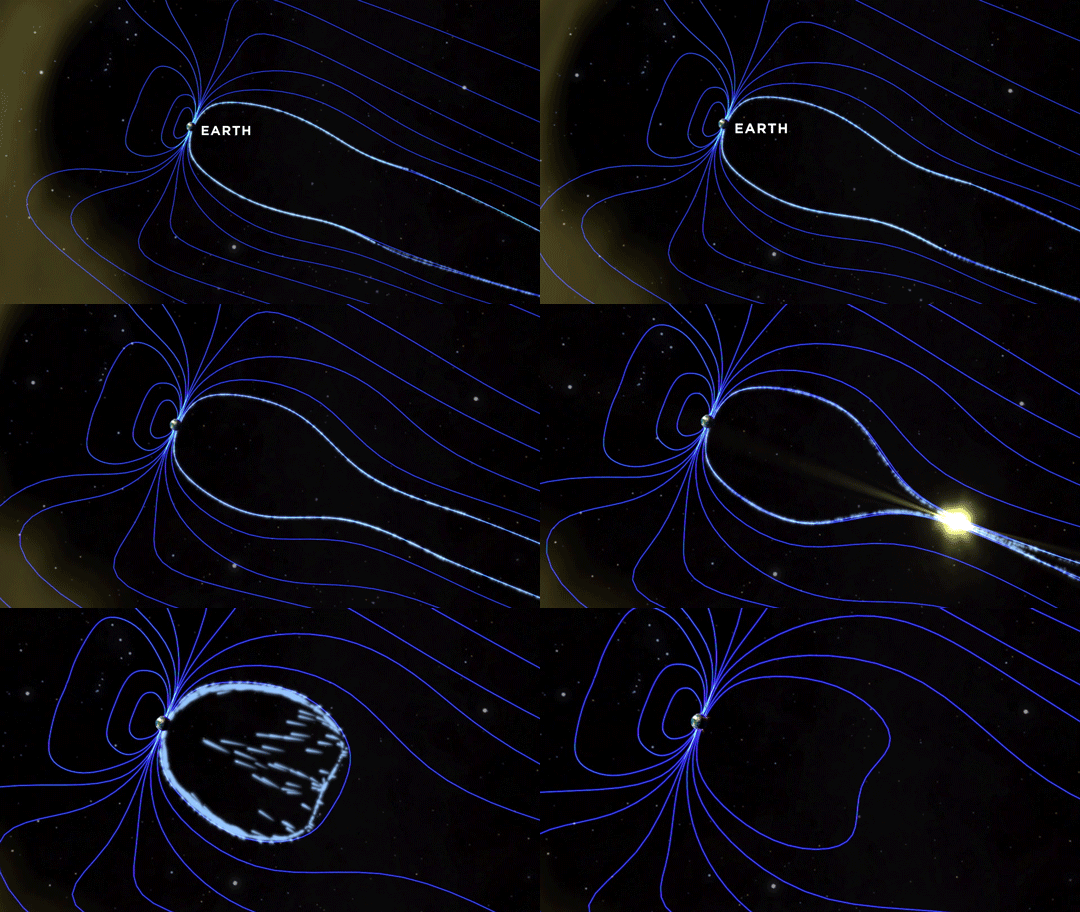
Earth’s magnetic field creates a protective bubble that shields us from highly energetic particles that stream in both from the Sun and interstellar space. As this solar wind bathes our planet, Earth’s magnetic field lines get stretched. Like elastic bands, they eventually release energy by snapping and flinging particles in their path to supersonic speeds.
That burst of energy is generated by magnetic reconnection. It’s pervasive throughout the universe — it happens on the Sun, in the space near Earth and even near black holes.
Scientists have observed this phenomenon many times in Earth’s vast magnetic environment, the magnetosphere. Now, a new study of data from our MMS mission caught the process occurring in a new and unexpected region of near-Earth space. For the first time, magnetic reconnection was seen in the magnetosheath — the boundary between our magnetosphere and the solar wind that flows throughout the solar system and one of the most turbulent regions in near-Earth space.
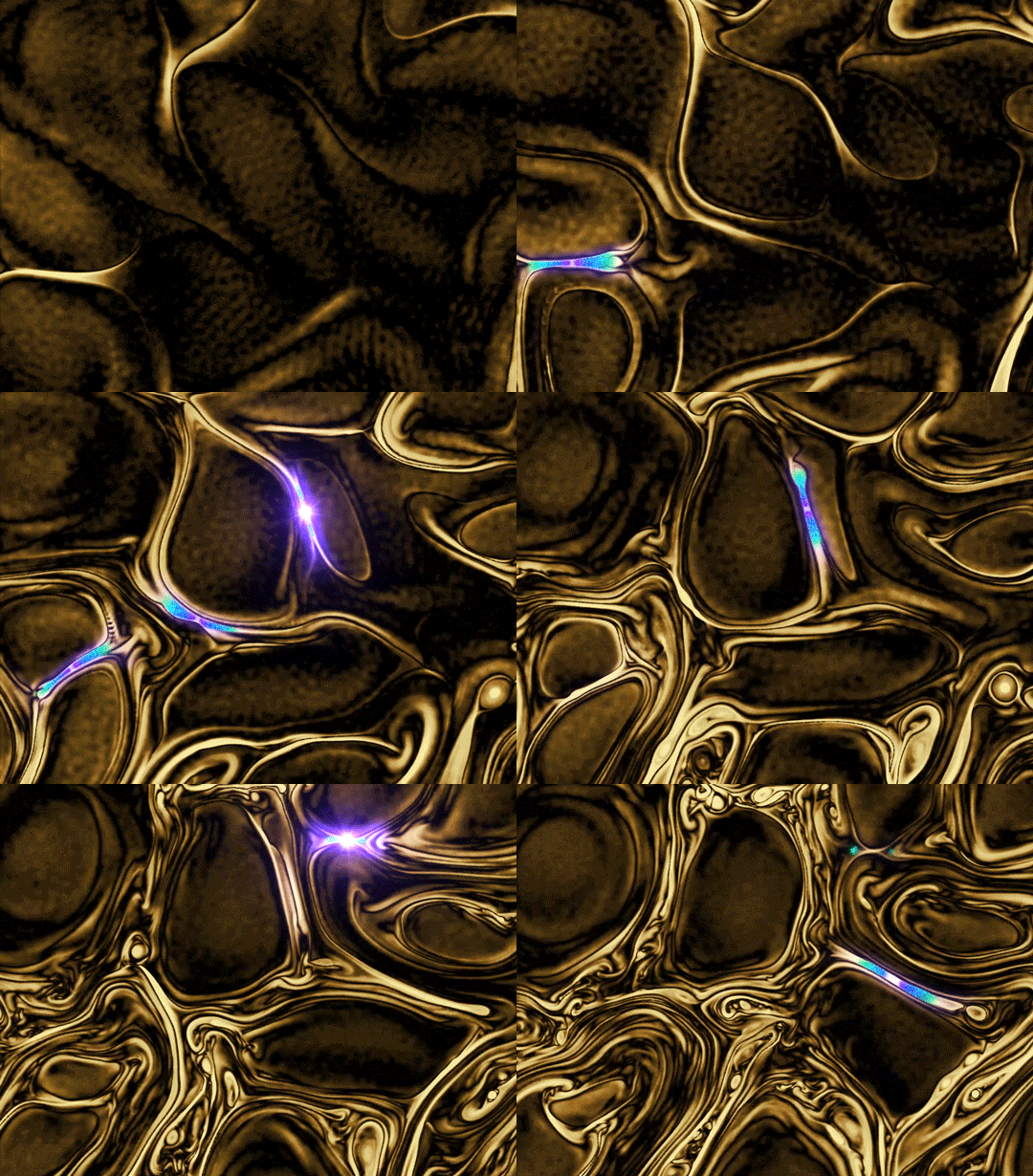
The four identical MMS spacecraft — flying through this region in a tight pyramid formation — saw the event in 3D. The arrows in the data visualization below show the hundreds of observations MMS took to measure the changes in particle motion and the magnetic field.
The data show that this event is unlike the magnetic reconnection we’ve observed before. If we think of these magnetic field lines as elastic bands, the ones in this region are much smaller and stretchier than elsewhere in near-Earth space — meaning that this process accelerates particles 40 times faster than typical magnetic reconnection near Earth. In short, MMS spotted a completely new magnetic process that is much faster than what we’ve seen before.
What’s more, this observation holds clues to what’s happening at smaller spatial scales, where turbulence takes over the process of mixing and accelerating particles. Turbulence in space moves in random ways and creates vortices, much like when you mix milk into coffee. The process by which turbulence energizes particles in space is still a big area of research, and linking this new discovery to turbulence research may give insights into how magnetic energy powers particle jets in space.
i didnt know this until rn but apparently theres things called sundogs & moondogs that are basically the halo that sometimes appears around the sun & moon
this is a sundog
and this is a moondog
this is so cool & such cute names omg?????? i love space







 rip tumblr