Astronomers have detected radio jets belonging to a neutron star with a strong magnetic field – something not predicted by current theory, according to a new study published in Nature.
The team, led by researchers at the University of Amsterdam, observed the object known as Swift J0243.6+6124 using the Karl G. Jansky Very Large Array radio telescope in New Mexico and NASA’s Swift space tel Full article
The path through the solar system is a rocky road. Asteroids, comets, Kuiper Belt Objects—all kinds of small bodies of rock, metal and ice are in constant motion as they orbit the Sun. But what’s the difference between them, anyway? And why do these miniature worlds fascinate space explorers so much? The answer is profound: they may hold the keys to better understanding where we all come from. Here’s 10 things to know about the solar system this week:
This picture of Eros, the first of an asteroid taken from an orbiting spacecraft, came from our NEAR mission in February 2000. Image credit: NASA/JPL
1. Asteroids
Asteroids are rocky, airless worlds that orbit our Sun. They are remnants left over from the formation of our solar system, ranging in size from the length of a car to about as wide as a large city. Asteroids are diverse in composition; some are metallic while others are rich in carbon, giving them a coal-black color. They can be “rubble piles,” loosely held together by their own gravity, or they can be solid rocks.
Most of the asteroids in our solar system reside in a region called the main asteroid belt. This vast, doughnut-shaped ring between the orbits of Mars and Jupiter contains hundreds of thousands of asteroids, maybe millions. But despite what you see in the movies, there is still a great deal of space between each asteroid. With all due respect to C3PO, the odds of flying through the asteroid belt without colliding with one are actually pretty good.
Other asteroids (and comets) follow different orbits, including some that enter Earth’s neighborhood. These are called near-Earth objects, or NEOs. We can actually keep track of the ones we have discovered and predict where they are headed. The Minor Planet Center (MPC) and Jet Propulsion Laboratory’s Center for Near Earth Object Studies (CNEOS) do that very thing. Telescopes around the world and in space are used to spot new asteroids and comets, and the MPC and CNEOS, along with international colleagues, calculate where those asteroids and comets are going and determine whether they might pose any impact threat to Earth.
For scientists, asteroids play the role of time capsules from the early solar system, having been preserved in the vacuum of space for billions of years. What’s more, the main asteroid belt may have been a source of water—and organic compounds critical to life—for the inner planets like Earth.
The nucleus of Comet 67P/Churyumov-Gerasimenko, as seen in January 2015 by the European Space Agency’s Rosetta spacecraft. Image credit: ESA/Rosetta/NAVCAM – CC BY-SA IGO 3.0
2. Comets
Comets also orbit the Sun, but they are more like snowballs than space rocks. Each comet has a center called a nucleus that contains icy chunks of frozen gases, along with bits of rock and dust. When a comet’s orbit brings it close to the Sun, the comet heats up and spews dust and gases, forming a giant, glowing ball called a coma around its nucleus, along with two tails – one made of dust and the other of excited gas (ions). Driven by a constant flow of particles from the Sun called the solar wind, the tails point away from the Sun, sometimes stretching for millions of miles.
While there are likely billions of comets in the solar system, the current confirmed number is 3,535. Like asteroids, comets are leftover material from the formation of our solar system around 4.6 billion years ago, and they preserve secrets from the earliest days of the Sun’s family. Some of Earth’s water and other chemical constituents could have been delivered by comet impacts.
An artist re-creation of a collision in deep space. Image credit: NASA/JPL-Caltech
3. Meteoroids
Meteoroids are fragments and debris in space resulting from collisions among asteroids, comets, moons and planets. They are among the smallest “space rocks.” However, we can actually see them when they streak through our atmosphere in the form of meteors and meteor showers.
This photograph, taken by an astronaut aboard the International Space Station, provides the unusual perspective of looking down on a meteor as it passes through the atmosphere. The image was taken on Aug. 13, 2011, during the Perseid meteor shower that occurs every August. Image credit: NASA
4. Meteors
Meteors are meteoroids that fall through Earth’s atmosphere at extremely high speeds. The pressure and heat they generate as they push through the air causes them to glow and create a streak of light in the sky. Most burn up completely before touching the ground. We often refer to them as “shooting stars.” Meteors may be made mostly of rock, metal or a combination of the two.
Scientists estimate that about 48.5 tons (44,000 kilograms) of meteoritic material falls on Earth each day.
The constellation Orion is framed by two meteors during the Perseid shower on Aug. 12, 2018 in Cedar Breaks National Monument, Utah. Image credit: NASA/Bill Dunford
5. Meteor Showers
Several meteors per hour can usually be seen on any given night. Sometimes the number increases dramatically—these events are termed meteor showers. They occur when Earth passes through trails of particles left by comets. When the particles enter Earth’s atmosphere, they burn up, creating hundreds or even thousands of bright streaks in the sky. We can easily plan when to watch meteor showers because numerous showers happen annually as Earth’s orbit takes it through the same patches of comet debris. This year’s Orionid meteor shower peaks on Oct. 21.
An SUV-sized asteroid, 2008TC#, impacted on Oct. 7, 2008, in the Nubian Desert, Northern Sudan. Dr. Peter Jenniskens, NASA/SETI, joined Muawia Shaddas of the University of Khartoum in leading an expedition on a search for samples. Image credit: NASA/SETI/P. Jenniskens
6. Meteorites
Meteorites are asteroid, comet, moon and planet fragments (meteoroids) that survive the heated journey through Earth’s atmosphere all the way to the ground. Most meteorites found on Earth are pebble to fist size, but some are larger than a building.
Early Earth experienced many large meteorite impacts that caused extensive destruction. Well-documented stories of modern meteorite-caused injury or death are rare. In the first known case of an extraterrestrial object to have injured a human being in the U.S., Ann Hodges of Sylacauga, Alabama, was severely bruised by a 8-pound (3.6-kilogram) stony meteorite that crashed through her roof in November 1954.
The largest object in the asteroid belt is actually a dwarf planet, Ceres. This view comes from our Dawn mission. The color is approximately as it would appear to the eye. Image credit: NASA/JPL-Caltech/UCLA/MPS/DLR/IDA
7. Dwarf Planets
Don’t let the name fool you; despite their small size, dwarf planets are worlds that are just as compelling as their larger siblings. Dwarf planets are defined by astronomers as bodies massive enough to be shaped by gravity into a round or nearly round shape, but they don’t have enough of their own gravitational muscle to clear their path of other objects as they orbit the Sun. In our solar system, dwarf planets are mostly found in the Kuiper Belt beyond Neptune; Pluto is the best-known example. But the largest object in the asteroid belt is the dwarf planet Ceres. Like Pluto, Ceres shows signs of active geology, including ice volcanoes.
8. Kuiper Belt Objects
The Kuiper Belt is a disc-shaped region beyond Neptune that extends from about 30 to 55 astronomical units – that is, 30 to 55 times the distance from the Earth to the Sun. There may be hundreds of thousands of icy bodies and a trillion or more comets in this distant region of our solar system.
An artist’s rendition of the New Horizons spacecraft passing by the Kuiper Belt Object MU69 in January 2019. Image credits: NASA/JHUAPL/SwRI
Besides Pluto, some of the mysterious worlds of the Kuiper Belt include Eris, Sedna, Quaoar, Makemake and Haumea. Like asteroids and comets, Kuiper Belt objects are time capsules, perhaps kept even more pristine in their icy realm.
This chart puts solar system distances in perspective. The scale bar is in astronomical units (AU), with each set distance beyond 1 AU representing 10 times the previous distance. One AU is the distance from the Sun to the Earth, which is about 93 million miles or 150 million kilometers. Neptune, the most distant planet from the Sun, is about 30 AU. Image credit: NASA/JPL-Caltech
9. Oort Cloud Objects
The Oort Cloud is a group of icy bodies beginning roughly 186 billion miles (300 billion kilometers) away from the Sun. While the planets of our solar system orbit in a flat plane, the Oort Cloud is believed to be a giant spherical shell surrounding the Sun, planets and Kuiper Belt Objects. It is like a big, thick bubble around our solar system. The Oort Cloud’s icy bodies can be as large as mountains, and sometimes larger.
This dark, cold expanse is by far the solar system’s largest and most distant region. It extends all the way to about 100,000 AU (100,000 times the distance between Earth and the Sun) – a good portion of the way to the next star system. Comets from the Oort Cloud can have orbital periods of thousands or even millions of years. Consider this: At its current speed of about a million miles a day, our Voyager 1 spacecraft won’t reach the Oort Cloud for more than 300 years. It will then take about 30,000 years for the spacecraft to traverse the Oort Cloud, and exit our solar system entirely.
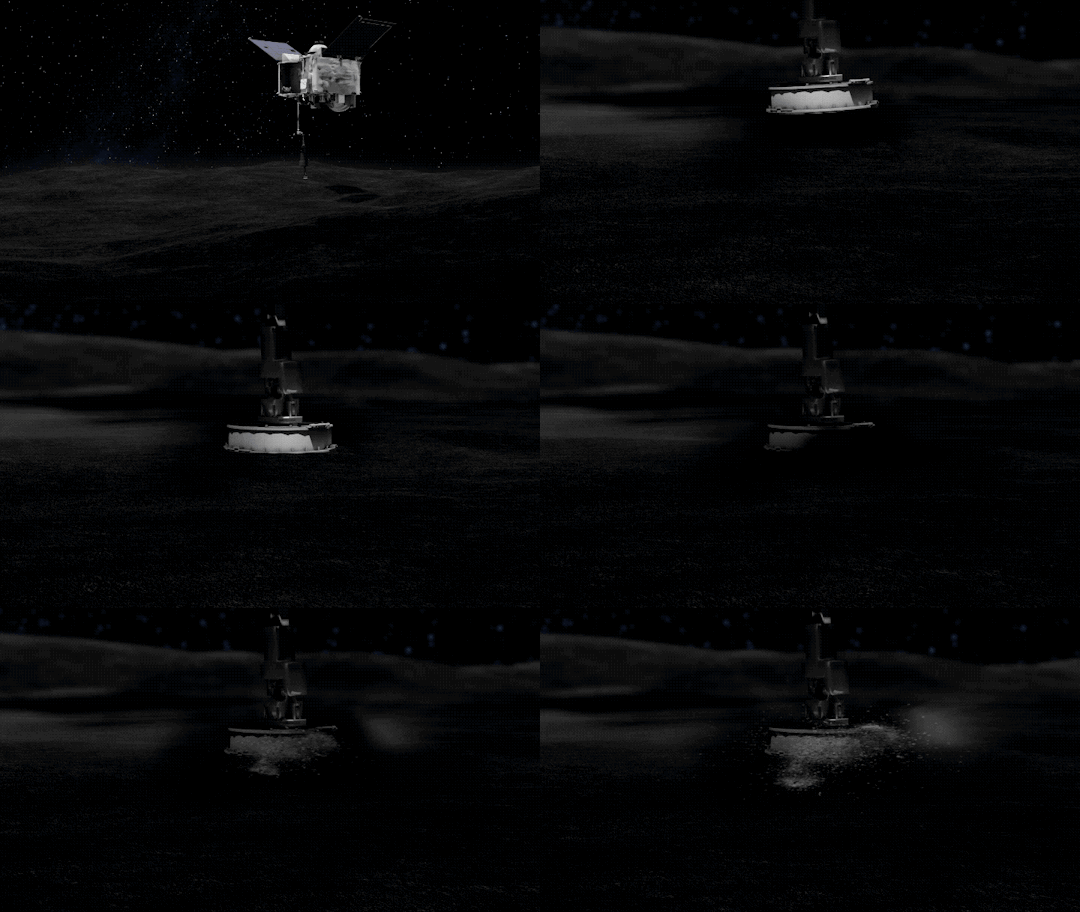
This animation shows our OSIRIS-REx spacecraft collecting a sample of the asteroid Bennu, which it is expected to do in 2020. Image credit: NASA/Goddard Space Flight Center
10. The Explorers
Fortunately, even though the Oort Cloud is extremely distant, most of the small bodies we’ve been discussing are more within reach. In fact, NASA and other space agencies have a whole flotilla of robotic spacecraft that are exploring these small worlds up close. Our mechanical emissaries act as our eyes and hands in deep space, searching for whatever clues these time capsules hold.
A partial roster of our current or recent missions to small, rocky destinations includes:
OSIRIS-REx – Now approaching the asteroid Bennu, where it will retrieve a sample in 2020 and return it to the Earth for close scrutiny.
New Horizons – Set to fly close to MU69 or “Ultima Thule,” an object a billion miles past Pluto in the Kuiper Belt on Jan. 1, 2019. When it does, MU69 will become the most distant object humans have ever seen up close.
Psyche – Planned for launch in 2022, the spacecraft will explore a metallic asteroid of the same name, which may be the ejected core of a baby planet that was destroyed long ago.
Lucy – Slated to investigate two separate groups of asteroids, called Trojans, that share the orbit of Jupiter – one group orbits ahead of the planet, while the other orbits behind. Lucy is planned to launch in 2021.
Dawn – Finishing up a successful seven-year mission orbiting planet-like worlds Ceres and Vesta in the asteroid belt.
Plus these missions from other space agencies:
The Japan Aerospace Exploration Agency (JAXA)’s Hayabusa2– Just landed a series of small probes on the surface of the asteroid Ryugu.
The European Space Agency (ESA)’s Rosetta – Orbited the comet 67P/Churyumov-Gerasimenko and dispatched a lander to its surface.
Make sure to follow us on Tumblr for your regular dose of space: http://nasa.tumblr.com.
Look again at that dot. That’s here. That’s home. That’s us. On it everyone you love, everyone you know, everyone you ever heard of, every human being who ever was, lived out their lives. The aggregate of our joy and suffering, thousands of confident religions, ideologies, and economic doctrines, every hunter and forager, every hero and coward, every creator and destroyer of civilization, every king and peasant, every young couple in love, every mother and father, hopeful child, inventor and explorer, every teacher of morals, every corrupt politician, every “superstar,” every “supreme leader,” every saint and sinner in the history of our species lived there–on a mote of dust suspended in a sunbeam.
The Earth is a very small stage in a vast cosmic arena. Think of the rivers of blood spilled by all those generals and emperors so that, in glory and triumph, they could become the momentary masters of a fraction of a dot. Think of the endless cruelties visited by the inhabitants of one corner of this pixel on the scarcely distinguishable inhabitants of some other corner, how frequent their misunderstandings, how eager they are to kill one another, how fervent their hatreds.
Our posturings, our imagined self-importance, the delusion that we have some privileged position in the Universe, are challenged by this point of pale light. Our planet is a lonely speck in the great enveloping cosmic dark. In our obscurity, in all this vastness, there is no hint that help will come from elsewhere to save us from ourselves.
The Earth is the only world known so far to harbor life. There is nowhere else, at least in the near future, to which our species could migrate. Visit, yes. Settle, not yet. Like it or not, for the moment the Earth is where we make our stand.
It has been said that astronomy is a humbling and character-building experience. There is perhaps no better demonstration of the folly of human conceits than this distant image of our tiny world. To me, it underscores our responsibility to deal more kindly with one another, and to preserve and cherish the pale blue dot, the only home we’ve ever known.
sometimes i laugh b/c like. when we first started exploring astronomy, we used our own solar system as a reference, b/c well. it was the closest thing we could study, right? it only makes sense.
only it turns out that the more we study the universe we find that things that are incredibly common in other solar stystems–like binary/trinary star systems, super-earths, hot jupiters, etc, are completely absent from our system
so like. the more we learn about the universe, the more we realize that it’s not just the earth that’s out of the norm, it’s our entire solar system that’s weird compared to the rest of the known universe
From Washington, D.C., the rings would only fill a portion of the sky, but appear striking nonetheless. Here, we see them at sunrise.
From Guatemala, only 14 degrees above the equator, the rings would begin to stretch across the horizon. Their reflected light would make the moon much brighter.
From Earth’s equator, Saturn’s rings would be viewed edge-on, appearing as a thin, bright line bisecting the sky.
At the March and September equinoxes, the Sun would be positioned directly over the rings, casting a dramatic shadow at the equator.
At midnight at the Tropic of Capricorn, which sits at 23 degrees south latitude, the Earth casts a shadow over the middle of the rings, while the outer portions remain lit.
A 3D mapping model of a chunk of the universe – 380,000 laser-etched dots in a glass sphere each represent a galaxy, and the diameter is 800 million lightyears.(Source)
We out here creating a lil mini universes and shit
We’re going to talk about some of the amazing new things NICER is showing us about black holes. But first, let’s talk about black holes — how do they work, and where do they come from? There are two important types of black holes we’ll talk about here: stellar and supermassive. Stellar mass black holes are three to dozens of times as massive as our Sun while supermassive black holes can be billions of times as massive!
Stellar black holes begin with a bang — literally! They are one of the possible objects left over after a large star dies in a supernova explosion. Scientists think there are as many as a billion stellar mass black holes in our Milky Way galaxy alone!
Supermassive black holes have remained rather mysterious in comparison. Data suggest that supermassive black holes could be created when multiple black holes merge and make a bigger one. Or that these black holes formed during the early stages of galaxy formation, born when massive clouds of gas collapsed billions of years ago. There is very strong evidence that a supermassive black hole lies at the center of all large galaxies, as in our Milky Way.
Imagine an object 10 times more massive than the Sun squeezed into a sphere approximately the diameter of New York City — or cramming a billion trillion people into a car! These two examples give a sense of how incredibly compact and dense black holes can be.
Because so much stuff is squished into such a relatively small volume, a black hole’s gravity is strong enough that nothing — not even light — can escape from it. But if light can’t escape a dark fate when it encounters a black hole, how can we “see” black holes?
Scientists can’t observe black holes directly, because light can’t escape to bring us information about what’s going on inside them. Instead, they detect the presence of black holes indirectly — by looking for their effects on the cosmic objects around them. We see stars orbiting somethingmassive but invisible to our telescopes, or even disappearing entirely!
When a star approaches a black hole’s event horizon — the point of no return — it’s torn apart. A technical term for this is “spaghettification” — we’re not kidding! Cosmic objects that go through the process of spaghettification become vertically stretched and horizontally compressed into thin, long shapes like noodles.
Scientists can also look for accretion disks when searching for black holes. These disks are relatively flat sheets of gas and dust that surround a cosmic object such as a star or black hole. The material in the disk swirls around and around, until it falls into the black hole. And because of the friction created by the constant movement, the material becomes super hot and emits light, including X-rays.
At last — light! Different wavelengths of light coming from accretion disks are something we can see with our instruments. This reveals important information about black holes, even though we can’t see them directly.
So what has NICER helped us learn about black holes? One of the objects this instrument has studied during its time aboard the International Space Station is the ever-so-forgettably-named black hole GRS 1915+105, which lies nearly 36,000 light-years — or 200 million billion miles — away, in the direction of the constellation Aquila.
Scientists have found disk winds — fast streams of gas created by heat or pressure — near this black hole. Disk winds are pretty peculiar, and we still have a lot of questions about them. Where do they come from? And do they change the shape of the accretion disk?
It’s been difficult to answer these questions, but NICER is more sensitive than previous missions designed to return similar science data. Plus NICER often looks at GRS 1915+105 so it can see changes over time.
NICER’s observations of GRS 1915+105 have provided astronomers a prime example of disk wind patterns, allowing scientists to construct models that can help us better understand how accretion disks and their outflows around black holes work.
NICER has also collected data on a stellar mass black hole with another long name — MAXI J1535-571 (we can call it J1535 for short) — adding to information provided by NuSTAR, Chandra, and MAXI. Even though these are all X-ray detectors, their observations tell us something slightly different about J1535, complementing each other’s data!
This rapidly spinning black hole is part of a binary system, slurping material off its partner, a star. A thin halo of hot gas above the disk illuminates the accretion disk and causes it to glow in X-ray light, which reveals still more information about the shape, temperature, and even the chemical content of the disk. And it turns out that J1535’s disk may be warped!
Image courtesy of NRAO/AUI and Artist: John Kagaya (Hoshi No Techou)
This isn’t the first time we have seen evidence for a warped disk, but J1535’s disk can help us learn more about stellar black holes in binary systems, such as how they feed off their companions and how the accretion disks around black holes are structured.
NICER primarily studies neutron stars — it’s in the name! These are lighter-weight relatives of black holes that can be formed when stars explode. But NICER is also changing what we know about many types of X-ray sources. Thanks to NICER’s efforts, we are one step closer to a complete picture of black holes. And hey, that’s pretty nice!
Make sure to follow us on Tumblr for your regular dose of space: http://nasa.tumblr.com.
Remember Rosetta? That comet-chasing European Space Agency (ESA) probe that deployed (and accidentally bounced) its lander Philae on the surface of Comet 67P? This GIF is made up of images Rosetta beamed back to Earth, which have been freely available online for a while. But it took Twitter user landru79 processing and assembling them into this short, looped clip to reveal the drama they contained.
while the stuff in the foreground is dust/ice on the surface of the comet itself, the background is actually stars. i saw a stabilized video where you can really make it out, and it blew my mind.






 rip tumblr