CERN – European Organization for Nuclear Research logo.
31 Aug 2018
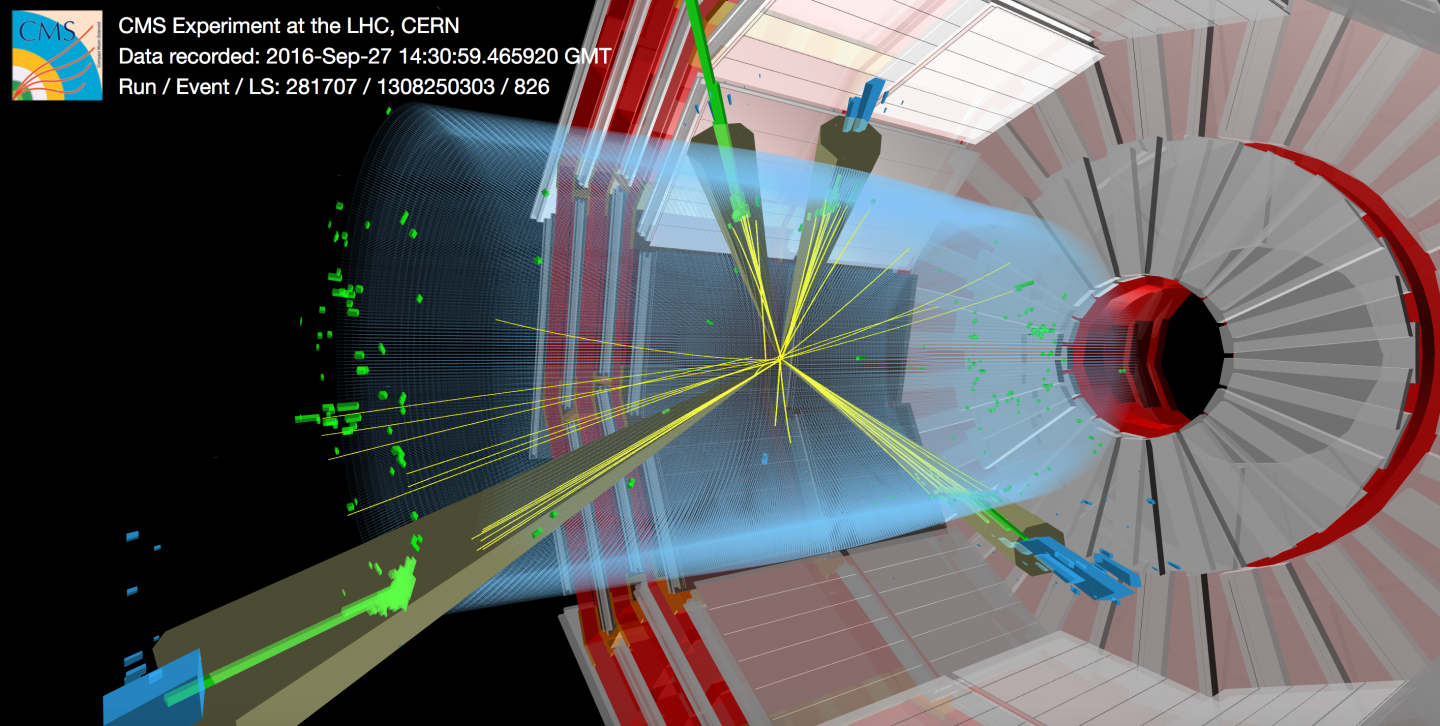
A proton–proton collision event with two emerging-jet candidates. (Image: CMS/CERN)
Quarks are the smallest particles that we know of. In fact, according to the Standard Model of particle physics, which describes all known particles and their interactions, quarks should be infinitely small. If that’s not mind-boggling enough, enter dark quarks – hypothetical particles that have been proposed to explain dark matter, an invisible form of matter that fills the universe and holds the Milky Way and other galaxies together.
In a recent study, the CMS collaboration describes how it has sifted through data from the Large Hadron Collider (LHC) to try and spot dark quarks. Although the search came up empty-handed, it allowed the team to inch closer to the parent particles from which dark quarks may originate.
One compelling theory extends the Standard Model to explain why the observed mass densities of normal matter and dark matter are similar. It does so by invoking the existence of dark quarks that interact with ordinary quarks via a mediator particle. If such mediator particles were produced in pairs in a proton–proton collision, each mediator particle of the pair would transform into a normal quark and a dark quark, both of which would produce a spray, or “jet”, of particles called hadrons, composed of quarks or dark quarks. In total, there would be two jets of regular hadrons originating from the collision point, and two “emerging” jets that would emerge a distance away from the collision point because dark hadrons would take some time to decay into visible particles.
In their study, the CMS researchers looked through data from proton–proton collisions collected at the LHC at an energy of 13 TeV to search for instances, or “events”, in which such mediator particles and associated emerging jets might occur. They used two distinguishing features to identify emerging jets and pick them out from a background of events that are expected to mimic their traits.
Large Hadron Collider (LHC). Animation Credit: CERN
The team found no strong evidence for the existence of such emerging jets, but the data allowed them to exclude masses for the hypothetical mediator particle of 400–1250 GeV for dark pions that travel for lengths between 5 and 225 mm before they decay. The results are the first from a dedicated search for such mediator particles and jets.
Note:
CERN, the European Organization for Nuclear Research, is one of the world’s largest and most respected centres for scientific research. Its business is fundamental physics, finding out what the Universe is made of and how it works. At CERN, the world’s largest and most complex scientific instruments are used to study the basic constituents of matter — the fundamental particles. By studying what happens when these particles collide, physicists learn about the laws of Nature.
The instruments used at CERN are particle accelerators and detectors. Accelerators boost beams of particles to high energies before they are made to collide with each other or with stationary targets. Detectors observe and record the results of these collisions.
Founded in 1954, the CERN Laboratory sits astride the Franco–Swiss border near Geneva. It was one of Europe’s first joint ventures and now has 22 Member States.
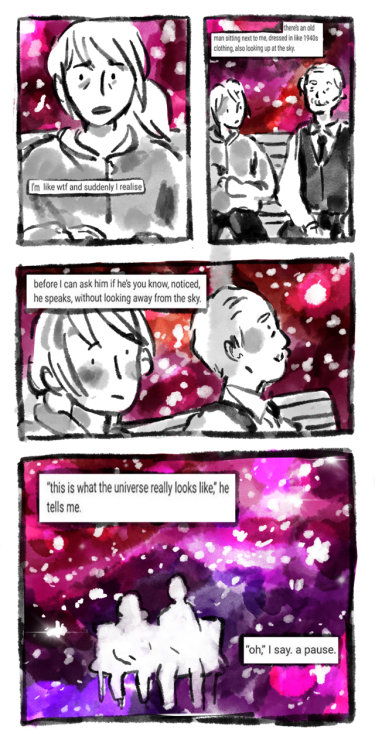
I just had this hyper-realistic dream and like. I don’t even know what to make of this lmao
I was sitting in this park, on a bench, looking up at the night sky and all the stars and stuff, and I blinked and suddenly the entire sky was different. I’m talking different constellations, the sky absolutely packed with billions more stars, some so close they’re massive. I’m like wtf and suddenly I realise there’s an old man sitting next to me, dressed in like 1940s clothing, also looking up at the sky.
before I can ask him if he’s you know, noticed, he speaks, without looking away from the sky.
“this is what the universe really looks like,” he tells me.
“oh,” I say. a pause. “…can you put it back?”
he smiles and nods. I look up. the sky has gone back to normal.
“what do I do with this information?” I ask, looking at him again.
he turns his head and, smiling, looks me dead in the face. "be careful.“
Johnson is an black American mathematician who’s work with orbital mechanics proved critical to the success of early NASA missions. Her work included calculating trajectories, launch windows, and emergency return paths for Project Mercury, the rendezvous paths for the Apollo Command and Lunar Module on it’s trip to the Moon, and her work was pivotal during the development of the Space Shuttle program.
She was initially hired on at the National Advisory Committee for Aeronautics (NACA) as a human computer, but her knowledge of analytic geometry helped her move up to an aerospace technologist. Once NACA was folded into NASA in 1958, Johnson worked in the Spacecraft Controls Branch, and she was often called by management to verify electronic computations.
In 2015, she was awarded the Presidential Medal of Freedom by President Barack Obama for her instrumental work with NASA. In 2016, a brand new building at NASA’s Langley Research Center in Hampton, Virginia, was named after her. The Katherine G. Johnson Computational Research Facility began operations in 2017.
Shrouded in a thick atmosphere, Saturn’s largest moon Titan really is hard to see. Small particles suspended in the upper atmosphere cause an almost impenetrable haze, strongly scattering light at visible wavelengths and hiding Titan’s surface features from prying eyes. But Titan’s surface is better imaged at infrared wavelengths where scattering is weaker and atmospheric absorption is reduced. Arrayed around this centered visible light image of Titan are some of the clearest global infrared views of the tantalizing moon so far. In false color, the six panels present a consistent processing of 13 years of infrared image data from the Visual and Infrared Mapping Spectrometer (VIMS) on board the Cassini spacecraft. They offer a stunning comparison with Cassini’s visible light view.
Here’s a nice photo of our home, Earth and it’s good ole friend the moon, I suppose, the other half of our system.
Although we see our moon nightly and observe it’s daily effects on our tides, I think I can be forgiven for saying that we didn’t really grow to appreciate the relationship between the Moon and Earth until we set foot on it in 1969. So, it’s nice to have a photo of them together.
Taken by NASA’s Juno spacecraft in 2011, we see Earth on the left and the Moon on the right. The image was taken when the spacecraft was around 9.66 million kilometres away; a long way from home.
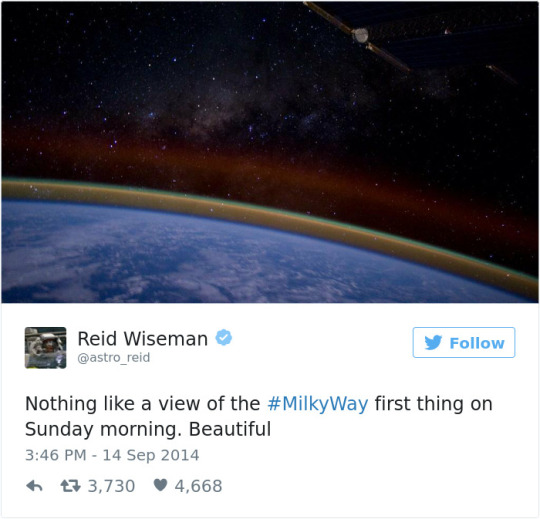
Captured here in this picturesque photo, mountain peaks in northern Italy poke through Earth’s water clouds and come between them and the Milky Way’s star clouds. High above the mountains, and far in the distance, dark dust lanes streak out from the central plane of our Milky Way Galaxy. The stars and dust are dotted with bright red clouds of glowing hydrogen gas, such as the Lagoon Nebula just above and to the left of center.
“Though my soul may set in darkness, it will rise in perfect light; I have loved the stars too fondly to be fearful of the night.”
A little doodle for one the most beautiful lines from any poem, The Old Astronomer.
This is not a little doodle. This. THIS. This is fucking MAGIC. You have captured pure wonder and whimsy and romance and bliss and that almost melancholy wholeness when you look up at the sky and just feel the smallness of your being and the grandness of the universe. All this captured with a lover’s eye. We cannot see her face but I feel the tender passionate ardour for this petite but mighty creature in the world. While at the same time I feel the bittersweet swoon of wanting to be gazed upon myself with such whole and overwhemling admiration and love. It is goddamn masterful.
I am fucking following your tumblr charliebowater you are amazing.
do tell me more about this lunar eclipse what’s up w it
Astronomically it’s a big deal because it’s going to last for a few hours, which is a lot longer than most eclipses last (plus it’s a blood moon!) but in a spiritual/astrological sense, it’s important because during a lunar eclipse, we essentially experience an entire moon cycle in the span of one day. The moon will be completely full, New, and full again within the eclipse. A lot of people may be experiencing a ton of tension in their lives right now; overly intense emotions, feeling lost or out of touch with their lives, meaningless drama and conflict with friends and family, or just a general sense of “nothing is right and everything is falling apart.” This is because right now, the universe wants to push and burn through all of the stagnant, unused, pent up energy being held within our lives. This eclipse won’t just start a new chapter, but for many of us it will begin an entirely new way of life. We’re clearing out the old to make room for an incredible array of new things to come! At the start of the leo season, we’re gearing up to leave behind what no longer helps us, and beginning to search for and find what will. If you’ve been wanting to quit an addiction, leave a relationship, change career paths or take up an intimidating new passion, this is the time to do it! If you’ve been waiting for a sign to do something big and bold, the full moon and it’s eclipse will provide a great wave of change on which to do so. That’s just what I’m feeling anyways
















 rip tumblr