The native Maori people of New Zealand have tattooed their faces for centuries. They had a complex warrior culture before the arrival of Europeans, and suffered under early colonialism, but have experienced a cultural revival since the 60′s.
The marks are called moko, and are etched with chisels instead of needles to leave grooves along with the ink. The true form is sacred, unique to each person, and distinct from European tattoos that mimic that traditional style.
There arent many pictures non combat related that look this badass
Actually most
Tā moko are done with modern tattoo equipment these days, but some people get them done the traditional way. And, as others have said, they’re not for Non-
Māori, as they have specific meanings and significance. If you want a tattoo with Māori
style, you can get a
kirituhi. These avoid any designs associated with particular tribes or famous people you’re not related to.
Kirituhi is a Māori style tattoo either made by a non-Māori tattooer, or made for a non-Māori wearer. Kirituhi has mana of it’s own and is a design telling the unique story of the wearer in the visual language of Māori art and design. Kiri means ‘skin’, and tuhi means ‘to write, draw, record, adorn or decorate with painting’.
Kirituhi is not restricted to only Māori people, and it is a way for Māori to share our cultural arts with people from around the world in a respectful manner, and for non-Māori artists to enjoy our beautiful art form as well. I happily do kirituhi for my clients around the world and it is a privilege to do such work for them.
Kirituhi is no lesser an artform than moko, however it is different and I believe these differences must be acknowledged and respected, so that the integrity of our taonga Māori – moko, is maintained around the world.
Moko is uniquely Māori and it is strictly reserved to be done by Māori, for Māori.
If either the recipient or tattooer do not have Māori whakapapa, then the resulting design is a Māori Style tattoo or kirituhi, NOT moko. The word moko originated from the Māori atua (god) of volcanic activity and earthquakes, Rūaumoko – therefore the origin of tā moko is divine and sacred – to me this is no small thing, nor should it be dismissed.
As my mentor once told me, ‘moko is about 99% culture, and 1% tattoo’.
*disassociates while playing rhythm game and somehow gets a perfect score*
yeah it’s called the Rhythm Game Trance State and it’s guaranteed to get you a Perfect score but only if you lose 90% of your awareness of the surrounding universe and float off into another dimension while your hands remain in the material world to break lose all hell on a poor game controller
and god forbid you get Aware again in the middle of your combo because your brain will try to take over and it will do a shit job of it
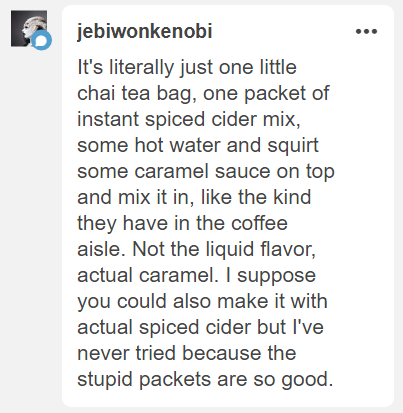
Once upon a time I worked in this little burger/coffee/ice cream shop and a lady came in one winter and asked if we had a caramel apple drink and we were like ‘well we have cider’ and she was like ‘no I don’t remember what it’s called but this place made a drink that was chai tea, apple cider, and caramel’ and Breezy offered to try and make something for her but she changed her mind and left so Breezy and I were like ‘alright let’s try this’ because we had chai tea, instant cider mix, a shit ton of caramel, instant hot water from the espresso and too much free time.
And let me tell you it was delightful. It tastes like watching the leaves changing color and dancing in the wind. It tastes like picking out pumpkins and gourds and fresh apples at the farm up north. It tastes like witches and freedom.
I make it every year now and this year I walked in the house on the morning of October first with all the ingredients and shouted ‘FALL DRINK’ and my roommates were like ‘????’ so I made them Fall Drink and now every time they get home from work they’re like ‘Fall Drink pls?????’
Anyway I remember literally nothing else about that woman but I’m very grateful to her.
for anyone wondering about proportions/etc here’s op’s answer from the repiles:


 rip tumblr