I always find it kind of weird that matriarchal cultures in fiction are always “women fight and hunt, men stay home and care for the babies” because world-building-wise, it makes no sense
think about it. like, assuming that gender even works the same in this fantasy culture as it does in ours, with gender conflated with sex (because let’s be real, all of these stories assume that), men wouldn’t be the ones to make the babies, so why would they be the ones to care for the babies? why is fighting and hunting necessary for leadership?
writing a matriarchy this way is just lazy, because you’re just taking the patriarchy and just swapping the people in it, rather than actually swapping the culture. especially when there are so many other cool things you could explore. like, what if it’s not a swap of roles but of what society deems important?
maybe a matriarchy would have hunting and fighting be part of the man’s job, but undervalued. like taking the trash out or cleaning toilets: necessary, but gross, and not noble or interesting. maybe farming is now the most important thing, and is given a lot of spiritual and cultural weight.
how would law work? what crimes would exist, and what things would be considered too trivial to make illegal? who gets what property? why?
how would religion work? how would you mark time or the passage into adulthood? what would marriage look like? if bloodlines are through the mother, bastardy wouldn’t even be a concept – how does that work?
what qualities would be most important in a person? how would you define strength or leadership? what knowledge would be the most coveted and protected? what acts or roles are considered useless or degrading?
like, you can’t just take our current society and say you’re turning it on its head when you’re just regurgitating it wholesale. you have to really think about why things are the way they are and change that.
This is a lesson a lot of us have to learn about our writing. It’s never as bad as we think it is, and sometimes we just need to take some time away from it to find that out.
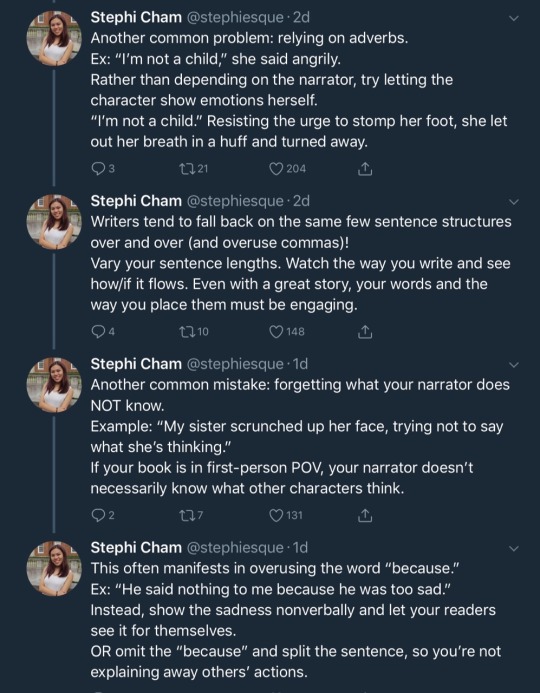
This. This is good fiction writing advice. I really appreciate how it was formatted as “this is a common problem, here is a solution to try in your own work” and not “oh god, don’t do that!” without any extra help. And I extra appreciated the “don’t rely on adverbs” bit, because they do have their place but they aren’t the only way actions can be emphasized.
We got a few questions about gangs versus organized crime, and what the difference is. So, I figured we’d do a follow up post about gangs. (The Wiki article about gangs rolls organized crime in with them which is… not accurate, they’re organized, yes, but different beasts.)
The main difference between gangs and organized crime is time. If the street gang survives, it grows up to become organized crime. They’re the Lost Boys in the interim stages before they grow up to become the Pirates. The gang is the proto phase of organized crime, the beginnings of the group before it’s become entrenched. Most Mafia/Mobs do find their original roots in street gangs before they grew up into professional enterprises. The main difference between the Mob and the Gang is the Mob has had time grow, develop, and learn from previous experiences.
The way to think about “organized crime” like the Triad, the American Mafias, the Yakuza, and others like is that they’re a criminal enterprise. They’re a business, and this is where Russian organized crime meets up with the Mafias. The heads of these organizations are like CEOs, and they function almost exactly like any other corporation except their working outside the law in human trafficking, drugs, etc. This includes stealing fashion designs and using sweatshop labor to sell cheap knock offs as an industry, which is something the Triad does. “Organized crime” is money moving to the tune of billions as international business versus the most enterprising of the street gangs which may own, maybe, a city.
Easy difference, the Black Mafia family sells drugs. The Cartels produce drugs, and sell them, and they sometimes contract out to street/motorcycle gangs. This is the pharmaceutical company versus your local pharmacy versus a single location Mom & Pop shop. The street gang is Mom & Pop. The older well-established gangs that’ve been around for forty to fifty years are the Rite-Aids. The Triad are Bayer. Given time, and assuming they survive to adulthood, the gang can hit the big time and own some place like Las Vegas before moving on to bigger and better. That takes time though, and they’ve got to grow up first. There are quite a few gangs moving toward, if they haven’t already become, organized criminal enterprises. The Bloods and the Crips are close, the Black Mafia, and MS13 is aggressively pursuing its transition into criminal enterprise. It might be tempting to lean toward the cartels or mafias for the sense of legitimacy they bring to the narrative, not to mention the romantic relationship some groups have with fiction.
The Gang is rougher, but much more suited to any narrative involving teens and about growing up. Let’s face it, the gang is the angry teenage phase of organized crime. They’re the dark side of found families, they’re messier, and they will stress characters with themes of brotherhood/sisterhood, respect, loyalty, co-dependency, and the meaning of family in ways you won’t get from an organized businesses because they weed that shit out. They don’t have time for your angst. The Gang, though? They thrive on emotional narratives about brutality, trauma, broken bonds, and shattered friendships. They’re about getting in over your head from the word go; before you ever learned how to swim and long before you’re ever given the chance.
The Lost Boys
Gangs form in marginalized communities that are not protected by the bureaucracy of the ruling government. Their purpose, their beginning purpose, is to protect. Their originating goal is to provide security and safety to their communities, to protect them from outsiders, and they recruit on that honorable ideal. Any community which is treated as “Other” runs the risk of creating not one gang but multiples. The behavior and culture of the gang is dependent on the culture of its participants, before the gang develops a culture of its own, their ideals, their beliefs, their views come fractured through the eyes of disenfranchised youth. They combine with a teenager’s volatile emotions and impulsivity.
The main draw of the gangs is sense of family they offer, the brotherhood. They primarily exert influence on young, disaffected, lonely neglected youth with absentee parents. In plain terms, they hunt up Latch Keys. These can be impoverished children from single-parent households whose older family members work so hard to put food on the table they can’t be there, the ones from white-collar households in a similar boat, those whose parents genuinely don’t care, those from abusive homes, and came out of a similar life. The key theme is the offer of stability, purpose, guidance, and open to influence by the gang. The gang offers the child or teen the love, attention, and guidance they crave, but at a price.
You know all those tell-tale warnings you got about peer-pressure? This is peer-pressure reworked into targeted social engineering.
A character’s initiation into a gang is an act of violence. Sometimes, it’s a beating. Sometimes, it’s a murder. Sometimes, the initiated murderer is thirteen years old. And, yes, the street gang is where you’ll find that sixteen year old hitman who was recruited out of elementary school and started running drugs at nine or ten years old. They’re not “professional” in the conventional sense, but they go out to perform hits and the resulting collateral damage is often very messy.
There’s more emotional depth here than “just business”. Leaving the gang is a betrayal of the brotherhood, betrayal of the family. Killing can be seen as retribution, to claim turf, get respect, exert authority, or protect from invaders.
A major theme for gang characters is exerting their identity through violence, establishing themselves as adults, and lashing out at cultures/societies/institutions that they feel have rejected/failed them.
They’ve turned to the only figures in their lives they feel understand them, the older members of their gang. The relationship between gang members is elder sibling and younger sibling rather than the patron-client, mentor/student, parent/child relationships you’d find in gangs with organized crime.
The sort of “send a message” brutality you get out gangs, the behavior, the emotion, and the thematic resonance they have with coming of age stories is, I think, what most of our followers are really asking for whenever they ask about the Mob. It’s worth exploring the romantic aspects of the gang, what they offer, and why they so easily lure young people in.
This is a writing advice blog. I’m going to take this last part to talk about how you can use gangs in your narratives. First…
To write crime, you must understand crime.
Understanding crime requires understanding the culture which spawns the crimes, the society, and the laws of the world your character exists in. You can’t break a rule if you don’t understand the rules. Right? If your reader doesn’t understand the rules of your setting, they won’t understand the impact of your character breaking with them.
Spend as much time on your lawfuls as your chaotics, if not more.
To write the gang, you must understand the necessity and purpose of the gang.
You need to walk a mile in someone else’s shoes. The pressures of their world, the loneliness of it, and the desire to have someone, anyone, who understands them. The intoxicating effect of fear, how inflicting fear makes you feel powerful, and the need to exert control in an overwhelming world where your environment is wildly spinning out of your grasp.
If you want to write a character who exists in the criminal underworld, and never spent any time looking at the criminals in question then you will come up short. I understand that it’s not a comfortable subject to research.
Romanticization station…
“The Gang” as a narrative trope lacks the prestige and legitimacy brought by more established organizations such as “The Mafia”. With youth, however, comes flexibility. Rogues living outside the system, renegades struggling to make it in a world overwhelmingly weighted against them, Band of Brothers, Rebel Without A Cause, Protect the Family, Paint the Town Red, and all your James Dean tropes can be applied to and claimed by gang members.
For your narrative, it’s always worth looking at the romanticized aspects of gang life because those tropes are often embraced and used as justifications by the gang members themselves. They’re also good recruiting tools.
With youth comes opportunity…
Where the greater adult world won’t take an underage character seriously, the gang will. Where a group like the American Mafia will turn up their nose at a sixteen year old hitman because they’ve already got a kid who acted as a courier, parked their cars, and went into the military to get the skills they needed, the gang will give the sixteen year old the chance to prove themselves and couch the hit as an opportunity for advancement.
They also see murder as a means of binding the gang member to the gang, even incarceration is a means of binding them tighter into the family. They care a little less about the character getting pinched. They might expect it. After all, everyone mucks things up that first time and most gang members have felt the weight of the juvenile justice system. Better to make the big mistakes while you’re still young so you can do better next time. Well, you can do better if you survive on the inside.
I got harder, I got smarter in the nick of time…
Take a hard look at your character, their motivations, their experiences, and how those resulted in the actions they’ve taken. They’re in a situation rife with manipulation and betrayal, where they’ll be pressured to take actions they may not feel comfortable with. Caught in an inevitable cycle of escalation where the violence they commit in the name of their brotherhood/sisterhood becomes more and more brutal, where they need to do more and more to prove themselves, are motivated to do so by advancing up the chain of command. Breaking this cycle is difficult.
In conclusion:
I’ve gone on long enough, and this post got longer than I intended. Gangs are a subject you can write whole books on and not even scratch the surface of. We’re probably not done with this subject, but if you want a teen criminal then the likelihood is that they’re in or have been involved in or, at least, aware of their local gangs to varying degrees. Your narrative should always have more than one, some run by kids, some run by older teens, some run by adults, and so on. You want to research the history of gangs, the current famous gangs that exist, and so on. The answers won’t always be easy or easily digestible. They’re not quick.
if your fictional discrimination is predicated on the marginalized community doing something to “deserve” its marginalization, you automatically fail any commentary on, or application of your story to, real-life oppression
“The Xingbarts started a war with us and now we Gurbits all hate them!” FAIL.
“Nurts are a legitimate, powerful threat if they aren’t denied basic rights!” FAIL.
“In the past, the Snorfals were our oppressors, so now we oppress them!” FAIL.
oppressors will certainly use any means at their disposal – including logic, science, religion, history, and philosophy – to justify oppression. “women are just physically incapable of learning, that’s why we can’t let them attend university!” “black people are divinely ordained by God to be our slaves!” “the jews control all the banks, that’s why we have to kill them!”
but it’s never real! it’s never actually valid! the whole point of oppression is that it’s completely arbitrary! there is no “reason” no matter how hard you try!
if you try to inject “grey areas” by making your fictional discrimination justified, you have fundamentally failed to understand how it works in real life
of course, that doesn’t mean you can’t have grey areas in your writing. there’s all sorts of actual grey areas in real life you can draw on: intracommunity issues, different ways the oppression is applied to different groups, internalized oppression, different philosophies within the group on the way to combat it
but none of those are “well actually oppression makes sense because reasons!”
Albert: Arabic, al-bara’at, “the salvation” Alexander: Greek, a+lex+ander, “a man without law”, popular among anarchists Alfred: Arabic, al-fareed, “the unique” Allison: Greek, “have mercy upon us” Bailey: Hebrew, “my master”, cf Hosea 2:16 Benedict: ben+edict, “son of the laws”, popular among statists Benjamin: ben+jamon, “son of Ham”, popular among Hamitic peoples Brooke: Hebrew, “blessed” Cassandra: kaas+ander, “cheese-man” Cathleen: Anglicization of “Cthulhuian”, popular among Cthulhu cultists. Cf. Christian Celia: small hair-like protrusion used in bacterial motion Cooper: short for “cooperator”, eg in prisoners dilemmas Cynthea: from sin+theos, “one who is without God”, popular among atheists Demi: short for “Demiurge” Derek: Hebrew, “path” Devin: “godlike” Emmett: Hebrew, “truth” Felicia: “catlike” Gerald: “a verb used as a noun” Godfrey: “one who is without God”, cf. Cynthea Isaiah: from iso+Yah, “one who is equal to God”, cf Devin Jacqueline: “one who is like a jackal”, cf. Felicia Jeb: short for “John Ellis Bush” Jeffrey: from Yah+free, “one who is without God”, cf. Godfrey and Cynthea Jermaine: “relevant” Jessie: short for “John Ellis Bush”, cf. Jeb Jezebel: short for “John Ellis Bush”, cf. Jeb, Jessie Karen: from ka+ren, “benevolent soul” Katarina: Japanese form of Cathleen Kinsley: eg Feanor Megan: Greek, “great” Monique: mono+unique, emphatic form of “unique”. Nevaeh: Hebrew, “prophetess” Percy: short for “pursuer”. Cf. Hunter and Chase Rayleigh: see “Riley” Raymond: from rei+mundi, form of “rex mundi”, “king of the world”, cf. Demi Riley: Anglicization of “R’lyeh”; popular among Cthulhu cultists. Cf. Cathleen Samantha: sam+anthros, “half a man” Savannah: short for “Savonarola”, famous Florentine monk Valerie: “one who is like the Valar”
Ha, I was just talking about this the other day with an editor friend, weird.
It depends largely on what kind of relationship I have with the author, and whether this is someone coming to me for in depth editing and consult, or someone who states outright all they want is a final line proof.
Most of my clients at the moment, tend to be people who come to me and go “I don’t know what the heck I’m doing please god help me!”, at which point I explain what kind of services I can provide.
For some of them, the idea that you can have an editor go back with you from scratch is a new concept. Developmental editing is not something they are aware of, and for many it comes as a relief to have someone go “actually upon reviewing this, I can see what you are going for, but if you are open to suggestions, I think you could expand upon [AWESOME FEATURE] by pursuing this”
(Which is why charging a reading fee is paramount to understanding what you are getting into before you agree to a project.) (Also shout out to the people who help me do this with Phangs, because yes, this happens to all of us.)
Which means you still get to give your input, but you’re not just taking away the manuscript from the author and fixing it for them like a frustrated parent taking over the diorama because it’s just easier to do it yourself.
That’s not what your job is.
Your job is to help the author be the best they can be, and sometimes that will involve a little hand holding. And occasionally a bout of tough love when you need to convince the author that while this is a scene/moment they are fond of, it’s hindering their dialogue/plot/character development. Some things belong in the character drafts to better help the author get a feel for the character. That doesn’t mean the reader needs to see all of it. Those moments can be hard to realize on your own.
When I want to suggest this type of editing, I am very open and up front about how much it will cost, but stress that I am willing to work with the author over X amount of weeks/offer discounts/payment plans, to achieve this goal, because I want to see them succeed.
Some people think it’s a money grab on my part, but most recognize it for what it is—a professional offering their experienced opinion and skills for a price, which in theory, the author should recoup from the increased sales their work will garner from being an overall better finished piece.
Those who think it’s a money grab, will usually also be offended by the idea that their work as is, is imperfect and needs that kind of attention. They don’t want you for that, you’re just supposed to fix the spelling, how dare you suggest their baby is flawed etc etc etc. Those are people I don’t want to work with anyway, so I wish them well and decline to work with them. I have other clients who need my time and are happy for my attention to detail in their work.
Others will simply say “no thanks but can you still fix the typos?” in which case, yea sure, I’ll do a basic proof. A gig’s a gig.
It might rankle at my personal sensibilities to let something “imperfect” go out into the world, but *shrug* what you think of as bad might be gold to someone else. I sit and correct the grammar of famous published authors in my head while reading sometimes. That doesn’t mean the book is bad, it just means it’s not my style.
And it’s important to realize when something is bad, vs when something is simply not your cup of tea.
I’m fortunate in that I’m a consummate mimic. It’s something I’ve always been somewhat able to do when it comes to writing and was able to hone it over the years. It made me a valuable asset for when it came to ghostwriting. But it also means you’ll rarely see the seams between where the author begins and the editing ends in a book I’ve worked on. (Sometimes it’s obvious and incredibly jarring, and that is bad editing.)
A lot of bad editors don’t or can’t do this. In their head they are right, right, right and if you deviate from what they deem to be a good style, you’re a Bad Writer. Which is just blatantly not true in a lot of cases.
If you can’t style match, or the style is too jarring for you to work with, then this is not a job for you. Be honest and tell them that, and if you can, maybe suggest someone you think will work well for them.
There will also just be instances where something is a minefield of problems, and it’s up to you whether you want to put the time and energy into unraveling it all.
Learning not to take on work is also a vital part of retaining your professional sanity and energy, particularly in freelance where it sometimes feels like you have to take any and all jobs you can get your hands on just to keep afloat. Trust me, I’ve worked on things I hated just to pay the bills, but I did so, hopefully, with detached and inoffensive professionalism. I’m very fortunate to find myself in a position where I can occasionally decline work if it seems like it’s going to be too much of a struggle just to make something legible.
The Four Horsemen of the Apocalypse face off against embodiments of the Seven Deadly Sins
War comes for Wrath and Envy. All they long for, all they can’t have, all they hate is at the other end of the gun they run towards, and they go down.
Starvation comes for Greed and Gluttony. When you hoard and hoard and hoard, and eat until you can eat no more, one day there is no more, and that brings them down.
Pestilence comes for Lust and Sloth. Disease carries off he who forever pines for other people, passed through the bodies he longs for, but disease also carries off he who will not lift a finger to escape him, and they both go down.
Pride is left alone on the battlefield, and faces his own opponent.
“Ha! I knew I would get the best one! None of the others could beat me!” Pride gloats loudly to Death, standing across the field. Death waits quietly.
Pride cannot bear the silence. “What? Aren’t you going to attack me? Aren’t you going to say anything? Does it take that little to cower you into submission?”
Pride looks incredulously across the field, but it takes him a few seconds to realise that the pale figure before him is quietly laughing. He steps back, but becomes aware of the three figures at his back as Death starts to speak.
“Pride, I don’t even need to deign to attack you. You did that yourself. Any of the four of us could bring you down, true, but you played the biggest part in letting us do that.”
“But… how?!” Pride says as the other three force him to his knees. “Tell me!”
Death gets down from his horse, walks over with quiet steps, and draws a simple iron knife. He kneels in front of Pride, draws the dagger across his throat, and then gets up and returns to his steed, muttering the answer to himself.
“You brought yourself down by not helping your friends. You brought yourself down by thinking you could take us on alone.”
Sticking a landing will royally fuck up your joints and possibly shatter your ankles, depending on how high you’re jumping/falling from. There’s a very good reason free-runners dive and roll.
Hand-to-hand fights usually only last a matter of seconds, sometimes a few minutes. It’s exhausting work and unless you have a lot of training and history with hand-to-hand combat, you’re going to tire out really fast.
Arrows are very effective and you can’t just yank them out without doing a lot of damage. Most of the time the head of the arrow will break off inside the body if you try pulling it out, and arrows are built to pierce deep. An arrow wound demands medical attention.
Throwing your opponent across the room is really not all that smart. You’re giving them the chance to get up and run away. Unless you’re trying to put distance between you so you can shoot them or something, don’t throw them.
Everyone has something called a “flinch response” when they fight. This is pretty much the brain’s way of telling you “get the fuck out of here or we’re gonna die.” Experienced fighters have trained to suppress this. Think about how long your character has been fighting. A character in a fist fight for the first time is going to take a few hits before their survival instinct kicks in and they start hitting back. A character in a fist fight for the eighth time that week is going to respond a little differently.
ADRENALINE WORKS AGAINST YOU WHEN YOU FIGHT. THIS IS IMPORTANT. A lot of times people think that adrenaline will kick in and give you some badass fighting skills, but it’s actually the opposite. Adrenaline is what tires you out in a battle and it also affects the fighter’s efficacy – meaning it makes them shaky and inaccurate, and overall they lose about 60% of their fighting skill because their brain is focusing on not dying. Adrenaline keeps you alive, it doesn’t give you the skill to pull off a perfect roundhouse kick to the opponent’s face.
Swords WILL bend or break if you hit something hard enough. They also dull easily and take a lot of maintenance. In reality, someone who fights with a sword would have to have to repair or replace it constantly.
Fights get messy. There’s blood and sweat everywhere, and that will make it hard to hold your weapon or get a good grip on someone.
A serious battle also smells horrible. There’s lots of sweat, but also the smell of urine and feces. After someone dies, their bowels and bladder empty. There might also be some questionable things on the ground which can be very psychologically traumatizing. Remember to think about all of the character’s senses when they’re in a fight. Everything WILL affect them in some way.
If your sword is sharpened down to a fine edge, the rest of the blade can’t go through the cut you make. You’ll just end up putting a tiny, shallow scratch in the surface of whatever you strike, and you could probably break your sword.
ARCHERS ARE STRONG TOO. Have you ever drawn a bow? It takes a lot of strength, especially when you’re shooting a bow with a higher draw weight. Draw weight basically means “the amount of force you have to use to pull this sucker back enough to fire it.” To give you an idea of how that works, here’s a helpful link to tell you about finding bow sizes and draw weights for your characters. (CLICK ME)
If an archer has to use a bow they’re not used to, it will probably throw them off a little until they’ve done a few practice shots with it and figured out its draw weight and stability.
People bleed. If they get punched in the face, they’ll probably get a bloody nose. If they get stabbed or cut somehow, they’ll bleed accordingly. And if they’ve been fighting for a while, they’ve got a LOT of blood rushing around to provide them with oxygen. They’re going to bleed a lot.
Here’s a link to a chart to show you how much blood a person can lose without dying. (CLICK ME)
If you want a more in-depth medical chart, try this one. (CLICK ME)
Hopefully this helps someone out there. If you reblog, feel free to add more tips for writers or correct anything I’ve gotten wrong here.
How to apply Writing techniques for action scenes:
– Short sentences. Choppy. One action, then another. When there’s a lull in the fight, take a moment, using longer phrases to analyze the situation–then dive back in. Snap, snap, snap. – Same thing with words – short, simple, and strong in the thick of battle. Save the longer syllables for elsewhere. – Characters do not dwell on things when they are in the heat of the moment. They will get punched in the face. Focus on actions, not thoughts. – Go back and cut out as many adverbs as possible. – No seriously, if there’s ever a time to use the strongest verbs in your vocabulary – Bellow, thrash, heave, shriek, snarl, splinter, bolt, hurtle, crumble, shatter, charge, raze – it’s now. – Don’t forget your other senses. People might not even be sure what they saw during a fight, but they always know how they felt. – Taste: Dry mouth, salt from sweat, copper tang from blood, etc – Smell: OP nailed it – Touch: Headache, sore muscles, tense muscles, exhaustion, blood pounding. Bruised knuckles/bowstring fingers. Injuries that ache and pulse, sting and flare white hot with pain. – Pain will stay with a character. Even if it’s minor. – Sound and sight might blur or sharpen depending on the character and their experience/exhaustion. Colors and quick movements will catch the eye. Loud sounds or noises from behind may serve as a fighter’s only alert before an attack. – If something unexpected happens, shifting the character’s whole attention to that thing will shift the Audience’s attention, too. – Aftermath. This is where the details resurface, the characters pick up things they cast aside during the fight, both literally and metaphorically. Fights are chaotic, fast paced, and self-centered. Characters know only their self, their goals, what’s in their way, and the quickest way around those threats. The aftermath is when people can regain their emotions, their relationships, their rationality/introspection, and anything else they couldn’t afford to think or feel while their lives were on the line.
Do everything you can to keep the fight here and now. Maximize the physical, minimize the theoretical. Keep things immediate – no theories or what ifs.
If writing a strategist, who needs to think ahead, try this: keep strategy to before-and-after fights. Lay out plans in calm periods, try to guess what enemies are thinking or what they will do. During combat, however, the character should think about his options, enemies, and terrain in immediate terms; that is, in shapes and direction. (Large enemy rushing me; dive left, circle around / Scaffolding on fire, pool below me / two foes helping each other, separate them.)
Lastly, after writing, read it aloud. Anyplace your tongue catches up on a fast moving scene, edit. Smooth action scenes rarely come on the first try.
More for martial arts or hand-to-hand in general
What a character’s wearing will affect how they fight. The more restricting the clothes, the harder it will be. If they’re wearing a skirt that is loose enough to fight in, modesty will be lost in a life or death situation.
Jewelry can also be very bad. Necklaces can be grabbed onto. Bracelets also can be grabbed onto or inhibit movement. Rings it can depend on the person.
Shoes also matter. Tennis shoes are good and solid, but if you’re unused to them there’s a chance of accidentally hurting your ankle. High heels can definitely be a problem. However, they can also make very good weapons, especially for someone used to balancing on the balls of their feet. Side kicks and thrusting kicks in soft areas (like the solar plexus) or the feet are good ideas. They can also (hopefully) be taken off quickly and used as a hand weapon. Combat boots are great but if someone relies more on speed or aren’t used to them, they can weigh a person down. Cowboy boots can be surprisingly good. Spin kicks (if a character is quick enough to use them) are especially nasty in these shoes.
If a character is going to fight barefoot, please keep location in mind. Concrete can mess up your feet quick. Lawns, yards, etc often have hidden holes and other obstacles that can mess up a fighter. Tile floors or waxed wood can be very slippery if you’re not careful or used to them.
Likewise, if it’s outside be aware of how weather will affect the fight. The sun’s glare can really impede a fighter’s sight. A wet location, inside or outside, can cause a fighter to slip and fall. Sweat on the body can cause a fighter to lose a grip on an opponent too.
Pressure points for a trained fighter are great places to aim for in a fight. The solar plexus is another great place to aim for. It will knock the wind out of anyone and immediately weaken your opponent.
It your character is hit in the solar plexus and isn’t trained, they’re going down. The first time you get hit there you are out of breath and most people double over in confusion and pain. If a fighter is more used to it, they will stand tall and expand themselves in order to get some breath. They will likely keep fighting, but until their breath returns to normal, they will be considerably weaker.
Do not be afraid to have your character use obstacles in their environment. Pillars, boxes, bookshelves, doors, etc. They put distance between you and an opponent which can allow you to catch your breath.
Do not be afraid to have your character use objects in their environment. Someone’s coming at you with a spear, trident, etc, then pick up a chair and get it caught in the legs or use it as a shield. Bedsheets can make a good distraction and tangle someone up. Someone’s invading your home and you need to defend yourself? Throw a lamp. Anything can be turned into a weapon.
Guns often miss their targets at longer distances, even by those who have trained heavily with them. They can also be easier to disarm as they only shoot in one direction. However, depending on the type, grabbing onto the top is a very very bad idea. There is a good likelihood you WILL get hurt.
Knives are nasty weapons by someone who knows what they’re doing. Good fighters never hold a knife the way you would when cutting food. It is best used when held against the forearm. In defense, this makes a block more effective and in offense, slashing movement from any direction are going to be bad. If a character is in a fight with a knife or trying to disarm one, they will get hurt.
Soft areas hit with hard body parts. Hard areas hit with soft body parts. The neck, stomach, and other soft areas are best hit with punches, side kicks, elbows, and other hard body parts. Head and other hard parts are best hit using a knife hand, palm strike, etc. Spin kicks will be nasty regardless of what you’re aiming for it they land.
Common misconception with round house kicks is that you’re hitting with the top of the foot. You’re hitting with the ball. You’re likely to break your foot when hitting with the top.
When punching, the thumb is outside of the fist. You’ll break something if you’re hitting with the thumb inside, which a lot of inexperienced fighters do.
Also, punching the face or jaw can hurt.
It can be hard to grab a punch if you’re not experienced with it despite how easy movies make it seem. It’s best to dodge or redirect it.
Hitting to the head is not always the best idea. It can take a bit of training to be able to reach for the head with a kick because of the height. Flexibility is very much needed. If there are problems with their hips or they just aren’t very flexible, kicks to the head aren’t happening.
Jump kicks are a good way to hit the head, but an opponent will see it coming if it’s too slow or they are fast/experienced.
A good kick can throw an opponent back or knock them to the ground. If the person you’ve hit has experience though, they’ll immediately be getting up again.
Even if they’ve trained for years in a martial art, if they haven’t actually hit anything before or gotten hit, it will be slightly stunning for the person. It does not feel the way you expect it too.
Those yells in martial arts are not just for show. If done right, they tighten your core making it easier to take a hit in that area. Also, they can be used to intimidate an opponent. Yelling or screaming right by their ear can startle someone. (Generally, KHR fans look at Squalo for yelling)
Biting can also be used if someone’s grabbing you. Spitting in someone’s eyes can’t hurt. Also, in a chokehold or if someone is trying to grab your neck in general, PUT YOU CHIN DOWN. This cuts off access and if they’re grabbing in the front can dig into their hand and hurt.
Wrist grabs and other grabs can be good. Especially if it’s the first move an opponent makes and the character is trained, there are simple ways to counter that will have a person on their knees in seconds..
Use what your character has to their advantage. If they’re smaller or have less mass, then they’ll be relying on speed, intelligence, evasion, and other similar tactics. Larger opponents will be able to take hits better, they’re hits may be slower depending on who it is but will hurt like hell if they land, and size can be intimidating. Taller people with longer legs will want to rely on kicking and keeping their distance since they have the advantage there. Shorter people will want to keep the distance closer where it’s easier for them but harder for a taller opponent. Punching is a good idea.
Using a person’s momentum against them is great. There’s martial arts that revolve around this whole concept. They throw a punch? Grab it and pull them forward and around. Their momentum will keep them going and knock them off balance.
Leverage can used in the same way. If used right, you can flip a person, dislocate a shoulder, throw out a knee, etc.
One note on adrenaline: All that was said above is true about it. But, in a fight, it can also make you more aware of what’s going on. A fight that lasts twenty seconds can feel like a minute because time seems to almost slow down while moving extremely rapidly. You only have so much time to think about what you’re doing. You’re taking in information constantly and trying to adjust. Even in the slow down adrenaline gives you, everything is moving very rapidly.
Feelings will be your downfall even more so than adrenaline. Adrenaline can make those feelings more intense, but a good fighter has learned not to listen to those feelings. A good fighter may feel anger at being knocked down or in some way humiliated – their pride taken down. Yet they will not act on the anger. Acting on it makes a fighter more instinctive and many will charge without thinking. Losing control of anything (adrenaline rush, emotions, technique, etc) can be a terrible thing in a fight.

 rip tumblr