I always find it kind of weird that matriarchal cultures in fiction are always “women fight and hunt, men stay home and care for the babies” because world-building-wise, it makes no sense
think about it. like, assuming that gender even works the same in this fantasy culture as it does in ours, with gender conflated with sex (because let’s be real, all of these stories assume that), men wouldn’t be the ones to make the babies, so why would they be the ones to care for the babies? why is fighting and hunting necessary for leadership?
writing a matriarchy this way is just lazy, because you’re just taking the patriarchy and just swapping the people in it, rather than actually swapping the culture. especially when there are so many other cool things you could explore. like, what if it’s not a swap of roles but of what society deems important?
maybe a matriarchy would have hunting and fighting be part of the man’s job, but undervalued. like taking the trash out or cleaning toilets: necessary, but gross, and not noble or interesting. maybe farming is now the most important thing, and is given a lot of spiritual and cultural weight.
how would law work? what crimes would exist, and what things would be considered too trivial to make illegal? who gets what property? why?
how would religion work? how would you mark time or the passage into adulthood? what would marriage look like? if bloodlines are through the mother, bastardy wouldn’t even be a concept – how does that work?
what qualities would be most important in a person? how would you define strength or leadership? what knowledge would be the most coveted and protected? what acts or roles are considered useless or degrading?
like, you can’t just take our current society and say you’re turning it on its head when you’re just regurgitating it wholesale. you have to really think about why things are the way they are and change that.
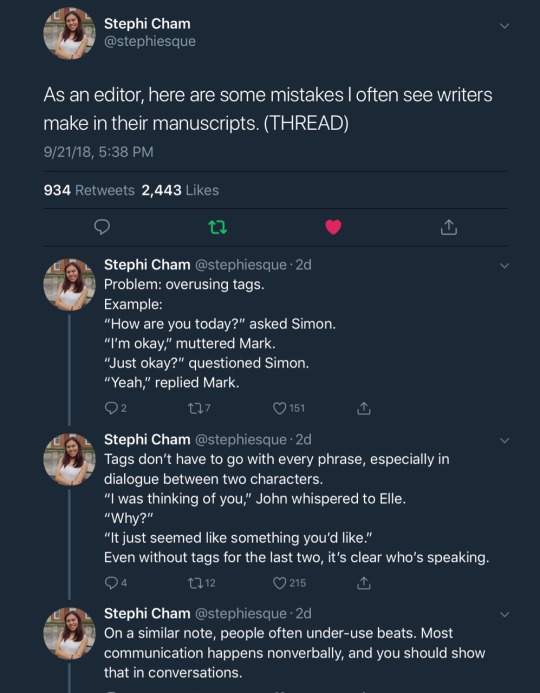
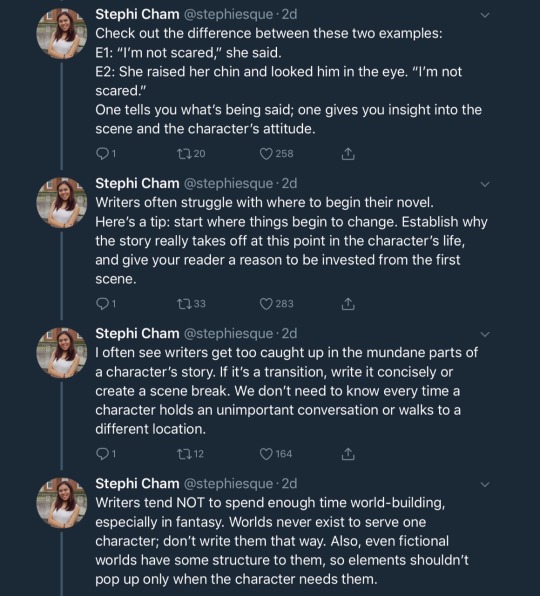
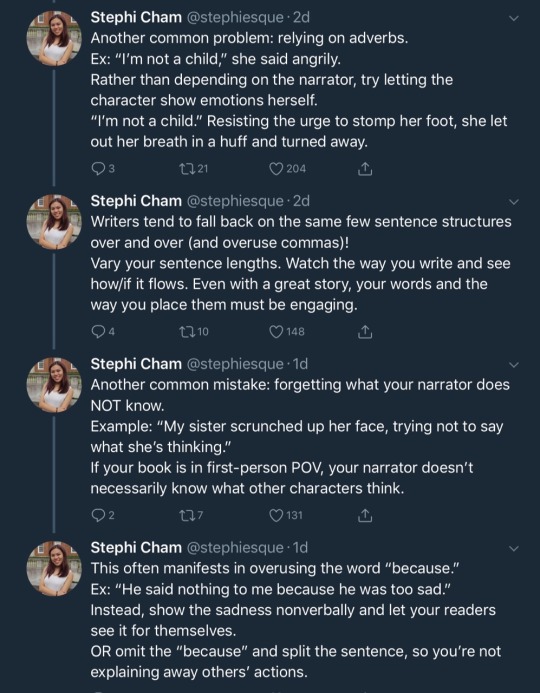
This. This is good fiction writing advice. I really appreciate how it was formatted as “this is a common problem, here is a solution to try in your own work” and not “oh god, don’t do that!” without any extra help. And I extra appreciated the “don’t rely on adverbs” bit, because they do have their place but they aren’t the only way actions can be emphasized.
We got a few questions about gangs versus organized crime, and what the difference is. So, I figured we’d do a follow up post about gangs. (The Wiki article about gangs rolls organized crime in with them which is… not accurate, they’re organized, yes, but different beasts.)
The main difference between gangs and organized crime is time. If the street gang survives, it grows up to become organized crime. They’re the Lost Boys in the interim stages before they grow up to become the Pirates. The gang is the proto phase of organized crime, the beginnings of the group before it’s become entrenched. Most Mafia/Mobs do find their original roots in street gangs before they grew up into professional enterprises. The main difference between the Mob and the Gang is the Mob has had time grow, develop, and learn from previous experiences.
The way to think about “organized crime” like the Triad, the American Mafias, the Yakuza, and others like is that they’re a criminal enterprise. They’re a business, and this is where Russian organized crime meets up with the Mafias. The heads of these organizations are like CEOs, and they function almost exactly like any other corporation except their working outside the law in human trafficking, drugs, etc. This includes stealing fashion designs and using sweatshop labor to sell cheap knock offs as an industry, which is something the Triad does. “Organized crime” is money moving to the tune of billions as international business versus the most enterprising of the street gangs which may own, maybe, a city.
Easy difference, the Black Mafia family sells drugs. The Cartels produce drugs, and sell them, and they sometimes contract out to street/motorcycle gangs. This is the pharmaceutical company versus your local pharmacy versus a single location Mom & Pop shop. The street gang is Mom & Pop. The older well-established gangs that’ve been around for forty to fifty years are the Rite-Aids. The Triad are Bayer. Given time, and assuming they survive to adulthood, the gang can hit the big time and own some place like Las Vegas before moving on to bigger and better. That takes time though, and they’ve got to grow up first. There are quite a few gangs moving toward, if they haven’t already become, organized criminal enterprises. The Bloods and the Crips are close, the Black Mafia, and MS13 is aggressively pursuing its transition into criminal enterprise. It might be tempting to lean toward the cartels or mafias for the sense of legitimacy they bring to the narrative, not to mention the romantic relationship some groups have with fiction.
The Gang is rougher, but much more suited to any narrative involving teens and about growing up. Let’s face it, the gang is the angry teenage phase of organized crime. They’re the dark side of found families, they’re messier, and they will stress characters with themes of brotherhood/sisterhood, respect, loyalty, co-dependency, and the meaning of family in ways you won’t get from an organized businesses because they weed that shit out. They don’t have time for your angst. The Gang, though? They thrive on emotional narratives about brutality, trauma, broken bonds, and shattered friendships. They’re about getting in over your head from the word go; before you ever learned how to swim and long before you’re ever given the chance.
The Lost Boys
Gangs form in marginalized communities that are not protected by the bureaucracy of the ruling government. Their purpose, their beginning purpose, is to protect. Their originating goal is to provide security and safety to their communities, to protect them from outsiders, and they recruit on that honorable ideal. Any community which is treated as “Other” runs the risk of creating not one gang but multiples. The behavior and culture of the gang is dependent on the culture of its participants, before the gang develops a culture of its own, their ideals, their beliefs, their views come fractured through the eyes of disenfranchised youth. They combine with a teenager’s volatile emotions and impulsivity.
The main draw of the gangs is sense of family they offer, the brotherhood. They primarily exert influence on young, disaffected, lonely neglected youth with absentee parents. In plain terms, they hunt up Latch Keys. These can be impoverished children from single-parent households whose older family members work so hard to put food on the table they can’t be there, the ones from white-collar households in a similar boat, those whose parents genuinely don’t care, those from abusive homes, and came out of a similar life. The key theme is the offer of stability, purpose, guidance, and open to influence by the gang. The gang offers the child or teen the love, attention, and guidance they crave, but at a price.
You know all those tell-tale warnings you got about peer-pressure? This is peer-pressure reworked into targeted social engineering.
A character’s initiation into a gang is an act of violence. Sometimes, it’s a beating. Sometimes, it’s a murder. Sometimes, the initiated murderer is thirteen years old. And, yes, the street gang is where you’ll find that sixteen year old hitman who was recruited out of elementary school and started running drugs at nine or ten years old. They’re not “professional” in the conventional sense, but they go out to perform hits and the resulting collateral damage is often very messy.
There’s more emotional depth here than “just business”. Leaving the gang is a betrayal of the brotherhood, betrayal of the family. Killing can be seen as retribution, to claim turf, get respect, exert authority, or protect from invaders.
A major theme for gang characters is exerting their identity through violence, establishing themselves as adults, and lashing out at cultures/societies/institutions that they feel have rejected/failed them.
They’ve turned to the only figures in their lives they feel understand them, the older members of their gang. The relationship between gang members is elder sibling and younger sibling rather than the patron-client, mentor/student, parent/child relationships you’d find in gangs with organized crime.
The sort of “send a message” brutality you get out gangs, the behavior, the emotion, and the thematic resonance they have with coming of age stories is, I think, what most of our followers are really asking for whenever they ask about the Mob. It’s worth exploring the romantic aspects of the gang, what they offer, and why they so easily lure young people in.
This is a writing advice blog. I’m going to take this last part to talk about how you can use gangs in your narratives. First…
To write crime, you must understand crime.
Understanding crime requires understanding the culture which spawns the crimes, the society, and the laws of the world your character exists in. You can’t break a rule if you don’t understand the rules. Right? If your reader doesn’t understand the rules of your setting, they won’t understand the impact of your character breaking with them.
Spend as much time on your lawfuls as your chaotics, if not more.
To write the gang, you must understand the necessity and purpose of the gang.
You need to walk a mile in someone else’s shoes. The pressures of their world, the loneliness of it, and the desire to have someone, anyone, who understands them. The intoxicating effect of fear, how inflicting fear makes you feel powerful, and the need to exert control in an overwhelming world where your environment is wildly spinning out of your grasp.
If you want to write a character who exists in the criminal underworld, and never spent any time looking at the criminals in question then you will come up short. I understand that it’s not a comfortable subject to research.
Romanticization station…
“The Gang” as a narrative trope lacks the prestige and legitimacy brought by more established organizations such as “The Mafia”. With youth, however, comes flexibility. Rogues living outside the system, renegades struggling to make it in a world overwhelmingly weighted against them, Band of Brothers, Rebel Without A Cause, Protect the Family, Paint the Town Red, and all your James Dean tropes can be applied to and claimed by gang members.
For your narrative, it’s always worth looking at the romanticized aspects of gang life because those tropes are often embraced and used as justifications by the gang members themselves. They’re also good recruiting tools.
With youth comes opportunity…
Where the greater adult world won’t take an underage character seriously, the gang will. Where a group like the American Mafia will turn up their nose at a sixteen year old hitman because they’ve already got a kid who acted as a courier, parked their cars, and went into the military to get the skills they needed, the gang will give the sixteen year old the chance to prove themselves and couch the hit as an opportunity for advancement.
They also see murder as a means of binding the gang member to the gang, even incarceration is a means of binding them tighter into the family. They care a little less about the character getting pinched. They might expect it. After all, everyone mucks things up that first time and most gang members have felt the weight of the juvenile justice system. Better to make the big mistakes while you’re still young so you can do better next time. Well, you can do better if you survive on the inside.
I got harder, I got smarter in the nick of time…
Take a hard look at your character, their motivations, their experiences, and how those resulted in the actions they’ve taken. They’re in a situation rife with manipulation and betrayal, where they’ll be pressured to take actions they may not feel comfortable with. Caught in an inevitable cycle of escalation where the violence they commit in the name of their brotherhood/sisterhood becomes more and more brutal, where they need to do more and more to prove themselves, are motivated to do so by advancing up the chain of command. Breaking this cycle is difficult.
In conclusion:
I’ve gone on long enough, and this post got longer than I intended. Gangs are a subject you can write whole books on and not even scratch the surface of. We’re probably not done with this subject, but if you want a teen criminal then the likelihood is that they’re in or have been involved in or, at least, aware of their local gangs to varying degrees. Your narrative should always have more than one, some run by kids, some run by older teens, some run by adults, and so on. You want to research the history of gangs, the current famous gangs that exist, and so on. The answers won’t always be easy or easily digestible. They’re not quick.
can we take a moment to just think about how incredibly scary magical healing is in-context?
You get your insides ripped open but your friend waves his hands and your flesh just pulls back together, agony and evisceration pulling back to a ‘kinda hurts’ level of pain and you’re physically whole, with the 100% expectation that you’ll get back up and keep fighting whatever it was that struck you down the first time.
You break your arm after falling somewhere and after you’re healed instead of looking for ‘another way around’ everybody just looks at you and goes “okay try again”.
You’ve been fighting for hours, you’re hungry, thirsty, bleeding, crying from exhaustion, and a hand-wave happens and only two of those things go away. you’re still hungry, you’re still weak from thirst, but the handwave means you have ‘no excuse’ to stop.
You act out aggressively maybe punch a wall or gnash your teeth or hit your head on something and it’s hand-waved because it’s ‘such a small injury you probably can’t even feel it anymore’ but the point was that you felt it at all?
Your pain literally means nothing because as long as you’re not bleeding you’re not injured, right? Here drink this potion and who cares about the emotional exhaustion of that butchered village, why are you so reserved in camp don’t you think it’s fun retelling that time you fell through a burning building and with a hand-wave you got back up again and ran out with those two kids and their dog?
Older warriors who get a shiver around magic-users not because of the whole ‘fireball’ thing but the ‘I don’t know what a normal pain tolerance is anymore’ effect of too much healing. Permanent paralysis and loss of sensation in limbs is pretty much a given in the later years of any fighter’s life. Did I have a stroke or did the mage just heal too hard and now this side of my face doesn’t work? No i’m not dead from the dragon’s claws but I can’t even bend my torso anymore because of how the scar tissue grew out of me like a vine.
Magical healing is great and keeps casualties down.
But man.
That stuff is scary.
shit just got creepy
Or maybe magical healing doesn’t leave scars or damage. It is magical, after all.
So after years of fighting, your skin is still perfect. Unmarred. In fact, you’re actually in better shape than regular people who don’t get magical healing when they fall out of trees or walk into doors or cut themselves while cooking dinner. You’re in such good shape that it’s unnatural.
And the really good healing magic takes away more than just the obvious injuries. You first start noticing it after about ten years when you go home and haha, you look the same age as your younger sibling, that’s funny.
Not so funny ten years later when they look older. Or forty years later, when you bury them still looking like you did at twenty. When do you retire from this gig anyway? How much damage is too much damage?
How many times do you glimpse the afterlife, or worse, how many times don’t you? What do you live through, get used to, show no outward sign of except a perfectly healthy body, too perfect for any person living a real life.
How many times are you sitting in a tavern with your friends and you hear the whispers, because the people around you know. How can they not know? Your weapons shine with enchantments and your armour is better than the best money can buy and there is not a damn scar on you. You hardly seem human to them.
How long before you hardly seem human to yourself?
And you find yourself struggling to remember the places where the scars should have been, phantom pains that wake you screaming, touching all the old injuries and finding nothing there. It’s all in your head. Was it ever anywhere else?
How long before you’re fighting a lich or a vampire or some other undead monster and you wonder…
Most commonly, this is exemplified with the Sassy Gay Best Friend. The Sassy Gay Best Friend has no queer friends, inexplicably content to surround himself exclusively with heterosexual, cisgender women and listen to them vent about what pugnacious assholes their boyfriends are.
The Sassy Gay Best Friend exhausts me just by thinking about him. The closest friends of every other queer person I know are composed predominantly of other queer people, myself included, and it’s with other queer people that we tend to best connect. Dealing with large groups of straight people tends to exhaust and upset me, and I cannot imagine willingly deal with half the amount of heterosexual melodrama as the Sassy Gay Best Friend.
Especially to forward the development of straight people, which it usually is.
The Bury Your Gays trope is thought to have originated with the strict censorship laws, which dictated that queer characters and relationships could only be portrayed if they atoned for their sins and “turned straight” by the end of the story, or – drumroll please – died. It is not, as many authors believe, a realistic portrayal of what life has always been like for queer people, because there have been innumerable examples of us living and loving happily throughout history.
In other words, the only thing burying your gays accomplishes is contributing to an ugly cycle. So if you have the option not to kill off queer characters, don’t.
This phenomenon, commonly known as queerbaiting, originated with clever creators finding loopholes in the aforementioned censorship laws of the nineteenth and twentieth century, by weaving romantic and/or erotic relationships between same gender-characters in between the lines.
One of my favorite examples of this phenomenon is 1950s film Some Like It Hot, a surprisingly tender and thoughtful examination of gender identity, femininity, and sexual orientation. Concisely put, the two male leads are circumstantially compelled to disguise themselves as women and travel with an all-female band, during which one of the men captures the affection of a (male) millionaire, who asks for his hand in marriage. He says yes, and the film ends with this exchange:
Okay, this isn’t exactly subtext, which is why the film was produced without the approval of the Motion Picture Production Code. But you get the idea: this is as blatant as queer identities could be in 1950s America.
The key difference? It is no longer the 1950s, and what was revolutionary for the time period is not revolutionary now. Don’t repeat JK Rowling’s fallacy and expect to squeak by with subtextual or offscreen representation.
Far too often, queer rep in the media showcases dysfunctional relationships, usually short-term, sex-based, and/or with a reasonably severe power imbalance (looking at you, Call Me By Your Name.) This is worrisome, because it conveys an unhealthy message to queer youth about what normality looks like, and perpetrates a pervasive stereotype that queer people are more likely to be deviant and unhealthy than their straight peers.
So allow your work to reflect this! Portray loving, supportive, and affectionate queer couples who encourage one another’s success and quality of life. Think Jamie and Amanita from Sense8, or Holt and Kevin from Brooklyn 99.
To countermand this, try to portray queer love as sweet, pure, and wholesome whenever possible. Depict puppy love and crushes and adorable dates between same gender couples. Expunge the idea that queer sexuality is inherently profane.
This doesn’t mean the couples can’t be interesting or complex, mind you – books such as Aristotle and Dante Discover the Secrets of the Universe are excellent examples of tenderly portrayed first love, while painting intriguing portraits of complex feelings and characters.
If you’re a straight person who hasn’t interacted much with the queer community, I’m going to personally recommend that you stay away from stereotypes. Promiscuous bisexuals, flamboyant gay men, butch lesbians, et cetera.
These people exist and deserve to be depicted – I’ve even depicted two out of the aforementioned three examples in me my most recent novel – but I’m inclined that it takes a member of the queer community to portray them with authenticity and respect.
So where do you start? Casual representation, that’s where.
Give me trans men relaxing in their binders at the end of the day, casual mention of same-gender crushes or past partners, a same-gender partner that the hero is fighting to get home to. Sometimes the best form of representation is to depict queer people as simply existing and living their lives.
Disclaimer:
These are all based off of my personal pet-peeves and opinions as a queer woman, and you don’t have to follow any of them. Though I firmly believe we need better representation from up-and-coming authors, I’m profusely anti-censorship, and I believe everyone deserves to write their story the way they want to.
I hope this helps, and happy writing! ❤
This is an excellent post. I agree wholeheartedly! As this is a personal pet-peeves list, I’m not trying to criticise or alter the original message at all, but I’d also like to just elaborate on one of the points regarding one of my own big pet-peeves.
While it’s important to display wholesome romance, that doesn’t necessarily mean celibate. If you want to write about ace, non-sex-having gay/lesbian/bi folks, that’s totally cool – but for me, especially on tumblr, it feels like there’s a slight move towards completely sanitising mlm and wlw relationships. You can write a wholesome, happy, loving and romantic relationship that includes sex and not have it be fetishistic. And I would encourage you to do so, even if just subtly, because it’s so important, especiallyconsidering Christianity’s long history of ‘hate the sin, not the sinner’ rhetoric (and other religions; I know it’s not Christianity alone) for wlw/mlm folks to see that their sex is not a dirty thing.
Thank you for this post!
You’re welcome!
And to address this statement, I agree, and I by no means sanitize queer characters in my own work – in my last novel, almost all of the major characters were queer, and a large portion of the plot centralized around their relationship with their sexuality. One character was a polyamorous stripper who openly loved sex, and wound up in a loving and committed relationship with a man who understood and supported his lifestyle. Another character was a bisexual woman who only felt comfortable being monogamous, and who ended up in an emotionally and sexually fulfilling relationship with a transgender lesbian. In a nutshell, a huge part of the book is about sex and sexuality.
However, this guide is intended for straight people, and it’s my personal philosophy that the only people equipped to explore queer sexuality through their writing are queer people (or straight people who are extremely immersed in the queer community.) It’s similar to the fact that I, for example, include a lot of Black characters in my writing, but as a non-Black person, would never write a novel about the experience of BEING Black; that’s not my story to tell.
I hope this helps elucidate things somewhat!
I would like to add, re: this segment:
Promiscuous bisexuals, flamboyant gay men, butch lesbians, et cetera.
speaking as a butch … butch lesbians aren’t the stereotype. Please, please, PLEASE write butch lesbians. Lesbians who are masculine, have short hair, have working jobs, are strong. PLEASE do that. Butch lesbians are so underrepresented even in media where lesbians exist, and there seems to be a perception among creators that crafting a butch woman and then making her straight is “subverting stereotypes!” and “progressive!” (looking at you, BioWare!)
Butch lesbians who are described as ugly, gross, predatory, angry, and violent are the stereotype. That’s a bad stereotype. Don’t do that.
But give me butches who are noble, compassionate, caring, genteel, handsome, strong, pragmatic and practical. Give me that. Please, please, please for the love of GOD give me that.
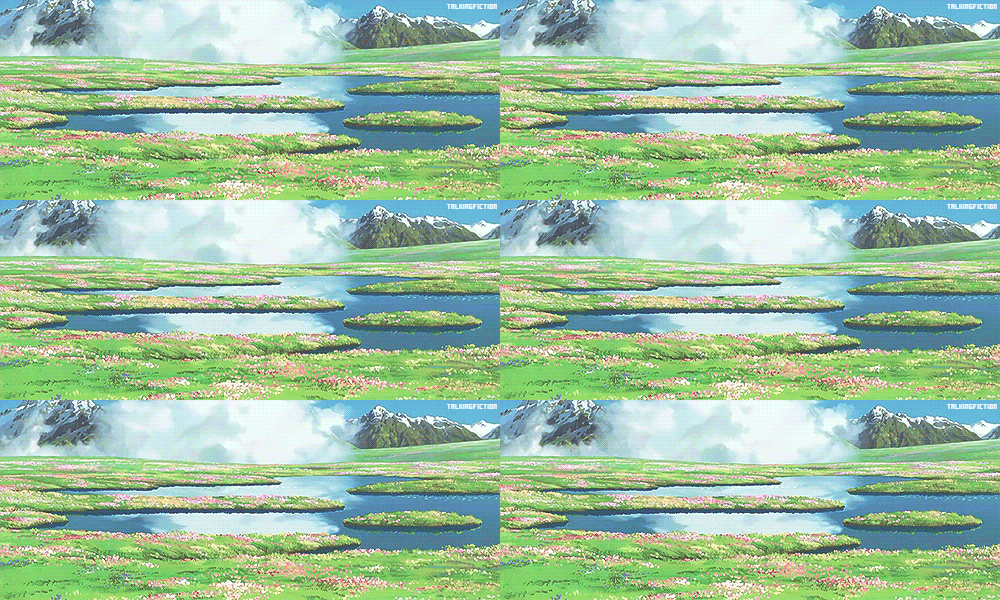
hi i have seen a lot of people talk about how they’d describe this but the truth is that (in my opinion) there’s a lot of stylistic choices here that i just want to talk about for a hot second 🙂 just some ways of thinking about it? that might help you get unstuck?
is your book even the kind of book that has long paragraphs of description? if you’re seeing something beautiful, you can just say, “there was a beautiful green and flowering field with a nice lake, a rolling fog, and mountains beyond” and let people make their own assumptions about what it looks like and movetf on.
“no raquel i really like long paragraphs.” okay time to get into The Senses. imagine yourself there. what would the grass feel like underfoot? is it soft, well-watered, or is it crunchy? do the flowers smell like death or do they smell good? is that fog or the gunsmoke from beyond the frame? are the mountains something to be passed over or surveyed? walk through all the senses. i really like adding smell because it’s the one most tangibly connected to memory (look it up). if i say “the field was green and smelled of wildflowers” that’s something connected to your senses. if i say “the lake, although still, reeked of blood” this is a whole different type of story. senses matter!
on that note, think about the poetry of it. are you the person who just says “clouds” or “rolling fog”? it’s okay if you’re either! i often switch between the two, because i don’t like long descriptions in my pieces and i don’t know why. and the tone of your piece should define that. if this is looking back on a fond memory, it should maybe be airy, light, full of “gentle, sun-kissed flowers” and “lambs-wool grass.” metaphors and similes and lots of fun things. but if it’s something like … this is a place we’re spending 12 seconds in during the story, don’t? bother? wasting your time? maybe the tone is being rushed, you’re looking out a train window and only get a glimpse. close your eyes and write what 12 seconds would give you in memory – a morose “it was beautiful out there, green and full of water and fog, mountains on the border” or a weary, “out there, in the fields and clouds and mountains”. see how even a few words changes tone?
sometimes there’s such a thing as trying too hard. plopping a word like “verdant” casually in there? great. when it’s “verdant green and crimson red flowers” etc it gets really tiring to write and read. make either your descriptions interesting with unusual terms – “bloodmoon red” idk – or stop driving yourself wild with more ways to say “beautiful.” say it and move on. this is also where tone is important – “verdant green and soft, whispering red flowers” is different than “violent green, with flowers shining in bloodspills upon it”. tone is …. crucial in expression.
i personally hate long descriptions. if you read half my stories, i straight up won’t describe things, because i don’t want to. here’s what i do instead: character-led discovery. instead of the narrator walking us through it, we discover it w/the characters, making it a little less outside of the story and a little more fluid. “he sat on the verdant grass, his fingers reaching to pick one of the many wildflowers. his head tilted to let the sun on his face, watching the clouds move at the foot of the mountains beyond.” aww so sweet 🙂 for me this is even like. more description than usual? because honestly unless these mountains gonn be important, who cares.
secondarily this is more what i think of when people say “show not tell” because everyone always stops at the senses but you gotta show like… how do your People interact with it. example: i’m colorblind. how i interact w/this gorgeousness is totally different.
but then you can also like ? let your characters literally do it for you:
“It was a field,” she shrugged, “It was like, super green and flowery and shit. I don’t know. there were clouds clouding along and mountainous mountains. what do you want from me. i felt like a deer frolicking in the got damb meadow come to dip my little deer nose into the nice little lake.” she slumped over. “i’m tired,” she added.”
literally let them talk for you. let them have your voice and say what you want the audience to get. “dude come look at this lake. it’s like. got a little halo of grass and flowers shit is so got damb cute” “nah man look at the mountains” “you’re all wrong check the ghost-clouds” “woooahhhh” actually works, and dialogue is a million times more fun to read and write (imho only tho) than like lines and lines of trying to force people to see what you see
on that note, unless it’s crucial people do see what you see? give up. let them figure it out on their own. watch a new scene: “she swore and went back for her shoe, dangling useless in the sewer grate, trying to keep her stocking foot aloft as she navigated the crowded sidewalk.” chances are, many of you saw a different shoe. in my head, it’s a red heel, but it’s not about the color – it’s about her being stuck w/out it. many of you probably naturally filled in the gaps – she’s in the city, she’s frustrated, her stockings means she’s not wearing pants (probably a skirt), the shoe getting stuck in the grate implies a heel, and, wherever she is, it’s crowded. she also looks like a pigeon in my head while she tries to work back to her shoe – but we don’t need to be told that, because our brains fill it in. if my piece was about that single red shoe, i’d name it. if it’s about how her day is going wrong? don’t bother.
sometimes it’s not you, it’s the scene. if the story don’t naturally take you there, it might be telling you – just hang on a dandy second, they wouldn’t go here. “but i want bella and edward in the field kissing” okay my guy. chill. take a second and ask – hey do i need to just skip this and move on? do i need to have them take a second? “bella, come with me,” he begged. she stared at him. “I’m not getting murdered,” she replied” – now that would have been some believable dialogue.
worst comes to worst, try it in a different style. if you’re usually all quick facts, elaborate more. if you’re usually paragraphs, have edward beg her to come by describing it through dialogue. help you and your story stay fresh with interesting techniques.
okay good luck out there. go write beautiful meadows that are more than just green or maybe just green and that’s enough for me. 🙂
Writing is a skill that many people struggle with, and when it comes to academic essays, many people are so anxious about writing that they don’t even know where to start. Many find it easier to begin when they have a clear idea of what they should and should not be doing, so I’ve compiled some tips to hopefully alleviate your essay-induced anxieties.
1. Hooks—you don’t need one. In fact, I would argue that you shouldn’t have one. They’re a juvenile method of starting a paper and, in many cases, they involve broad generalizations that aren’t even true. “Since the beginning of literature, people have been interested in how evil characters are portrayed in novels.” Have they, really? When exactly is the so-called “beginning” of literature? What is your proof that a largely illiterate society cared about the way in which characters were depicted when people like Defoe and Behn were penning some of the first English-language novels? One could argue that most people now don’t even care about how characters are depicted in novels. Get my point? It’s juvenile, sounds lazy, and you can skip all of this by just getting to the damn point by opting to begin your essay rather than constructing a flowery hook.
2. Your thesis. In most cases, your thesis should make an argument of your own, and it should be an argument that you can prove with evidence. You could have a spectacular sounding thesis that is saturated with sophisticated claims and language, but it doesn’t matter how good your thesis sounds if you don’t have textual evidence to back it up. Further, you need to make sure that your thesis answers the question the prompt is asking—if the prompt asks you to use Rousseau’s Discourse on Inequality to access the actions of Frankenstein’s creature, you better make sure that you directly and clearly relate those two texts in your thesis statement. When constructing your thesis statement, make sure that you are addressing the prompt fully, and ensure that you have adequate evidence to back up your claims. You don’t want to get too far into an essay only to realize that you don’t have enough evidence for your argument.
3. Creating a voice in your writing. Have a strong, confident voice. Sound sure of yourself. Don’t say things such as, “This might prove why this character does this.” Make a confident argument—explain in a clear and confident manner the way in which your evidence supports your thesis argument. This is easy to do once you learn how to integrate appropriate quotes into your essays.
4. Using quotes. Quotes are necessary for most forms of essay writing; without them, your argument is weak. Provide context when introducing a quote—don’t simply throw a quote at your reader with no context or explanation. Use shorter quotes when possible, and integrate them into your sentences. Try not to let a quote stand alone as its own sentence. Here’s an example of successfully integrating appropriate quotes into your writing:
“However, Caliban openly attempted to rape Miranda, and when Prospero mentions this, Caliban enthusiastically states that if Prospero hadn’t stopped him, he would have “peopled else this isle with Calibans” (1.2.420-421). Prior to this attempted rape, Prospero and Caliban apparently shared a reciprocal relationship, wherein Prospero taught Caliban English and, in return, Caliban “showed [him] all the qualities o’ th’ isle” (1.2.403).”
As you can see above, quotes are used to provide succinct evidence for what you’re talking about. They show that you have read and possess a clear understanding of the text, and they provide textual evidence that strengthens your argument.
5. The structure of your essay. Your essay does not need to be a cookie-cutter five paragraph monstrosity that has been drilled into your brain since 8th grade; you can switch it up as you see necessary. It’s not necessarily a bad thing to have paragraphs of varying lengths, multiple paragraphs discussing the same argument, or even to bring up previously stated topics and arguments in order to further explore what you’re talking about. Don’t feel obligated to constrain yourself to formulaic writing when frankly, it often isn’t the best way to write a paper. Make your argument in the most natural way possible, and if that required seven body paragraphs, then so be it.
6. Editing your essays. I advise reading your essay out loud when editing. In your initial read-through, check for grammatical mistakes and typos. These mistakes will be obvious if you read your paper aloud. After ensuring that your paper is free from technical errors, reread it again to check how one idea transitions to the next. Does your essay have clear and natural transitions from topic to topic, or are there abrupt shifts that need to be worked out? Finally, make sure your paper adequately proves the overall argument you’re attempting to make. Is your argument the driving force in your paper, or do you make unnecessary digressions? These are all important things to consider before turning in your final essay.
Remember, writing essays is something that, with practice, can become quite easy. Don’t treat writing an essay as some kind of foreign, impossible task; all writing an essay really involves is making an argument and attempting to prove your argument with evidence. If you can do this, then writing becomes substantially easier. Good luck!
by now, most of you have probably seen this post about how “Athena gifted Medusa with ugliness and the power to turn men to stone as a way of protecting her from further violations of her person…As the original myth tells it, she lived in solitude because she did not wish to be around men after what Poseidon had done. And Athena gave her the power to never be at the mercy of a male again”
In addition, it makes some claims about how the image of Medusa’s head was found on the lintel of women’s shelters, and it was patriarchal Rome that subverted this myth into the one of rape and victim-blaming and turned her ugliness into something shameful.
….EXCEPT REALLY NOT
first let me say, I am all for reinterpreting and retelling Greek myths! People have been doing it down the ages, and I love the Romantic fixation on Prometheus and Freud’s fetish for Oedipus and tumblr’s fascination with Persephone/Hades. And I am definitely all for reclaiming stories that have been used to shame and silence women.
But I am also allergic to those retellings being retroactively fitted back into their sexist framework. On top of this being just plain old revisionist history, it does a disservice to why we needed to retell it in the first place.
Medusa was (probably) not natively a feminist heroine and her head was not hung above doorways of women’s shelters (not sure if Classical Greece had anything recognizable women’s shelters, my research hasn’t turned up anything.) Ancient Rome is not automatically more patriarchal than Ancient Greece, because Greece was pretty damn gross in a lot of ways and their myths are not exempt from that.
Sticking a landing will royally fuck up your joints and possibly shatter your ankles, depending on how high you’re jumping/falling from. There’s a very good reason free-runners dive and roll.
Hand-to-hand fights usually only last a matter of seconds, sometimes a few minutes. It’s exhausting work and unless you have a lot of training and history with hand-to-hand combat, you’re going to tire out really fast.
Arrows are very effective and you can’t just yank them out without doing a lot of damage. Most of the time the head of the arrow will break off inside the body if you try pulling it out, and arrows are built to pierce deep. An arrow wound demands medical attention.
Throwing your opponent across the room is really not all that smart. You’re giving them the chance to get up and run away. Unless you’re trying to put distance between you so you can shoot them or something, don’t throw them.
Everyone has something called a “flinch response” when they fight. This is pretty much the brain’s way of telling you “get the fuck out of here or we’re gonna die.” Experienced fighters have trained to suppress this. Think about how long your character has been fighting. A character in a fist fight for the first time is going to take a few hits before their survival instinct kicks in and they start hitting back. A character in a fist fight for the eighth time that week is going to respond a little differently.
ADRENALINE WORKS AGAINST YOU WHEN YOU FIGHT. THIS IS IMPORTANT. A lot of times people think that adrenaline will kick in and give you some badass fighting skills, but it’s actually the opposite. Adrenaline is what tires you out in a battle and it also affects the fighter’s efficacy – meaning it makes them shaky and inaccurate, and overall they lose about 60% of their fighting skill because their brain is focusing on not dying. Adrenaline keeps you alive, it doesn’t give you the skill to pull off a perfect roundhouse kick to the opponent’s face.
Swords WILL bend or break if you hit something hard enough. They also dull easily and take a lot of maintenance. In reality, someone who fights with a sword would have to have to repair or replace it constantly.
Fights get messy. There’s blood and sweat everywhere, and that will make it hard to hold your weapon or get a good grip on someone.
A serious battle also smells horrible. There’s lots of sweat, but also the smell of urine and feces. After someone dies, their bowels and bladder empty. There might also be some questionable things on the ground which can be very psychologically traumatizing. Remember to think about all of the character’s senses when they’re in a fight. Everything WILL affect them in some way.
If your sword is sharpened down to a fine edge, the rest of the blade can’t go through the cut you make. You’ll just end up putting a tiny, shallow scratch in the surface of whatever you strike, and you could probably break your sword.
ARCHERS ARE STRONG TOO. Have you ever drawn a bow? It takes a lot of strength, especially when you’re shooting a bow with a higher draw weight. Draw weight basically means “the amount of force you have to use to pull this sucker back enough to fire it.” To give you an idea of how that works, here’s a helpful link to tell you about finding bow sizes and draw weights for your characters. (CLICK ME)
If an archer has to use a bow they’re not used to, it will probably throw them off a little until they’ve done a few practice shots with it and figured out its draw weight and stability.
People bleed. If they get punched in the face, they’ll probably get a bloody nose. If they get stabbed or cut somehow, they’ll bleed accordingly. And if they’ve been fighting for a while, they’ve got a LOT of blood rushing around to provide them with oxygen. They’re going to bleed a lot.
Here’s a link to a chart to show you how much blood a person can lose without dying. (CLICK ME)
If you want a more in-depth medical chart, try this one. (CLICK ME)
Hopefully this helps someone out there. If you reblog, feel free to add more tips for writers or correct anything I’ve gotten wrong here.
How to apply Writing techniques for action scenes:
– Short sentences. Choppy. One action, then another. When there’s a lull in the fight, take a moment, using longer phrases to analyze the situation–then dive back in. Snap, snap, snap. – Same thing with words – short, simple, and strong in the thick of battle. Save the longer syllables for elsewhere. – Characters do not dwell on things when they are in the heat of the moment. They will get punched in the face. Focus on actions, not thoughts. – Go back and cut out as many adverbs as possible. – No seriously, if there’s ever a time to use the strongest verbs in your vocabulary – Bellow, thrash, heave, shriek, snarl, splinter, bolt, hurtle, crumble, shatter, charge, raze – it’s now. – Don’t forget your other senses. People might not even be sure what they saw during a fight, but they always know how they felt. – Taste: Dry mouth, salt from sweat, copper tang from blood, etc – Smell: OP nailed it – Touch: Headache, sore muscles, tense muscles, exhaustion, blood pounding. Bruised knuckles/bowstring fingers. Injuries that ache and pulse, sting and flare white hot with pain. – Pain will stay with a character. Even if it’s minor. – Sound and sight might blur or sharpen depending on the character and their experience/exhaustion. Colors and quick movements will catch the eye. Loud sounds or noises from behind may serve as a fighter’s only alert before an attack. – If something unexpected happens, shifting the character’s whole attention to that thing will shift the Audience’s attention, too. – Aftermath. This is where the details resurface, the characters pick up things they cast aside during the fight, both literally and metaphorically. Fights are chaotic, fast paced, and self-centered. Characters know only their self, their goals, what’s in their way, and the quickest way around those threats. The aftermath is when people can regain their emotions, their relationships, their rationality/introspection, and anything else they couldn’t afford to think or feel while their lives were on the line.
Do everything you can to keep the fight here and now. Maximize the physical, minimize the theoretical. Keep things immediate – no theories or what ifs.
If writing a strategist, who needs to think ahead, try this: keep strategy to before-and-after fights. Lay out plans in calm periods, try to guess what enemies are thinking or what they will do. During combat, however, the character should think about his options, enemies, and terrain in immediate terms; that is, in shapes and direction. (Large enemy rushing me; dive left, circle around / Scaffolding on fire, pool below me / two foes helping each other, separate them.)
Lastly, after writing, read it aloud. Anyplace your tongue catches up on a fast moving scene, edit. Smooth action scenes rarely come on the first try.
More for martial arts or hand-to-hand in general
What a character’s wearing will affect how they fight. The more restricting the clothes, the harder it will be. If they’re wearing a skirt that is loose enough to fight in, modesty will be lost in a life or death situation.
Jewelry can also be very bad. Necklaces can be grabbed onto. Bracelets also can be grabbed onto or inhibit movement. Rings it can depend on the person.
Shoes also matter. Tennis shoes are good and solid, but if you’re unused to them there’s a chance of accidentally hurting your ankle. High heels can definitely be a problem. However, they can also make very good weapons, especially for someone used to balancing on the balls of their feet. Side kicks and thrusting kicks in soft areas (like the solar plexus) or the feet are good ideas. They can also (hopefully) be taken off quickly and used as a hand weapon. Combat boots are great but if someone relies more on speed or aren’t used to them, they can weigh a person down. Cowboy boots can be surprisingly good. Spin kicks (if a character is quick enough to use them) are especially nasty in these shoes.
If a character is going to fight barefoot, please keep location in mind. Concrete can mess up your feet quick. Lawns, yards, etc often have hidden holes and other obstacles that can mess up a fighter. Tile floors or waxed wood can be very slippery if you’re not careful or used to them.
Likewise, if it’s outside be aware of how weather will affect the fight. The sun’s glare can really impede a fighter’s sight. A wet location, inside or outside, can cause a fighter to slip and fall. Sweat on the body can cause a fighter to lose a grip on an opponent too.
Pressure points for a trained fighter are great places to aim for in a fight. The solar plexus is another great place to aim for. It will knock the wind out of anyone and immediately weaken your opponent.
It your character is hit in the solar plexus and isn’t trained, they’re going down. The first time you get hit there you are out of breath and most people double over in confusion and pain. If a fighter is more used to it, they will stand tall and expand themselves in order to get some breath. They will likely keep fighting, but until their breath returns to normal, they will be considerably weaker.
Do not be afraid to have your character use obstacles in their environment. Pillars, boxes, bookshelves, doors, etc. They put distance between you and an opponent which can allow you to catch your breath.
Do not be afraid to have your character use objects in their environment. Someone’s coming at you with a spear, trident, etc, then pick up a chair and get it caught in the legs or use it as a shield. Bedsheets can make a good distraction and tangle someone up. Someone’s invading your home and you need to defend yourself? Throw a lamp. Anything can be turned into a weapon.
Guns often miss their targets at longer distances, even by those who have trained heavily with them. They can also be easier to disarm as they only shoot in one direction. However, depending on the type, grabbing onto the top is a very very bad idea. There is a good likelihood you WILL get hurt.
Knives are nasty weapons by someone who knows what they’re doing. Good fighters never hold a knife the way you would when cutting food. It is best used when held against the forearm. In defense, this makes a block more effective and in offense, slashing movement from any direction are going to be bad. If a character is in a fight with a knife or trying to disarm one, they will get hurt.
Soft areas hit with hard body parts. Hard areas hit with soft body parts. The neck, stomach, and other soft areas are best hit with punches, side kicks, elbows, and other hard body parts. Head and other hard parts are best hit using a knife hand, palm strike, etc. Spin kicks will be nasty regardless of what you’re aiming for it they land.
Common misconception with round house kicks is that you’re hitting with the top of the foot. You’re hitting with the ball. You’re likely to break your foot when hitting with the top.
When punching, the thumb is outside of the fist. You’ll break something if you’re hitting with the thumb inside, which a lot of inexperienced fighters do.
Also, punching the face or jaw can hurt.
It can be hard to grab a punch if you’re not experienced with it despite how easy movies make it seem. It’s best to dodge or redirect it.
Hitting to the head is not always the best idea. It can take a bit of training to be able to reach for the head with a kick because of the height. Flexibility is very much needed. If there are problems with their hips or they just aren’t very flexible, kicks to the head aren’t happening.
Jump kicks are a good way to hit the head, but an opponent will see it coming if it’s too slow or they are fast/experienced.
A good kick can throw an opponent back or knock them to the ground. If the person you’ve hit has experience though, they’ll immediately be getting up again.
Even if they’ve trained for years in a martial art, if they haven’t actually hit anything before or gotten hit, it will be slightly stunning for the person. It does not feel the way you expect it too.
Those yells in martial arts are not just for show. If done right, they tighten your core making it easier to take a hit in that area. Also, they can be used to intimidate an opponent. Yelling or screaming right by their ear can startle someone. (Generally, KHR fans look at Squalo for yelling)
Biting can also be used if someone’s grabbing you. Spitting in someone’s eyes can’t hurt. Also, in a chokehold or if someone is trying to grab your neck in general, PUT YOU CHIN DOWN. This cuts off access and if they’re grabbing in the front can dig into their hand and hurt.
Wrist grabs and other grabs can be good. Especially if it’s the first move an opponent makes and the character is trained, there are simple ways to counter that will have a person on their knees in seconds..
Use what your character has to their advantage. If they’re smaller or have less mass, then they’ll be relying on speed, intelligence, evasion, and other similar tactics. Larger opponents will be able to take hits better, they’re hits may be slower depending on who it is but will hurt like hell if they land, and size can be intimidating. Taller people with longer legs will want to rely on kicking and keeping their distance since they have the advantage there. Shorter people will want to keep the distance closer where it’s easier for them but harder for a taller opponent. Punching is a good idea.
Using a person’s momentum against them is great. There’s martial arts that revolve around this whole concept. They throw a punch? Grab it and pull them forward and around. Their momentum will keep them going and knock them off balance.
Leverage can used in the same way. If used right, you can flip a person, dislocate a shoulder, throw out a knee, etc.
One note on adrenaline: All that was said above is true about it. But, in a fight, it can also make you more aware of what’s going on. A fight that lasts twenty seconds can feel like a minute because time seems to almost slow down while moving extremely rapidly. You only have so much time to think about what you’re doing. You’re taking in information constantly and trying to adjust. Even in the slow down adrenaline gives you, everything is moving very rapidly.
Feelings will be your downfall even more so than adrenaline. Adrenaline can make those feelings more intense, but a good fighter has learned not to listen to those feelings. A good fighter may feel anger at being knocked down or in some way humiliated – their pride taken down. Yet they will not act on the anger. Acting on it makes a fighter more instinctive and many will charge without thinking. Losing control of anything (adrenaline rush, emotions, technique, etc) can be a terrible thing in a fight.




 rip tumblr