My number one tip for straight men (I mean, it could conceivably work for other genders and sexualities, but you’d have to adjust it quite a bit) is: inagine they’re a man.
Imagine that you just randomly told some bloke in a pub that he has beautiful eyes.
That you walked up behind your coworker Jim and started caressing his neck and shoulders while talking to him about the budget.
That you just sent a large and unexplained bouquet of flowers to Darren in Accounting.
That instead of complimenting a coworker on her breasts, you complimented him on his dick.
Does the action now seem weird? Uncomfortable? Do you no longer want to do it now that it isn’t directed at somebody you are sexually attracted to?
That strongly suggests that your action has a sexual aspect to it and therefore probably counts as sexual harassment!
I have a large, colorful tattoo on one arm. I’ve had multiple strange men cross a room to tell me how awesome it is, frequently while I’m at work, and it has never made me uncomfortable.
A couple of weeks ago, someone yelled out a car at me ‘I FUCKING LOVE YOUR BOOTS’, which was awesome.
It’s just… it’s really not hard to compliment people in a way that isn’t creepy, if your goal is actually to compliment them and not to slide a ‘btw I’m thinking about fucking you’ under the radar.
And the fact that some guys have NO IDEA how to do this really shows what’s wrong with our society.
Every time my extended family gets together in upstate ny, we (the Adults) all get wasted & at least 1 giant Family Scandal comes out…..tonight is that night..
We’ve Got A Winner Folks, And It Involves Arson AND A Nun!
So apparently my aunt cecelia (not really my aunt, just the best friend of my dads cousin, whomst we also call aunt) once married a dude referred to only as Florida Asshole. He was named such because he apparently left my aunt cecelia while she was in the hospital, stole all of their stuff, and fucked off to florida. Aunt cecelia then hired a p.i. to find him, as u do, and went down to florida with my dads cousin (who was going to florida for a work trip, and had no idea Florida Asshole was there). Apparently the p.i. told aunt cecelia which city the guy was in, but hadnt found the exact address yet, so ofc aunt cecelia did what any other able bodied half insane scorned person might. She went to a costume shop, bought a full nun costume, and went door to door under the assumption that she was collecting charity. (She did, in fact, donate everything she collected. This was an important fact to her). At one of the houses, she looked in the window and noticed an awful lot of furniture that used to be hers. So she, obviously, went to a gas station and bought several cans of gasoline, threw a molotov cocktail through the front window, and began pouring gasoline over the rest of the house. At this point, Florida Asshole came outside, recognized his ex wife looking like a renegade nun sent to punish him for his sins, and began beating her. The neighbors, seeing the strange new man beating a nun in his front yard while his house was on fire, did the only sensible thing in this story and called the police. Who promptly arrested Florida Asshole for assaulting a nun. Aunt cecelia did not get arrested, came clean to her best friend, and was immediately sent back to new york with a ticket bought under my other aunt’s name. We don’t know if she still has an arrest warrant out for her in florida, and that’s tonight’s Family Scandal!
is “chai” a TYPE of tea??! bc in Hindi/Urdu, the word chai just means tea
its like spicy cinnamon tea instead of bland gross black tea
I think the chai that me and all other Muslims that I know drink is just black tea
i mean i always thought chai was just another word for tea?? in russian chai is tea
why don’t white people just say tea
do they mean it’s that spicy cinnamon tea
why don’t they just call it “spicy cinnamon tea”
the spicy cinnamon one is actually masala chai specifically so like
there’s literally no reason to just say chai or chai
They don’t know better. To them “chai tea” IS that specific kind of like, creamy cinnamony tea. They think “chai” is an adjective describing “tea”.
What English sometimes does when it encounters words in other languages that it already has a word for is to use that word to refer to a specific type of that thing. It’s like distinguishing between what English speakers consider the prototype of the word in English from what we consider non-prototypical.
(Sidenote: prototype theory means that people think of the most prototypical instances of a thing before they think of weirder types. For example: list four kinds of birds to yourself right now. You probably started with local songbirds, which for me is robins, blue birds, cardinals, starlings. If I had you list three more, you might say pigeons or eagles or falcons. It would probably take you a while to get to penguins and emus and ducks, even though those are all birds too. A duck or a penguin, however, is not a prototypical bird.)
“Chai” means tea in Hindi-Urdu, but “chai tea” in English means “tea prepared like masala chai” because it’s useful to have a word to distinguish “the kind of tea we make here” from “the kind of tea they make somewhere else”.
“Naan” may mean bread, but “naan bread” means specifically “bread prepared like this” because it’s useful to have a word to distinguish between “bread made how we make it” and “bread how other people make it”.
We also sometimes say “liege lord” when talking about feudal homage, even though “liege” is just “lord” in French, or “flower blossom” to describe the part of the flower that opens, even though when “flower” was borrowed from French it meant the same thing as blossom.
We also do this with place names: “brea” means tar in Spanish, but when we came across a place where Spanish-speakers were like “there’s tar here”, we took that and said “Okay, here’s the La Brea tar pits”.
Or “Sahara”. Sahara already meant “giant desert,” but we call it the Sahara desert to distinguish it from other giant deserts, like the Gobi desert (Gobi also means desert btw).
Languages tend to use a lot of repetition to make sure that things are clear. English says “John walks”, and the -s on walks means “one person is doing this” even though we know “John” is one person. Spanish puts tense markers on every instance of a verb in a sentence, even when it’s abundantly clear that they all have the same tense (”ayer [yo] caminé por el parque y jugué tenis” even though “ayer” means yesterday and “yo” means I and the -é means “I in the past”). English apparently also likes to use semantic repetition, so that people know that “chai” is a type of tea and “naan” is a type of bread and “Sahara” is a desert. (I could also totally see someone labeling something, for instance, pan dulce sweetbread, even though “pan dulce” means “sweet bread”.)
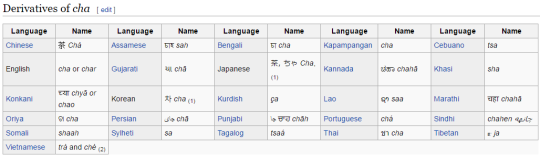
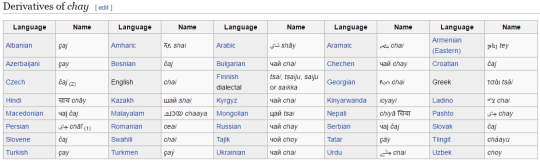
Also, specifically with the chai/tea thing, many languages either use the Malay root and end up with a word that sounds like “tea” (like té in Spanish), or they use the Mandarin root and end up with a word that sounds like “chai” (like cha in Portuguese).
So, can we all stop making fun of this now?
Okay and I’m totally going to jump in here about tea because it’s cool. Ever wonder why some languages call tea “chai” or “cha” and others call it “tea” or “the”?
It literally all depends on which parts of China (or, more specifically, what Chinese) those cultures got their tea from, and who in turn they sold their tea to.
The Portuguese imported tea from the Southern provinces through Macau, so they called tea “cha” because in Cantonese it’s “cha”. The Dutch got tea from Fujian, where Min Chinese was more heavily spoken so it’s “thee” coming from “te”. And because the Dutch sold tea to so much of Europe, that proliferated the “te” pronunciation to France (”the”), English (”tea”) etc, even though the vast majority of Chinese people speak dialects that pronounce it “cha” (by which I mean Mandarin and Cantonese which accounts for a lot of the people who speak Chinese even though they aren’t the only dialects).
And “chai”/”chay” comes from the Persian pronunciation who got it from the Northern Chinese who then brought it all over Central Asia and became chai.
Way too many parents need to learn the difference between “a child being disrespectful” and “a human person expressing an opinion that differs from theirs”
my mom had a nice technique for this. when i’d give her sass, she’d say, “i don’t speak rude, what’s that in polite-person-ese?”
basically, she’d encourage me to rephrase my opinion without the attitude. so “UGH, you NEVER let me do ANYTHING!” would (often after quite a bit of bitching and grumbling) turn into “it feels like every time i have a fun idea, you say no, and i just end up sitting around the house.”
and at that point we could troubleshoot like civilized people. she could explain that she didn’t want me to go to jimmy’s sleepover because jimmy’s dad creeps her out, and i could suggest maybe i could have andy over instead, and she could say sure, why not call peter and stacy and brianna and have your own party, i’ll pop some popcorn and rent a movie, and i could add what if we put up tents in the back yard and have a bonfire and roast marshmallows, and she could laugh and say don’t push it.
I really like this technique because it addresses the OPs comment but recognizes that the two can coexist. The problem is often the child is expressing their opinion in a rude or disrespectful way. And as humans we automatically become adverse to opinions we feel are aggressive toward us.