me, late 20s, discovering i love to cook, and have neck pain: holy shit i’m going to turn into a person who does yoga
me, buying paper napkins and eyebanging a herb garden: i’m having an identity crisis
me: *reaches automatically for coaster, catches sight of my reflection in my newly purchased wine glasses that were on sale*: i don’t know who you are anymore
“i’m not a fan of embellishments on throw pillows, they tend to snag” I say, and gasp in horror at what I’ve become
“Did you know they make odorized garbage bags now?” I say without flinching, the sclerae of my eyes as black and ashen as my soul
“why can’t female heroes kick arse in heels” because it’s not practical and will literally snap your damn ankle you can scream weaponised femininity all you want but first off, you need to admit that they’re not an almighty symbol of empowerment, and secondly that if you do a job with a lot of physical activity in heels you’re risking your own safety. all these women fighting in heels on tv are going to end up seriously injuring themselves.
weaponised femininity is a concept made up in an attempt to get us to embrace the industries created to hold us back/profit from our insecurities so that we can continue to fit into the male expectation of what a woman should be and not question why we are forced to spend thousands on our appearance every year
just a small anecdote. I had a friend who worked in theater; she was the stage manager and an actress came to her in tears one day because the director absolutely refused to let her do a choreographed fight scene in less than 3 inch heels because “they’re platforms so you’ll be okay.” My friend, who is a woman’s size 10, brought her own heels in the next day and DEMANDED the director put them on and try the choreography before the actress did it. He finally agreed to change it, without putting the heels on.
so like I know you might think of “all those women on tv fighting in heels” as fictional woman who WOULD hurt themselves in real life, but its fiction so its okay…except those women are portrayed by real actresses who are actually fighting in actual heels, being directed by dudes who have never worn a pair of heels in their lives, alongside men who aren’t expected to constantly wear things that make their stunts 2x more dangerous than they have to be. Just a thought.
Hi guys I’m obsessed with this shit lately because I don’t want anyone to have unhappy, unsupported boobs like I did. Even if you think your boobs and bras are fine, try it. It will make a big difference in comfort, support, and shape, even if you have small boobs or big boobs. A proper fitting bra can fix back, shoulder, and neck pain, along with breast soreness – and it can help you look 10lbs lighter, and your breasts a hell of a lot perkier. This guide also works for proper-sized bikinis and bathing suits (many online stores linked to below sell both- sometimes for as low as 10$!)
Don’t just like this, REBLOG IT. EVERYBODY WITH BOOBS DESERVES A PROPER FIT. Even if you don’t wear bras yourself, spread it around to tumblr or with your friends or family.
Grab a soft tape measurer (use inches) and get nekkid – don’t wear a bra or shirt please, you don’t wear a bra or shirt underneath your bra, do you? This part is fast and easy, and will help you find your ‘Starting Point’ bra size – you may not end up in this exact size, but it will get you in the right ballpark.
How to Measure:
Measure your underbust – go right underneath the root of your breasts, but make sure the tape is straight/parallel to the floor. Take a firm, snug measurement – if you have chub, take it tighter.
Measure your bust bent over – bend forward so your back is parallel to the floor and your boobs are hanging so you have access to all that beautiful breast tissue that is now brought forward. Measure very loosely around the nipples, keeping tape straight/horizontal/perpendicular to the floor.
If your breasts are kind of empty and/or have a lot of sag, this method may overestimate your cup size. Instead, take your bust measurement bent over, standing, and lying flat on your back, and take an average of those three measurements and use that for your calculations.
How to Use These Measurements to find your ‘Starting Size’:
Round up your underbust measurement to the nearest even number. If you are only half an inch or less away from being a lower size, use that instead (unless you have a bony ribcage). This is automatically your band size. No BS. There is no adding imaginary inches here.
CUP SIZES ARE NOT STANDARD, UNLIKE COMMONLY THOUGHT (AND TOLD TO US BY ASSHOLES LIKE VS). They are TOTALLY relative to band size. The cup on a 30D has 4 inches less volume than the cup on a 34D. A 30D is actually the same cup size as a 34B!
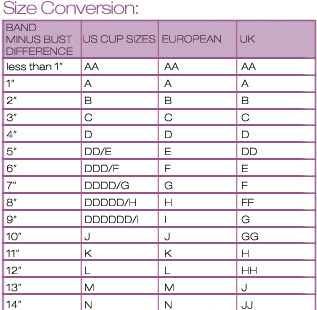
No one has their shit together on the lettering for each cup size, so here’s a handy dandy chart. Remember to go with UK measurement as they somewhat have their shit together (and because American companies do not make much above DD, so there’s literally no point in knowing it, but the European sizing may come in handy)
I DON’T CARE IF YOU LIVE IN THE USA, DO NOT USE THE AMERICAN MEASUREMENTS, FFS. YOU’LL ONLY MAKE THINGS HARDER AND MORE CONFUSING FOR YOURSELF. ANY BOUTIQUE IN NORTH AMERICA WORTH GOING TO, AND 99% OF ONLINE STORES, IS GOING TO SELL PRIMARILY BRITISH OR EUROPEAN BRANDS AND WILL GO BY THEIR SIZING. THERE IS LITERALLY NO POINT IN KNOWING AMERICAN SIZING
DO NOT USE AMERICAN SIZING
DO NOT USE AMERICAN FUCKING SIZING
EVEN IF YOU ARE AMERICAN
AND LIVE IN THE US
USE THE BRITISH SIZING
For example, I have a 29.5 inch underbust and a 38 inch bust when bent over. So, I should take a 30 band and then there’s an 8 inch difference. So I am a 30FF in UK sizing. This is just my starting point when looking for bras, and I may not always end up with this exact size
Do not pull the ‘omg no I’m not a G cup my boobs aren’t that big you’re more stupid that the idea of vegetable bread’ shit with me ok? You drank the Kool-Aid and now you need to piss it out. CUP SIZES ARE NOT STANDARD. A 34D IS BIGGER IN THE CUPS THAN A 30E. Here, take a look at a chart of cup volumes and see what I mean.
Also… not all ‘big cup’ bras are ugly and granny-like. Just check out brands like Freya or Gossard or Gorteks or Panache or Cleo! They are gorgeous!
Trying it on: What a proper fit is like
ALWAYS SCOOP AND SWOOP BEFORE ASSESSING WHETHER IT FITS OR NOT. What does this mean? This means bend over, hike up your bra so that it sits right under the root of your breasts. Then, start smooshing all your back fat and armpit rolls or any loose tissue thats underneath or to the side of the cup, INTO the cup. All that stuff is breast tissue that got pushed around from your shitty bras, no I am not bullshitting – after a few months of wearing better bras, many people end up having to get a bigger cup and sometimes even a smaller band too, as all the smooshed breast tissue migrates back to the boob, where it should be. Not kidding. So get everything in there and make sure the wire is positioned perfectly under your boobs. Then stand up and assess the fit. If it seemed to fit before scooping, it won’t fit now.
THIS IS JUST A STARTING POINT. Try on your starting size and work from there. You may need to go up or down a band size, or up or down many cup sizes. Not all brands or even models in that brand are made the same way, and the shape of your boobs also helps determine the size and fit, so don’t try on JUST the size you calculated, say “it doesn’t fit”, and then give up and go back to your 36Cs. You aren’t doing yourself any favours. If you don’t feel comfortable in your ‘starting point size’, go ahead and try a size up or down in bands and/or a size or two or even three up or down in cups as needed.
ALWAYS start on the loosest hook. If you need to start on the tightest hook, go down a band size. The point of hooks is simple – as your bra gets used, it gradually loses its elasticity and gets loose. So, you use your hooks to bring it in, and when you reach the last hook, well, be prepared to get rid of your bra in a few months (unless you invest in a band tightener like the Rixie Clip)
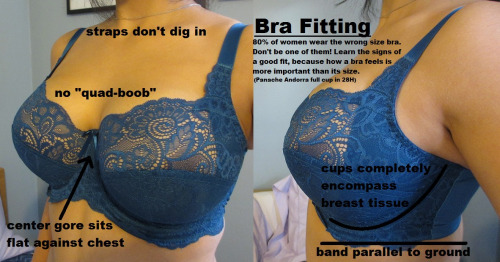
A proper fit means the bra band is straight and parallel to the floor. If it isn’t, and seems to be getting pulled up, its too big and isn’t supporting you. Get a smaller band. You shouldn’t be able to stretch it more than a couple inches off your back. It may feel tight at first, but bras do need ‘breaking in’ and you are used to wearing things that do not fit correctly, so give it a chance. Of course, it should not hurt either!
A proper fit means your bra straps are not digging in.
A proper fit means the gore (the little centerpiece of the bra where the wires sort of meet) MUST tack/sit firmly against your chest. If it doesn’t, then the wires are not truly fully underneath your boobs and so are not giving you the proper support.
A proper fit means your boobs must fit smoothly into the entire cup (after scooping and swooping). The wire should totally encase all your breast tissue (this includes armpit fat and stuff). There should be no empty space at the bottom or top of the cup. Your boobs should not be overflowing from the top of the cup. If there’s overflowing or uncontained tissue after scooping, or of it feels tight, get a bigger cup.
A proper fit means you should be able to lift your arms over your head and jump around without the band or underwire budging or exposing underboob.
Size Tweaks/Troubleshooting (make sure you scoop and swoop first):
The band feels tight: Is the gore tacking or not? If not, go up a cup size or two (or maybe even three or four). Even if the gore is tacking, try this first. The band may be tight because the cups are too small, so your boobs are stretching the band out too much to overcompensate for lack of cup depth, making it feel tighter. If after trying larger cups, it still feels uncomfortably tight, go up a band size (and down a cup size if the first size fit well in the cups – remember, cup is relative to band, a 32DD is the same in the cups as a 34D). Remember though that it takes a few days to break a bra in, so it may feel tight or perfect at first, and then comfortable or too loose later.
The band feels loose/band is riding up and not remaining parallel to the floor: Go down a band size (and up a cup size or two because blablah relativity).
The gore is not tacking, but band is not tight: Band size is too big, or maybe fits just right – but the cups are too small. You know what to do.
Boobs spilling over: Go up a cup size. Check first though that the bottom of the cup is not empty, and hike it up if it is!
Empty space at bottom of cup: Hike that shit up so it gets right to the roots of your breasts. This may fix bulging/spillage. If you can’t get it higher, then you need a smaller cup or this make of bra is just not suited to your shape.
Empty space at top of cup: You need a smaller cup, or this shape of bra just does not suit you your breasts, especially if your breasts are not very full on top. Or you need to scoop and swoop!
Straps digging in: Loosen them. If your boobs suddenly sag, then the band is not supportive enough, and you need a tighter band.
Armpit rolls: Bigger cup and/or scoop and swoop that shit. The cut of bra may also just not be for you (for now anyway – your armpit rolls may migrate back into the boobs and disappear eventually!)
They don’t even make my size!!: If you’re in a 28-48 D-KK (UK sizing) cup, you will find your size online easily enough. however, if you have a smaller band than that or need smaller cups, they are hard to find – message me and I’ll try to help you with a solution!
So, for example, my starting size may be 30FF, but I may end up wearing a 28G or H if the band of that model is too loose and the gore not tacking. Or the band may be fine and I may need a bigger cup so I’ll get a 30G. Or The band may be good but the cups too big, so I’ll get a 30F or E. Or the band may be too small to be comfortable and I’ll wear a 32F or E (same cupsize-ish as 30FF!).
What Not to Do:
NEVER PUT YOUR BRA IN THE DRYER. AND PREFERABLY, WASH IT BY HAND. The heat and twisting ruins the elasticity of the bra and reduces its life! This is the best way to ruin bras, don’t do it.
Do not add 3 or 4 or 5 inches or whatever to your band measurement. That is BS that American companies use so that they don’t have to manufacture a larger range of sizes – they use it to fit you into their stock, not their stock onto you. The band will be too big and unsupportive. Those 4 inches they add to the band are 4 inches that should be in the cup size, so no wonder people think anything over DD should be huge.
Do not measure your ‘overbust’ cause really what the fuck does that have to do with how large you are underneath your boobs, come on
Do not do the above because 80% of the support comes from the band, which needs to be firm against you and not be sliding or moving around.Would you wear underwear 4 inches bigger than your hips? No, so why would you wear a bra band 4 inches bigger than your ribcage that gets pulled up and stuff and would fall off if not for the straps, while expecting it to support the boobies at the same time?
Do not go down a band size and then forget to go up a cup size or two. Again, cup sizes are not static. A 30FF is the same cup volume as a 32F or E. If you don’t do this, no shit the bra will fit badly or feel tight.
Do not go straight to Victoria’s Secret or La Senza or whatever, even if you are lucky enough to fit in their small range of sizes – they don’t seem to follow sizing very well. Still, try, by all means, but be aware that their bras may be odd compared to others.
"But where do I get these Bras? I’ve never even seen these sizes!“
Luckily, the internet makes this shit really easy. Buying bras online is nearly always way cheaper, even with shipping, and even if coming from somewhere in Europe! But of course, its best to try on stuff first, to avoid the hassle of return shipping (even though its still not that expensive – just annoying). So what I advise is to find a store near you, try stuff on there, note down the Brand, Model, and Size, and then buy it online for up to a quarter of of the in-store price.
If you can’t find a store near you, online ordering is still extremely cheap, even with return shipping. Instead of getting a whole bunch of bras in only 1 size each, pick out a few models and order a few sizes of each. Ex: one with a bigger or smaller band if your measurements are close to needing a bigger or smaller band size, and then some up or down a couple cup sizes so you can compare the fit. When you have the perfect fit in one bra, it will be easier to go on Bratabase or r/ABraThatFits and have them suggest bras that give similar shape or suggest a different size to you as a model you’re interested in may run large or small.
So, Where to Find:
Note: You can find proper-sized bras as low as 10$ US online (particularly from ebay or brastop.com) and most average 30-45$.
If in Canada, look for a Change Lingerie near you to try on bras. Note that they only carry their own brand.
If in the USA, look for a Nordstrom or Nordstrom Rack near you to try on bras. They carry all sorts of brands and have an online store as well (and also ship to Canada!)
Use a store locator from the webpage of a bra brand company to find non-chain, privately owned stores – if they have one of these brands, they’ll have others. Here’s the locator for Freya,Curvy Kate, Fantasie, Chantelle, Panache, and Affinitas. There are more than just these of course.
If you are small in the band AND in the cup (under a D cup) look at the Little Bra Company.
WARNING: There are many chain stores (Nordstrom, Lane Bryant, Mark and Spencer, Change etc) that do bra fittings and have a good reputation. However, each store is different – some measure correctly, and some use the stupid VS method. Every store has a different team of employees and knowledge. DO NOT GO IN WITHOUT HAVING MEASURED YOURSELF FIRST, JUST IN CASE THEY ARE ONE OF THE BAD STORES. DO NOT TRUST ALL BRA FITTERS, EVEN IF SOMEONE RECOMMENDED THEM TO YOU. If your fitter gives you a measurement different from this one, be mentally prepared to have a difficult time getting them to help you find the right bra.
I had the fitter at Change help me, and when I mentioned that the gore did not tack, she said “Oh, the gore never touches the chest with these bras”. I was like HAHA NOPE BRING ME A LARGER CUP WOMAN. And lo and behold, 2 extra cup sizes later, the gore tacked (and my boobs stopped spilling out). She was very nice otherwise but if I hadn’t known better that could have been bad.
Resources:
r/ABraThatFits: forum for bras, they will help you with sizing, fitting, and finding the right model for your breast shape – they have links to a lot of resources, such as online stores, used bra listings, etc.
Busty Resources Wiki: Great resource for fitting tips, diagrams, explanations, styles.
Bra Band Project: an online gallery of what various sizes look like! Dump your disbelief!
List of Online Retailers: Online is MUCH cheaper and shipping is usually cheap too, even from Europe. Try bras in a store near you , pick out what you like, and order them online instead.
Bratabase: Database of bras, with user inputted measurements of each bra model in its size – bras may be marked the same size, but with this you can see which may have bigger or smaller bands or cups, or what style may suit what shape of breast, all of which helps find the perfect fit for you!
Great Youtube Video on Bra Fitting: This is one of the few people on Youtube who knows their shit about bras. Great for the visuals to help you understand what a bad fit and proper fit look like.
Venusian Glow is a great bra blog – SO MUCH INFO. Suggests bras based on your boob shape amongst other things.
Reblogging to pass this information on.
I have seen many patients with back pain that could have been helped with properly fitting bras.
This. I was a 40I before my breast reduction and bras were expensive and hard to find, but once I started actually wearing the correct size I felt so much better.
(I feel even MORE better at a 38C, but I had medical issues that necessitated the reduction.)
It has come to my attention as of late that people do not fully understand the difference in the punks. Some people seem to think that Steampunk is pretty much everything when you see it.
Let us review the fundamentals. Steampunk is set in an alternate future where steam was the primary technology and they continued on that path till now. That’s basically it. However there are MANY alternate futures with alternate technology’s, and lumping all of them into steampunk is just cheapening them. So let me just show you an example of each.
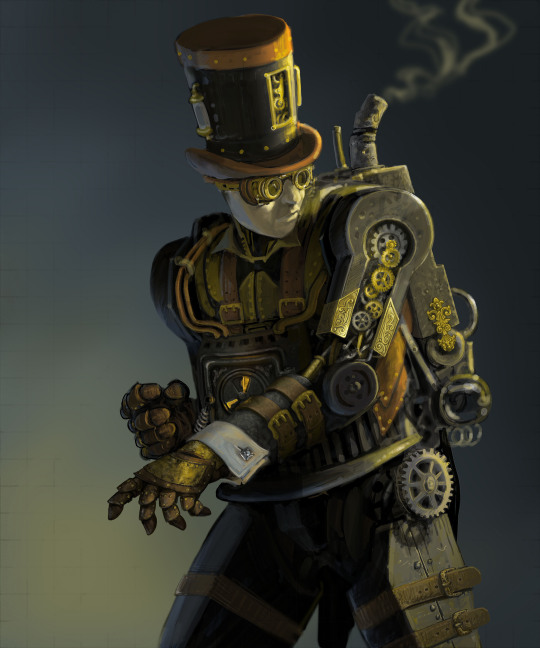
CLOCK/STEAMPUNK: This era is often Victorian in style for some reason and the steam powered robots often use lots of smoke stacks, gears, clockwork, belts and goggles.
TESLAPUNK: Unlike steampunk, this world functions as if Nikola Tesla had revolutionized the world with his electricity. Lots of lightning rods, Tesla rods and power cables. Often this is confused as steampunk because they often have the a similar look.
DIESELPUNK: This universe takes place in a world where diesel engines and machines using oil are everywhere. This is criminally underused. They usually use a more art deco and WW1/2 style.
ATOMIC/RAYPUNK: This one uses atomic technology. Lasers, blasters, radiation, green glows, aliens and giant robots. Also rarely used but I dare you to watch “The Iron Giant” and tell me you don’t love it.
CYBERPUNK: Possibly more well known than steampunk. A future, in which technology is so advanced people are more technologically advanced than some of the robots. Chainsaw arms, robotic eyes, hooking your brain up to the internet and evil corporations.
BIOPUNK: Imagine a future where technology has advanced so much that we construct living organisms as easily as building a robots. Living machines, weapons, organic clothing and new and improved limbs.
JUNKPUNK: Almost as unknown as candlepunk but still one to remember. This world all technology is composed of random parts you might find in a junkyard. Kind of like the ‘Coolest’ cooler.
SOLARPUNK: This one has been getting some recent attention. However in a world where technology is powered by the sun I have yet to find one robot picture so sorry about this one.
PUNKPUNK: You have gone off the far side of the spectrum. Turn back.
Hopefully now you can tell the different alternate futures apart and can better survive in the world with this Essential information.
(Note this is not my artwork just a quick google search, but I am working on a series that will clarify these examples better with my own work.)
Yo, just saying, but Cyberpunk ISN’T just an aesthetic.
Cyberpunk is a genre about contrast between high technologies and low life, and as such they focus on sadder/violent parts of people’s lives, like crime, law enforcement (treated realistically and not like in cop dramas), cybercrime, drug dealing, terrorism or warfare.
Common themes include any variation on a concept of identity (from identity theft, through search for identity, to identity politics), loneliness in digital age, anti-capitalism focusing on unchecked power of corporations, anti-fascism focusing on technological surveillance state, ethics of artificial intelligence and other technologies.
Best known examples are probably Robocop, Ghost in the Shell, Matrix (especially the first movie, sequels are more like post-apo war stories), Neuromancer, Snow Crash, Deus Ex, Shadowrun, System Shock.
Steampunk was an offshoot of cyberpunk, but since stopped being a genre and became only an aesthetic.
Biopunk is offshoot of cyberpunk, and usually contains similar themes (just with genetic engineering). Other offshoots include nanopunk (with nanotechnology) and, which has recently been getting more attention, nowpunk – stories that use concepts and themes of cyberpunk, but are set in contemporary times – we’re talking stuff like Mr Robot tv show, or Watch_Dogs video games.
Honestly, a lot of the punk settings and ideas are in some way political, or at least VERY good at exploring issues relevant to the time period they pull inspiration from.
Steampunk for imperialism, biopunk for ethical issues of biotechnology, atompunk for the red scare and cold war, etc. etc.
Not saying every story with these looks NEEDS to deal with those specific issues, but each punk type opens itself up to discussing those types of issues much more easily.
Also, each punk doesn’t need to exist separate from each other. I have a setting that is bio, solar, and junkpunk all at once.
These genres and aesthetics are tools, and the rules about ‘em aren’t hard and fast to say the least.
The “punk” part of all of these is a political analysis and a rebellion.
Steampunk without addressing the imperialism and class privilege of the Victorian era is “gaslamp fantasy” or “alternative history sci-fi”, depending on how sci-magical it goes.
Cyberpunk without the dystopia of a world ruled by megacorporations, and the small rebellions people engage in just to survive, is just gritty sci-fi.
Dieselpunk that doesn’t analyze how the imperialism of the late 19th century evolved into the rise of fascism in the early 20th is just more alternative history sci-fi.
Teslapunk have some similar imperialism themes to steampunk plus some of the anti-corporate vibe of cyberpunk. It’s an analysis of thing like “what would the world be like if an autistic dreamer like Tesla hadn’t been ground into the dirt by the corporate greed of Edison and others?” or “what if Edison and the other corporatists had stolen EVEN MORE of Tesla’s work?”
Solarpunk seeks to build clean energy, green spaces, and sustainable industries in response to the real threat of climate change.
The “punk” part is important. It gives us tools to dismantle injustice in the real world by analyzing or overcoming the injustice in a fictional one.
i don’t really think the relationship between generation z and millennials is comparable to the relationship between baby boomers and millennials
mostly because largely speaking. baby boomers are the parents of millennials but millennials aren’t the parents of generation z
your older sibling telling you you’re an idiot for eating laundry detergent just isn’t the same thing as your parents berating you for not having a job in a shitty economy
Birds do it and so do doughnut-shaped fusion facilities called “tokamaks.” But tokamak chirping – a rapidly changing frequency wave that can be far above what the human ear can detect – is hardly welcome to researchers who seek to bring the fusion that powers the sun and stars to Earth. Such chirping signals a loss of heat that can slow fusion reactions, a loss that has long puzzled scientists. Full article
there was a disastrous performance of Macbeth at the Old Vic by Peter O’Toole and apparently there was this one part in the play one night where a Servant comes in and should say “Your wife, my lord, is dead” but what ACTUALLY happened was
Minimum Wage should be indexed to 2% of a city’s median rent.
And here’s why:
Housing costs are the single biggest financial burden facing Americans today.
The Department of Housing and Urban Development define being cost-burdened as spending more than a third of your income on rent. By that definition, over half of the households in this country are cost-burdened. Source
If we want people to be able to afford to live in cities and not get priced out, we have to make a two pronged approach. One is to build houses towards all incomes and price ranges, not just luxury condos. And the other is a robust wage floor so people can actually afford to live.
Fight for 15 is doing an amazing job and I love them, but we have to realize that is quite a few places, $15/hr still isn’t enough to live on.
Which is where the 2% comes in. It allows a minimum wage that is flexible with regards to the costs of living.
And it wasn’t plucked out of thin air either:
Rent should be a third of a persons income, or to restate the equation: income should be three times a person’s rent.
And since a full time job is 8 hrs a day / 40 hrs a week / 160 hrs a month.
So when you do the math, the ideal hourly minimum wage as a percentage of rent works out to around 1.875%, which for ease of calculation is 2%.
Example minimum wages under a 2% rent rule:
San Francisco: $67.40/hr
New York City: $56/hr
Boston: $55.94/hr
Los Angeles: $27/hr
Houston: $21.38/hr
St. Louis: $18.22/hr
Billings, MT: $17.16/hr
I. That puts San Fran’s cost-of-living issue into perspective.



 rip tumblr